
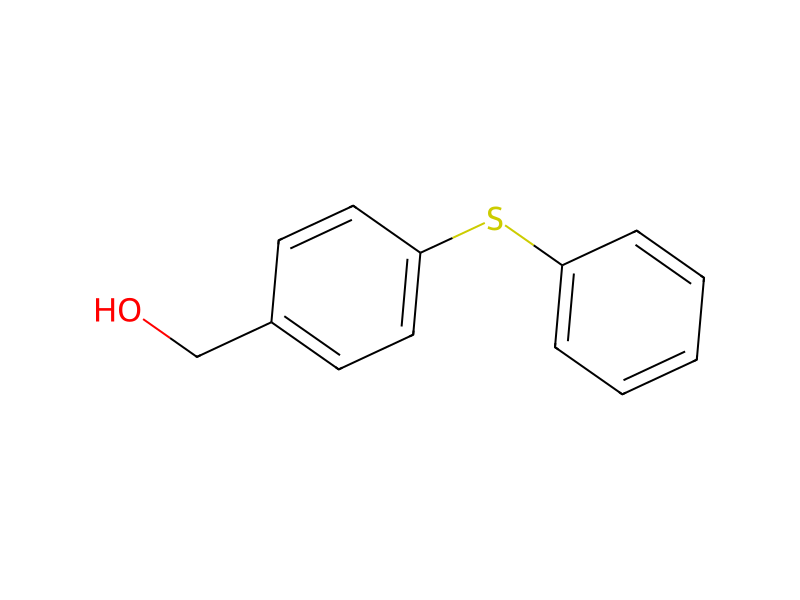
Basic information
- Standard SMILES
OCc1ccc(Sc2ccccc2)cc1- InChIKey
PGOAWMRWDZJQTB-UHFFFAOYSA-N- Molecular formula
- C13H12OS
- Average molar mass
- 216.3 g/mol
- Monoisotopic mass
- 216.06088618
Names & identifiers
- Preferred name
- p-(Phenylthio)benzyl alcohol
- IUPAC
- (4-phenylsulfanylphenyl)methanol
- English name
- p-(phenylthio)benzyl alcohol
- Molecular formula
- C13H12OS
- Molecular weight
- 216.3
Names & synonyms
6317-56-2p-(Phenylthio)benzyl alcohol4-(Phenylthio)benzyl Alcohol4-(Phenylthio)benzenemethanolbenzenemethanol, 4-(phenylthio)-[4-(phenylsulfanyl)phenyl]methanolNSC 43060TMD9BW7WU5EINECS 228-658-6NSC-43060DTXSID10212511(4-(PHENYLSULFANYL)PHENYL)METHANOL
Show more names
(4-(Phenylthio)4-(Phenylthio)Benzyl Chlorideparabenzenethioylbenzenemethylol(4-(chloromethyl)phenyl)(phenyl)sulfane
RefChem:169268DTXCID40135002228-658-6(4-(phenylthio)phenyl)methanol(4-phenylsulfanylphenyl)methanolMFCD04108413[4-(phenylthio)phenyl]methanolNSC43060
Database identifiers
- CAS
6317-56-2- PubChem CID
- 80593
- DTXSID
DTXSID10212511- UNII
- TMD9BW7WU5
- EC Number
- 228-658-6
- Nikkaji
- J206.909A
Properties
Computed structural properties
- XLogP
- 3.1
- Topological polar surface area
- 45.5 Ų
- Hydrogen bond donors
- 1
- Hydrogen bond acceptors
- 2
- Rotatable bonds
- 3
- Heavy atoms
- 15
- Formal charge
- 0
- Complexity
- 169
Physicochemical properties
- Melting point
- 46 · 46-48°C
- Boiling point
- 390.2 · 390.2±25.0 °C(Predicted)
- Density
- 1.21 · 1.21±0.1 g/cm3(Predicted)
- storage temp.
- -20 °C · Sealed in dry,Store in freezer, under -20°C
- solubility
- DMSO (Slightly), Methanol (Slightly)
- form
- Solid
- pka
- 14.26 · 14.26±0.10(Predicted)
- color
- Pale Beige to Light Beige
- InChI
- InChI=1S/C13H12OS/c14-10-11-6-8-13(9-7-11)15-12-4-2-1-3-5-12/h1-9,14H,10H2
- InChIKey
- PGOAWMRWDZJQTB-UHFFFAOYSA-N
- SMILES
- C1(CO)=CC=C(SC2=CC=CC=C2)C=C1
- FDA UNII
- 9 BW7WU5 · TMD9BW7WU5
- Symbol(GHS)
- 7 · GHS07
- Signal word
- Warning
- Hazard statements
- 302 · H302
- Precautionary statements
- 280 · P280-P305+P351+P338
Safety & regulation
GHS classification
GHS Classification
This chemical does not meet GHS hazard criteria for 66.7% (2 of 3) of all reports.
Warning
H302 (33.3%): Harmful if swallowed [Warning Acute toxicity, oral];H315 (33.3%): Causes skin irritation [Warning Skin corrosion/irritation];H319 (33.3%): Causes serious eye irritation [Warning Serious eye damage/eye irritation];H335 (33.3%): May cause respiratory irritation [Warning Specific target organ toxicity, single exposure; Respiratory tract irritation]
P261, P264, P264+P265, P270, P271, P280, P301+P317, P302+P352, P304+P340, P305+P351+P338, P319, P321, P330, P332+P317, P337+P317, P362+P364, P403+P233, P405, and P501 (click each P-code to see the statement)
Aggregated GHS information provided per 3 reports by companies from 3 notifications to the ECHA C&L Inventory. Each notification may be associated with multiple companies.;Reported as not meeting GHS hazard criteria per 2 of 3 reports by companies.;There is 1 notification provided by 1 of 3 reports by companies with hazard statement code(s).;Information may vary between notifications depending on impurities, additives, and other factors. The percentage value in parenthesis indicates the notified classification ratio from companies that provide hazard codes. Only hazard codes with percentage values above 10% are shown. For more detailed information, please visit ECHA C&L website.
Hazard information
Hazard Classes and CategoriesAcute Tox. 4 (33.3%);Skin Irrit. 2 (33.3%);Eye Irrit. 2A (33.3%);STOT SE 3 (33.3%)
Safety data
- Signal word
- Warning
- Symbol(GHS)
- GHS07
- Hazard statements
- H302
- Precautionary statements
- P280-P305+P351+P338
Chemistry & industry
Applications
UsesAn impurity of Fenticonazole nitrate (F279250), a new potent antimycotic compound.
Upstream & downstream products
Upstream raw materials
Suppliers50 total
Shandong chuangyingchemical Co., Ltd.18853181302 · [email protected]
武汉英诺医药科技有限公司+86-027-59232304 15387063101 · [email protected]
合肥翰刚医药科技有限公司+8618062405514 · [email protected]
上海毕得医药科技股份有限公司400-1647117 13681763483 · [email protected]
湖北科乐精细化工有限公司027-59101668 19945030958 · [email protected]
Dayang Chem (Hangzhou) Co.,Ltd.+86-0571-88938639 17705817739 · [email protected]
淄博丽硕化工贸易有限公司13853320569
北京安司莫森技术有限公司010-82954736 13391601435 · [email protected]
毕佳索(上海毕得医药科技股份有限公司)400-6005915 · [email protected]
Syntechem Co.,Ltd[email protected]
北京华威锐科化工有限公司0757-86329057 18934348241 · [email protected]
安耐吉化学&3A(安徽泽升科技股份有限公司)400-0056266 · [email protected]
常州科化生物科技有限公司0519-68985668 13685222090 · [email protected]
欧利希(湖北)医药科技有限公司17316404525 17316404525 · [email protected]
上海瀚鸿科技股份有限公司021-54306202 13764082696 · [email protected]
常州市淇奥化工有限公司0519-85607258
广东方信生物科技有限公司0751-2838688 13376594225 · [email protected]
嘉兴市艾森化工有限公司0573-85285100 18627885956 · [email protected]
上海隆盛化工有限公司58099637 13585536065 · [email protected]
武汉丰泰威远科技有限公司+86-27-8746-5837 +86-18627785180 · [email protected]
武汉丰泰威远科技有限公司027-87465837 19945049750 · [email protected]
孝感深远化工有限公司15527621225; 15527621225 · [email protected]
云南西力生物技术股份有限公司0871-65217109 · [email protected]
Xiamen AmoyChem Co., Ltd+86-86-5926051114 · [email protected]
卡迪亚医药科技有限公司0371-86615086 18203638366 0371-86159066 13526786601
成都麦卡希化工有限公司028-85632863 18108198598 · [email protected]
济南铭雅医药科技有限公司0531-85828981 · [email protected]
湖北鑫源顺医药化工有限公司13971561712, 13995564702, 027-50664929 · [email protected]
上海毕得医药科技股份有限公司400-164-7117 18317119277 · [email protected]
北京福源坊科技有限公司010-57903446 15869909019 · [email protected]
上海御略医药科技有限公司021-60345187 13671753212 · [email protected]
上海寰川实业有限公司021-61478794 · [email protected]
陕西缔都医药化工有限公司029-81024372 17792795018 · [email protected]
凯试(上海)科技有限公司021-50135380 · [email protected]
济南凯化化工有限公司0531-86986780 13153183025 · [email protected]
AN PharmaTech Co Ltd86(21)68097365 · [email protected]
南京伶亚生物医药科技有限公司18068075658 · [email protected]
Alfa Chemistry1-516-6625404 · [email protected]
厦门志信化学有限公司+86-5922680277 +86-13806087780 · [email protected]
山东轩鸿生物医药有限公司+86-0531-88801869 15090917080
嘉兴市德亿化工有限公司0573-85866609 13325730825 · [email protected]
Alfa Chemistry+1-5166625404 · [email protected]
湖北源梦生物科技有限公司027-68897569 18120462897 · [email protected]
上海润栖医药科技有限公司021-38751876 15000076078 · [email protected]
上海前衍生物科技有限公司02781293128 · [email protected]
上海源叶生物科技有限公司13636370518 · [email protected]
湖北阡陌生物科技有限公司0711-3812399 18062309155 · [email protected]
武汉市承天精细化工有限公司18164098996 · [email protected]
武汉沃格达生物科技有限公司15071299552 · [email protected]
武汉克米克生物医药技术有限公司027-13163388153 13163388153 · [email protected]
Related reactions
2 records

Linked notes
Loading…