HomeMCPWorkbenchSkills
HomeWorkbenchNotificationsMe
llms.txt · MCP GuidePrivacy Policy · Terms of Service · Supportv1.8.0
  1. Home
  2. /Compound

Valeronitrile

HCID 8061
New noteNew reactionRequest quotes
Print preview

Completing data — refresh the page later to see the latest
Basic informationOverviewNames & identifiersPropertiesSafety & regulationChemistry & industryRelated reactionsCompound notes
Substructure searchFind similar structures

Basic information

CAS
110-59-8
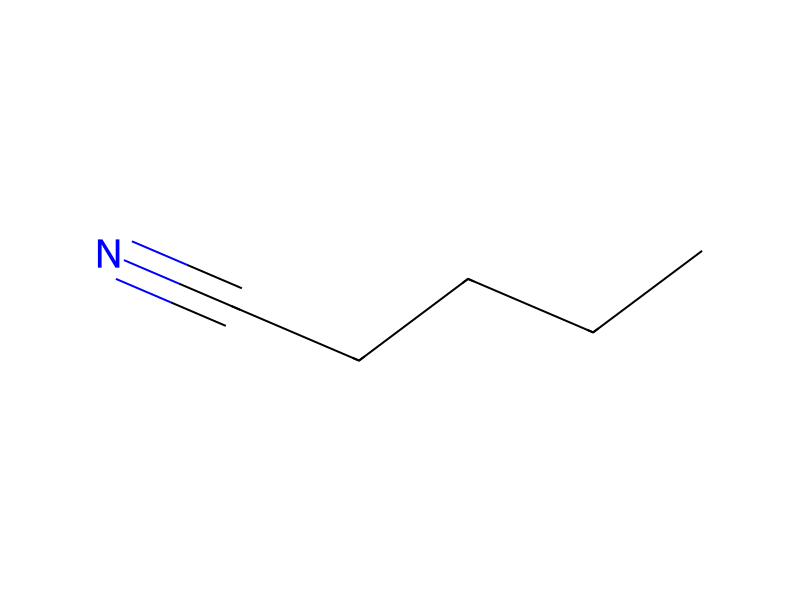
Standard SMILES
CCCCC#N
InChIKey
RFFFKMOABOFIDF-UHFFFAOYSA-N
Molecular formula
C5H9N
Average molar mass
83.13 g/mol
Monoisotopic mass
83.07349929

Overview

Valeronitrile is a clear colorless to yellow liquid. (NTP, 1992)

Names & identifiers

Preferred name
Valeronitrile
IUPAC
pentanenitrile
English name
Valeronitrile
Molecular formula
C5H9N
Molecular weight
83.13

Names & synonyms

VALERONITRILEPentanenitrile110-59-8Butyl cyanide1-Cyanobutane1-Butyl cyaniden-BUTYL CYANIDEPentanonitrilen-PentanenitrileButane, 1-cyano-EINECS 203-781-8CCRIS 6114
Show more names
PENTANITRILEValeronitrilN-VALERONITRILEPENTANE NITRILENITRILE C5zhnegwujinButylcyanid1-Cyanbutan
DTXSID3026275BRN 1736706AI3-30052X44H3R47D4VALERONITRILE [MI]4-02-00-00875 (Beilstein Handbook Reference)DTXCID106275EC 203-781-8

Database identifiers

CAS
110-59-8
PubChem CID
8061
DTXSID
DTXSID3026275
ChEMBL
CHEMBL1503158
ChEBI
CHEBI:192304
UNII
X44H3R47D4
EC Number
203-781-8
Nikkaji
J5.095D

Properties

Computed structural propertiesFilling in

XLogP
1.1
Topological polar surface area
23.8 Ų
Hydrogen bond donors
0
Hydrogen bond acceptors
1
Rotatable bonds
2
Heavy atoms
6
Formal charge
0
Complexity
57.6

Experimental & physicochemical properties

Chemical ClassesNitrogen Compounds -> Nitriles
SpringerMaterials PropertiesSchoenflies notation
LogP · 2 items

1.12

1.12

Density · 2 items

0.8008 at 68 °F (NTP, 1992) - Less dense than water; will float

0.8008 @ 20°C

Solubility1 to 5 mg/mL at 72.5 °F (NTP, 1992)
Flash Point105 °F (NTP, 1992)
Boiling Point · 3 items

282 to 286 °F at 760 mmHg (NTP, 1992)

141.00 to 142.00 °C. @ 760.00 mm Hg

141.3 °C @760 [mm Hg]

Melting Point · 3 items

-141 °F (NTP, 1992)

-96.2 °C

-96.2 °C

Vapor Pressure · 2 items

5 mmHg at 64.6 °F ; 10 mmHg at 86 °F; 20 mmHg at 109.9 °F (NTP, 1992)

Safety & regulation

Safety information is for reference only and does not replace the supplier’s Safety Data Sheet (SDS), applicable regulations, or professional assessment.

GHS classification

GHS Classification · 4 items

Danger

H226 (98.4%): Flammable liquid and vapor [Warning Flammable liquids]

P210, P233, P240, P241, P242, P243, P264, P270, P280, P301+P316, P301+P317, P303+P361+P353, P321, P330, P370+P378, P403+P235, P405, and P501 (click each P-code to see the statement)

Aggregated GHS information provided per 64 reports by companies from 5 notifications to the ECHA C&L Inventory. Each notification may be associated with multiple companies.

Hazard information

Regulatory Information · 3 items

Chemical: Pentanenitrile

REACH registered substance: Valeronitrile (EC: 203-781-8)

Pentanonitrile: Does not have an individual approval but may be used under an appropriate group standard

DOT LabelFlammable Liquid Poison
Fire HazardsThis chemical is combustible. (NTP, 1992)
Health HazardsSYMPTOMS: Exposure to this compound may cause irritation.
Hazards SummaryAn irritant; [MSDSonline] May be harmful after ingestion, inhalation, or skin absorption; [CAMEO] See NITRILES.
Reactive GroupNitriles
Reactivity AlertsHighly Flammable
Reactivity Profile · 1 item

Nitriles, such as VALERONITRILE, may polymerize in the presence of metals and some metal compounds. They are incompatible with acids; mixing nitriles with strong oxidizing acids can lead to extremely violent reactions. Nitriles are generally incompatible with other oxidizing agents such as peroxides and epoxides. The combination of bases and nitriles can produce hydrogen cyanide. Nitriles are hydrolyzed in both aqueous acid and base to give carboxylic acids (or salts of carboxylic acids). These reactions generate heat. Peroxides convert nitriles to amides. Nitriles can react vigorously with reducing agents. Acetonitrile and propionitrile are soluble in water, but nitriles higher than propionitrile have low aqueous solubility. They are also insoluble in aqueous acids. This compound is incompatible with strong acids, strong bases, strong oxidizing agents and strong reducing agents. (NTP, 1992).

Chemistry & industry

Pharmacology

Cellular LocationsCytoplasm

Uses & manufacturing

UsesUsed as a solvent; [Merck Index]
General Manufacturing InformationPentanenitrile: ACTIVE
Applications · 4 items

UsesValeronitrile is used as building block in organic synthesis. Product Data Sheet

UsesValeronitrile is used in the preparation of valeric acid. It is also used to enhance the nitrilase activity in many strains.

UsesSolvent.

General DescriptionClear colorless to yellow liquid.

Upstream & downstream products

Upstream raw materials

Valeric acid1-BromobutaneVALERENIC ACIDIndustrial ethanol

Downstream products

DibutylamineAMINOPENTAMIDE SULFATE (200 MG)1,1,1-Trimethoxypentane2-PENTENENITRILE

Related reactions

22 records
New reaction record
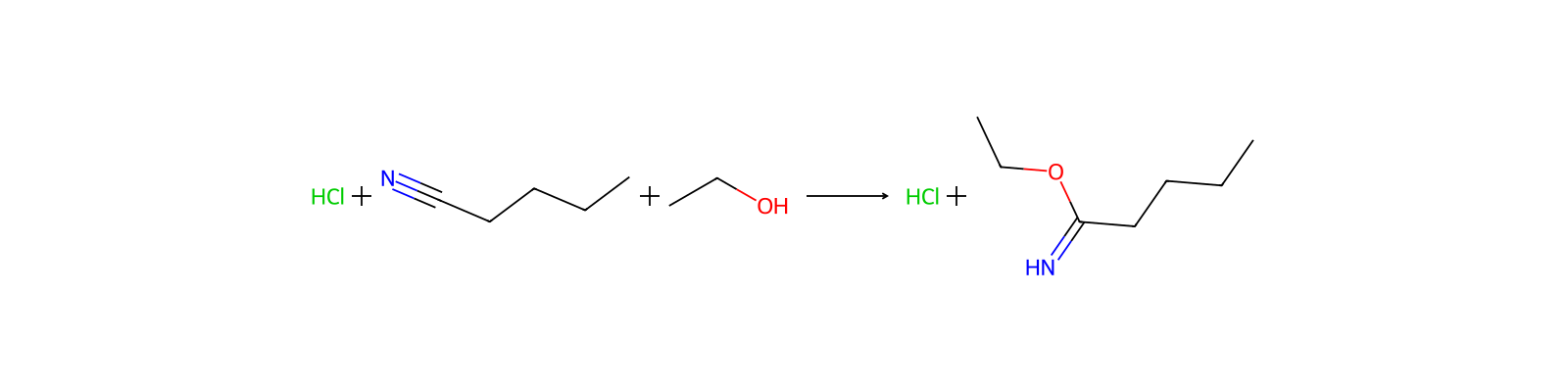
HRID 36173 reaction equation
HRID 36173As reactantuspto-grants-1995_05
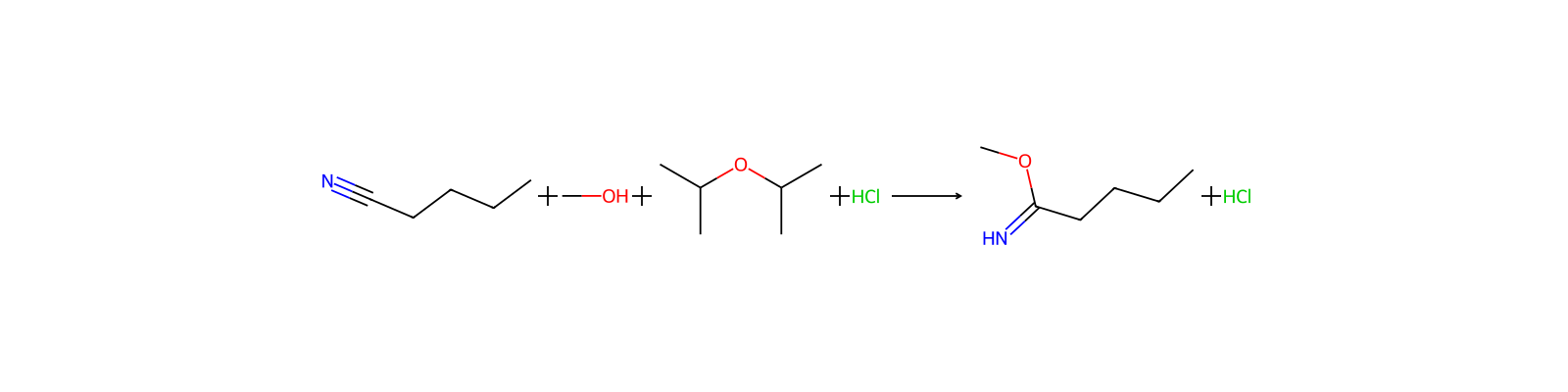
HRID 128991 reaction equation
HRID 128991As reactantuspto-grants-1995_11
HRID 156709 reaction equation
HRID 156709As reactantTraining data from https://doi.org/10.1039/C8SC04228D (9/10)
HRID 257838 reaction equation
HRID 257838As reactantuspto-grants-1993_11
HRID 373120 reaction equation
HRID 373120As reactantuspto-grants-1992_11
HRID 664009 reaction equation
HRID 664009As reactantTraining data from https://doi.org/10.1039/C8SC04228D (3/10)
HRID 831189 reaction equation
HRID 831189As reactantTest data from https://doi.org/10.1039/C8SC04228D
HRID 865381 reaction equation
HRID 865381As reactantuspto-grants-1996_10
Page 1 of 3

Compound notes

Loading…

On this pageBasic informationOverviewNames & identifiersPropertiesSafety & regulationChemistry & industryRelated reactionsCompound notes
More actions
New noteNew reactionRequest quotes

7.3 [mmHg]

Physical Description · 3 items

Valeronitrile is a clear colorless to yellow liquid. (NTP, 1992)

Clear colorless to yellow liquid; Slightly soluble in water; [CAMEO]

Liquid

Physicochemical properties

Melting point
96 °C · −96 °C(lit.)
Boiling point
139 · 139-141 °C(lit.)
Density
0.795 g/mL · 0.795 g/mL at 25 °C(lit.)
vapor pressure
7 hPa · 7.0 hPa (20 °C)
refractive index
20 · n20/D 1.397(lit.)
Flash point
105 °F · 105 °F
storage temp.
30 °C · Store below +30°C.
solubility
10 g/l · 10.0g/l
form
Liquid
color
Clear colorless
Water Solubility
0.1 · 0.1-0.5 g/100 mL at 22.5 ºC
Merck
14 · 14,9905
BRN
1736706 · 1736706
Henry's Law Constant
1.6 · 1.6×10-1 mol/(m3Pa) at 25℃, Brockbank (2013)
Dielectric constant
17.4 · 17.4(21℃)
Exposure limits
25 mg/m3 · NIOSH: IDLH 25 mg/m3
Stability
Stable. Incompatible with strong acids, strong bases, strong oxidizing agents, strong reducing agents. Flammable.
InChI
1S/C5H9N/c1-2-3-4-5-6/h2-4H2,1H3
InChIKey
RFFFKMOABOFIDF-UHFFFAOYSA-N
SMILES
CCCCC#N
LogP
1.12 · 1.120
CAS DataBase Reference
110 · 110-59-8(CAS DataBase Reference)
EWG's Food Scores
1 · 1
FDA UNII
44 H3R47D4 · X44H3R47D4
NIST Chemistry Reference
Pentanenitrile(110-59-8)
EPA Substance Registry System
Valeronitrile (110-59-8)
UNSPSC Code
41116107 · 41116107
NACRES
24 · NA.24
Symbol(GHS)
2 · GHS02,GHS06
Signal word
Danger
Hazard statements
301 · H301-H315-H319-H226
Precautionary statements
501 · P501-P270-P240-P210-P233-P243-P241-P242-P264-P280-P370+P378-P337+P313-P305+P351+P338-P362+P364-P303+P361+P353-P332+P313-P301+P310+P330-P403+P235-P405
PPE
Eyeshields, Faceshields, Gloves, type ABEK (EN14387) respirator filter
Hazard Codes
T
Risk Statements
10 · 10-25-2017/10/25
Safety Statements
36 · 36/37/39-45-16
RIDADR
1992 · UN 1992 3/PG 3
WGK Germany
3 · 3
RTECS
8195000 · YV8195000
Autoignition Temperature
520 °C · 520 °C
TSCA
TSCA listed
HazardClass
3 · 3
PackingGroup
III
HS Code
29269095 · 29269095
Storage Class
3 · 3 - Flammable liquids
Hazard Classifications
4 OralFlam · Acute Tox. 4 OralFlam. Liq. 3
Toxicity
50 orally · LD50 orally in male mice: 2.297 mmol/kg (Tanii)
REACH Registrations
Active
Limited Quantities
5 L · 5.0 L (1.3 gallons) (liquid)
Excepted Quantities
Max Inner Pack (30g or 30ml) and Max Outer Pack (1Kg or 1L)
Air and Water ReactionsSlightly soluble in water.
Hazard Classes and CategoriesFlam. Liq. 3 (98.4%)

Safety & protection

Fire FightingFires involving this material can be controlled with a dry chemi cal, carbon dioxide or Halon extinguisher. (NTP, 1992)
First Aid · 1 item

EYES: First check the victim for contact lenses and remove if present. Flush victim's eyes with water or normal saline solution for 20 to 30 minutes while simultaneously calling a hospital or poison control center. Do not put any ointments, oils, or medication in the victim's eyes without specific instructions from a physician. IMMEDIATELY transport the victim after flushing eyes to a hospital even if no symptoms (such as redness or irritation) develop.

Nonfire Spill Response · 1 item

SMALL SPILLS AND LEAKAGE: If you spill this chemical, FIRST REMOVE ALL SOURCES OF IGNITION. Then, use absorbent paper to pick up all liquid spill material. Your contaminated clothing and absorbent paper should be sealed in a vapor-tight plastic bag for eventual disposal. Solvent wash all contaminated surfaces with 60-70% ethanol followed by washing with a soap and water solution. Do not reenter the contaminated area until the Safety Officer (or other responsible person) has verified that the area has been properly cleaned.

Isolation and EvacuationExcerpt from ERG Guide 131 [Flammable Liquids - Toxic]:
Protective Action Criteria (PAC) · 3 items

1.0 [mg/m3]

11 [mg/m3]

66 [mg/m3]

Personal Protective Equipment (PPE) · 1 item

RECOMMENDED RESPIRATOR: Where the neat test chemical is weighed and diluted, wear a NIOSH-approved half face respirator equipped with an organic vapor/acid gas cartridge (specific for organic vapors, HCl, acid gas and SO2) with a dust/mist filter. (NTP, 1992)

Toxicology

Adverse EffectsOther Poison - Chemical Asphyxiant

Safety data

PPE
Eyeshields, Faceshields, Gloves, type ABEK (EN14387) respirator filter
wgk
3
tsca
TSCA listed
rtecs
YV8195000
ridadr
UN 1992 3/PG 3
hs_code
29332100
Toxicity
LD50 orally in male mice: 2.297 mmol/kg (Tanii)
risk_code
10-25-2017/10/25
Signal word
Danger
Symbol(GHS)
GHS02,GHS06
hazard_code
T
safety_code
36/37/39-45-16
hazard_class
3
Storage Class
3 - Flammable liquids
packing_group
III
Hazard statements
H301-H315-H319-H226
Limited Quantities
5.0 L (1.3 gallons) (liquid)
Excepted Quantities
Max Inner Pack (30g or 30ml) and Max Outer Pack (1Kg or 1L)
REACH Registrations
Active
Hazard Classifications
Acute Tox. 4 OralFlam. Liq. 3
Autoignition Temperature
520 °C
Precautionary statements
P501-P270-P240-P210-P233-P243-P241-P242-P264-P280-P370+P378-P337+P313-P305+P351+P338-P362+P364-P303+P361+P353-P332+P313-P301+P310+P330-P403+P235-P405
4’-[(2-butyl-4-chloro-5-hydroxymethyl)-1H-imidazol-1-yl)methyl]-[1,1’-Biphenyl]-2-carbonitrile

Additional notes

DefinitionChEBI: Pentanenitrile is a nitrile.