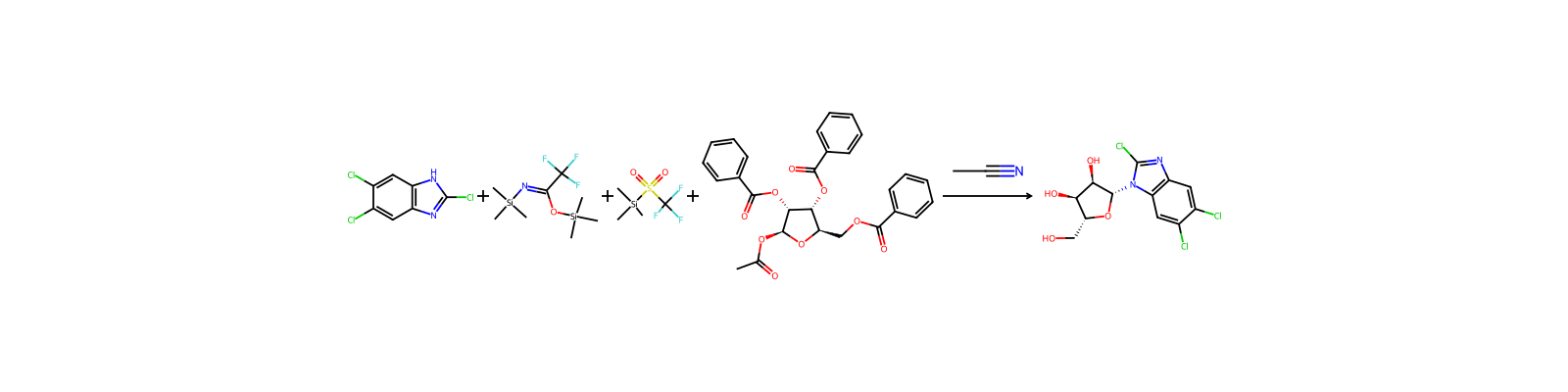

Basic information
- CAS
6974-32-9- Standard SMILES
CC(=O)O[C@@H]1O[C@H](COC(=O)c2ccccc2)[C@@H](OC(=O)c2ccccc2)[C@H]1OC(=O)c1ccccc1- InChIKey
GCZABPLTDYVJMP-CBUXHAPBSA-N- Molecular formula
- C28H24O9
- Average molar mass
- 504.5 g/mol
- Monoisotopic mass
- 504.14203235
Names & identifiers
- Preferred name
- beta-D-Ribofuranose, 1-acetate 2,3,5-tribenzoate
- IUPAC
- [(2R,3R,4R,5S)-5-acetyloxy-3,4-dibenzoyloxyoxolan-2-yl]methyl benzoate
- English name
- beta-D-Ribofuranose 1-acetate 2,3,5-tribenzoate
- Molecular formula
- C28H24O9
- Molecular weight
- 504.48
Names & synonyms
6974-32-91-O-Acetyl-2,3,5-tri-O-benzoyl-beta-D-ribofuranose.beta.-D-Ribofuranose, 1-acetate 2,3,5-tribenzoateEINECS 230-220-4NSC 23349beta-D-Ribofuranose, 1-acetate 2,3,5-tribenzoateDTXSID408843461-Acetyl-2,3,5-tribenzoyl-beta-D-ribofuranoseAcetyl-tribenzoyl-.beta.-d-ribofuranose1-Acetyl-2,3,5-tribenzoyl-.beta.-D-ribofuranose1-O-Acetyl-2,3,5-O-benzoyl-.beta.-d-ribofuranose1-O-Acetyl-2,3,5-tri-O-benzoyl-.beta.-D-ribofuranose
Show more names
1-O-Acetyl-2,3,5-tri-O-benzoyl-β-D-ribofuranoseABR1-O-Acetyl-2,3,5-tri-O-benzoyl-β-D-ribose1-O-acetyl 2,3,5-tri-O-benzoyl-β-d-[UL-13C5]ribofuranoside1-Acetyl-21-O-AcetyLB-D-RIBOFURANOSE-β-D-ribofuranose
1-O-Acetyl-2,3,5-tri-O-benzyl-.beta.-D-ribofuranoseRefChem:119334DTXCID901023793Acetyl-tribenzoyl-beta-d-ribofuranose1-O-Acetyl-2,3,5-O-benzoyl-beta-d-ribofuranose1-O-Acetyl-2,3,5-tri-O-benzyl-beta-D-ribofuranose230-220-4GCZABPLTDYVJMP-CBUXHAPBSA-N
Properties
Computed structural properties
- XLogP
- 5.6
- Topological polar surface area
- 114 Ų
- Hydrogen bond donors
- 0
- Hydrogen bond acceptors
- 9
- Rotatable bonds
- 12
- Heavy atoms
- 37
- Formal charge
- 0
- Complexity
- 793
Physicochemical properties
- Melting point
- 128 · 128-130 °C
- alpha
- 24.4 · 24.4 º (c=1, pyridine)
- Boiling point
- 621 · 621.0±55.0 °C(Predicted)
- Density
- 1.35 · 1.35±0.1 g/cm3(Predicted)
- refractive index
- 24 ° · 24 ° (C=1, Pyridine)
- storage temp.
- Sealed in dry,Room Temperature
- solubility
- Chloroform (Slightly), Ethyl Acetate (Slightly), Methanol (Slightly, Sonicated),
- form
- Liquid
- color
- Clear slightly yellow or greenish to brown
- optical activity
- 20 · [α]20/D +24.3°, c = 1 in pyridine
- BRN
- 100243 · 100243
- InChIKey
- GCZABPLTDYVJMP-CBUXHAPBSA-N
- SMILES
- C(OC)(=O)C1=CC=CC=C1[C@@H]1[C@@H](OC(=O)C2=CC=CC=C2)[C@@H](OC(=O)C2=CC=CC=C2)[C@H](OC(C)=O)O1 |&1:10,11,21,31,r|
- CAS DataBase Reference
- 6974 · 6974-32-9(CAS DataBase Reference)
Safety & regulation
GHS classification
GHS Classification
This chemical does not meet GHS hazard criteria for 100% (4 of 4) of all reports.
Not Classified
Aggregated GHS information provided per 4 reports by companies from 1 notifications to the ECHA C&L Inventory.
Hazard information
Regulatory Information.beta.-D-Ribofuranose, 1-acetate 2,3,5-tribenzoate: Does not have an individual approval but may be used under an appropriate group standard
Hazard Classes and CategoriesNot Classified
Safety data
- PPE
- Eyeshields, Gloves, type N95 (US)
- wgk
- 3
- tsca
- TSCA listed
- hs_code
- 29400090
- risk_code
- 36/38
- Signal word
- Warning
- Symbol(GHS)
- GHS07
- hazard_code
- Xi
- safety_code
- 22-24/25-37/39-26
- Storage Class
- 11 - Combustible Solids
- Hazard statements
- H315-H319-H335
- Precautionary statements
- P261-P305+P351+P338
Chemistry & industry
Uses & manufacturing
General Manufacturing Information.beta.-D-Ribofuranose, 1-acetate 2,3,5-tribenzoate: ACTIVE
Applications
Descriptionβ-D-Ribofuranose 1-Acetate 2,3,5-Tribenzoate is an optically active ribose derivative. It is white to orange to green powder to crystals, slightly soluble in methanol, and can be used as a starting material for nucleoside synthesis. The substance is also used as an intermediate for Clofarabine, which belongs to a class of drugs called purine nucleoside antimetabolites and is used to treat acute lymphoblastic leukemia (ALL) in children and young adults aged 1 to 21 years.
UsesAn inhibitor of neutrophil-keyhole limpet hemocyanin adhesion
Upstream & downstream products
Downstream products
Suppliers101 total
国药集团化学试剂有限公司86-21-63210123 · [email protected]
北京华美互利生物化工010-56205725 · [email protected]
Related reactions
638 records


Compound notes
Loading…