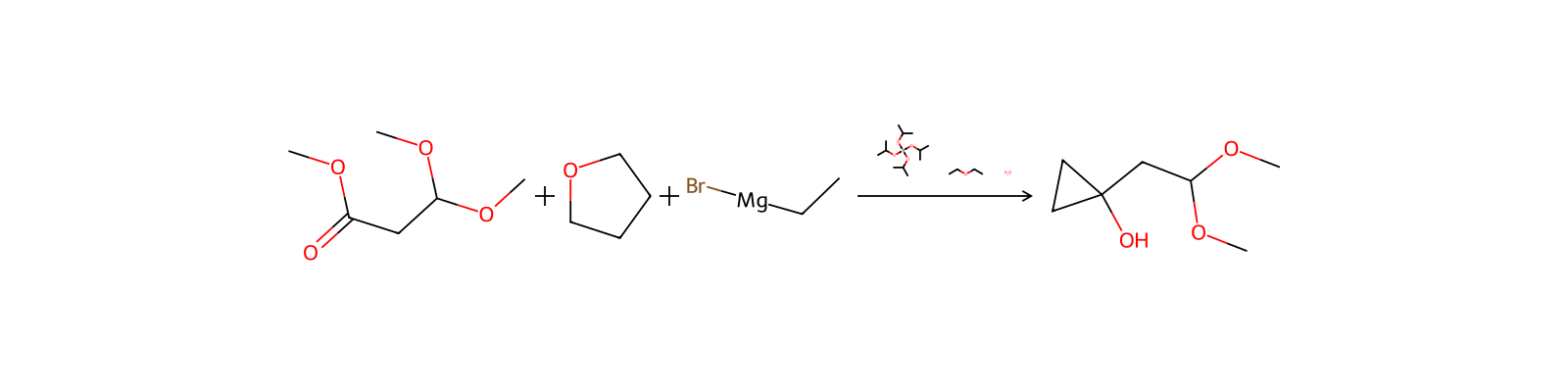
HRID 10110As reactant

7424-91-1COC(=O)CC(OC)OCSMCVPMKCDDNUCQ-UHFFFAOYSA-N7424-91-1DTXSID40225230Safety information is for reference only and does not replace the supplier’s Safety Data Sheet (SDS), applicable regulations, or professional assessment.
This chemical does not meet GHS hazard criteria for 14.3% (1 of 7) of reports.
Warning
H227 (28.6%): Combustible liquid [Warning Flammable liquids]
P210, P261, P264, P264+P265, P271, P280, P302+P352, P304+P340, P305+P351+P338, P319, P321, P332+P317, P337+P317, P362+P364, P370+P378, P403, P403+P233, P405, and P501 (click each P-code to see the statement)
Aggregated GHS information provided per 7 reports by companies from 6 notifications to the ECHA C&L Inventory. Each notification may be associated with multiple companies.
UsesMethyl β,β-Dimethoxypropionate is used as a reactant in the preparation of tetrahydro-β-carboline derivatives as antitumor growth and metastasis agents.
General DescriptionMethyl 3,3-dimethoxypropionate was used in the synthesis of 3-indolyl α,β-unsaturated carbonyl compounds.
Preparation300.0 g of methyl acetate and 16.5 g of sodium methoxide were added to a high-pressure reactor. CO gas was then introduced to a pressure of 3.0 MPa. The reaction temperature was maintained at 60 °C, and the CO pressure was controlled at 3.0 MPa. After the reaction was complete, the solution was transferred to a distillation vessel to remove excess methyl acetate. 131.4 g of a 10% hydrogen chloride methanol solution was slowly added dropwise at a reaction temperature of 65 °C. After post-treatment, concentration, and distillation, 30.6 g of methyl 3,3-dimethoxypropionate was obtained, with a purity of 95.7% and a yield of 66.2%.