
HRID 6625As reactant
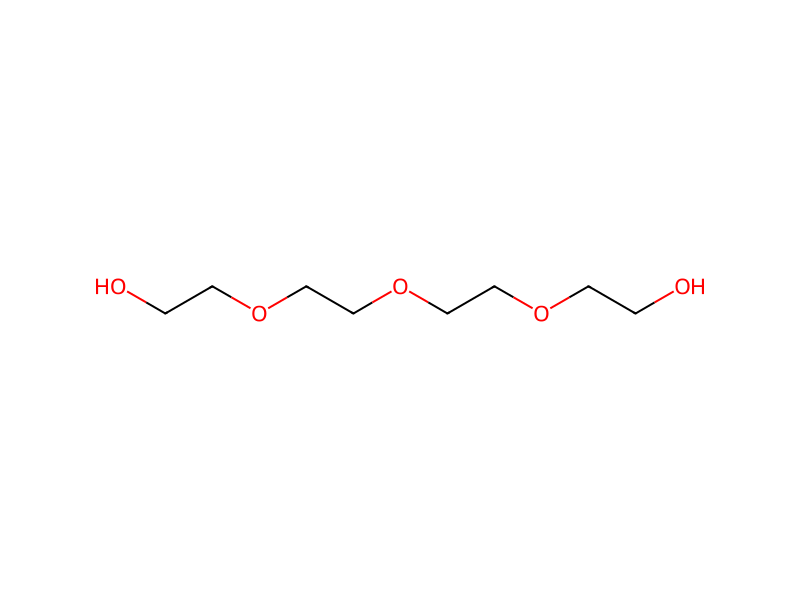
112-60-7OCCOCCOCCOCCOUWHCKJMYHZGTIT-UHFFFAOYSA-NTetraethylene glycol is a colorless to straw-colored liquid with a mild odor. Sinks and mixes with water. (USCG, 1999)
112-60-7、157299-02-0DTXSID9026922CHEMBL1235254CHEBI:44920Cosmetic ingredients (PEG-4) -> CIR (Cosmetic Ingredient Review)
Solvent; Humectant
1.12 at 68 °F (USCG, 1999) - Denser than water; will sink
1.1285 g/cu cm at 15 °C
Hygroscopic. Bulk density: 9.4 lb/gal at 20 °C
1.1248 @ 20°C
Liquid
Colorless liquid
Colorless to straw-colored liquid
Miscible with water /1.0X10+6 mg/L/ at 20 °C
Insoluble in benzene, toluene, or gasoline
Soluble in ethanol, ethyl ether, carbon tetrachloride, dioxane
Miscible with methanol
360 °F (USCG, 1999)
360 °F (182 °C) (Open cup)
621 °F at 760 mmHg (USCG, 1999)
327.3 °C
327.3 °C @760 [mm Hg]
Safety information is for reference only and does not replace the supplier’s Safety Data Sheet (SDS), applicable regulations, or professional assessment.
This chemical does not meet GHS hazard criteria for 83% (293 of 353) of all reports.
Warning
H319 (17%): Causes serious eye irritation [Warning Serious eye damage/eye irritation]
P264+P265, P280, P305+P351+P338, and P337+P317 (click each P-code to see the statement)
Aggregated GHS information provided per 353 reports by companies from 6 notifications to the ECHA C&L Inventory.
Chemical: Benzene, 1,3-bis(1-isocyanato-1-methylethyl)-, homopolymer
Chemical: Ethanol, 2,2'-[oxybis(2,1-ethanediyloxy)]bis-
Ethanol, 2,2'-[oxybis(2,1-ethanediyloxy)]bis- is listed on the EPA's Chemical Data Reporting (CDR) system. Manufacturers and importers of Ethanol, 2,2'-[oxybis(2,1-ethanediyloxy)]bis- are required to report information about their production and use of this chemical to the EPA under the Toxic Substances Control Act (TSCA). (40 eCFR Part 711)
REACH registered substance: 3,6,9-trioxaundecane-1,11-diol (EC: 203-989-9)
Ethanol, 2,2'-[oxybis(2,1-ethanediyloxy)]bis-: Does not have an individual approval but may be used under an appropriate group standard
In rat studies, testicular abnormalities and congenital anomalies have been reported. [REPROTOX] In oral lethal dose studies, rats exhibited heavy breathing, tremors, and sluggishness; [Reference #1] An irritant; [MSDSonline] See Ethylene glycol.
TETRAETHYLENE GLYCOL is a ether-alcohol derivative. The ether being relatively unreactive. Flammable and/or toxic gases are generated by the combination of alcohols with alkali metals, nitrides, and strong reducing agents. They react with oxoacids and carboxylic acids to form esters plus water. Oxidizing agents convert alcohols to aldehydes or ketones. Alcohols exhibit both weak acid and weak base behavior. They may initiate the polymerization of isocyanates and epoxides. May attack some forms of plastics (USCG, 1999).
1 - Materials that, under emergency conditions, can cause significant irritation.
1 - Materials that must be preheated before ignition can occur. Materials require considerable preheating, under all ambient temperature conditions, before ignition and combustion can occur.
0 - Materials that in themselves are normally stable, even under fire conditions.
Wear self-contained breathing apparatus for firefighting if necessary.
Alcohol foam, dry chemical or carbon dioxide.
Stable under recommended storage conditions.
Keep container tightly closed in a dry and well-ventilated place. Store under inert gas. Storage class (TRGS 510): Combustible liquids.
Avoid breathing vapors, mist or gas.
Keep in suitable, closed containers for disposal.
SRP: Recycle any unused portion of the material for its approved use or return it to the manufacturer or supplier. Ultimate disposal of the chemical must consider: the material's impact on air quality; potential migration in air, soil or water; effects on animal, aquatic and plant life; and conformance with environmental and public health regulations. If it is possible or reasonable use an alternative chemical product with less inherent propensity for occupational harm/injury/toxicity or environmental contamination.
Product: Offer surplus and non-recyclable solutions to a licensed disposal company. Contaminated Packaging: Dispose of as unused product.
Gloves must be inspected prior to use. Use proper glove removal technique (without touching glove's outer surface) to avoid skin contact with this product. Dispose of contaminated gloves after use in accordance with applicable laws and good laboratory practices. Wash and dry hands.
90 [mg/m3]
990 [mg/m3]
5900 [mg/m3]
Goggles or face shield and rubber gloves. (USCG, 1999)
Use equipment for eye protection tested and approved under appropriate government standards such as NIOSH (US) or EN 166(EU).
Handle with gloves.
Impervious clothing, The type of protective equipment must be selected according to the concentration and amount of the dangerous substance at the specific workplace.
Respiratory protection not required. For nuisance exposures use type OV/AG (US) or type ABEK (EU EN 14387) respirator cartridges. Use respirators and components tested and approved under appropriate government standards such as NIOSH (US) or CEN (EU).
Goggles or face shield & rubber gloves.
TERRESTRIAL FATE: Based on a classification scheme(1), an estimated Koc value of 10(SRC), determined from a structure estimation method(2), indicates that tetraethylene glycol is expected to have very high mobility in soil(SRC). Volatilization of tetraethylene glycol from moist soil surfaces is not expected to be an important fate process(SRC) given an estimated Henry's Law constant of 1.2X10⁻¹¹ atm-cu m/mole(SRC), based upon its vapor pressure, 4.65X10⁻⁵ mm Hg(3), and an assigned value for water solubility of 1X10+6 mg/L (miscible)(4). Tetraethylene glycol is not expected to volatilize from dry soil surfaces(SRC) based upon its vapor pressure(3). Tetraethylene glycol is expected to biodegrade in soil based upon a 4% degradation in 5 days under unacclimated conditions to an 88% degradation in 20 days after acclimation, both using a wastewater inoculum(5).
AQUATIC FATE: Based on a classification scheme(1), an estimated Koc value of 10(SRC), determined from a structure estimation method(2), indicates that tetraethylene glycol is not expected to adsorb to suspended solids and sediment(SRC). Volatilization from water surfaces is not expected(3) based upon an estimated Henry's Law constant of 1.2X10⁻¹¹ atm-cu m/mole(SRC), derived from its vapor pressure, 4.65X10⁻⁵ mm Hg(4), and an assigned value for water solubility of 1X10+6 mg/L (miscible)(5). Tetraethylene glycol is not expected to undergo hydrolysis in the environment due to the lack of functional groups that hydrolyze under environmental conditions(3). According to a classification scheme(6), an estimated BCF of 3(SRC), from an estimated log Kow of -2.02(2) and a regression-derived equation(2), suggests the potential for bioconcentration in aquatic organisms is low(SRC). Tetraethylene glycol is expected to biodegrade in water based upon a 4% degradation in 5 days under unacclimated conditions to an 88% degradation in 20 days after acclimation, both using a wastewater inoculum(7).
ATMOSPHERIC FATE: According to a model of gas/particle partitioning of semivolatile organic compounds in the atmosphere(1), tetraethylene glycol, which has a vapor pressure of 4.65X10⁻⁵ mm Hg at 26 °C(2), will exist in both the vapor and particulate phases in the ambient atmosphere. Vapor-phase tetraethylene glycol is degraded in the atmosphere by reaction with photochemically-produced hydroxyl radicals(SRC); the half-life for this reaction in air is estimated to be 7.6 hours(SRC), calculated from its rate constant of 5.0X10⁻¹¹ cu cm/molecule-sec at 25 °C(SRC) that was derived using a structure estimation method(3). Particulate-phase tetraethylene glycol may be removed from the air by wet and dry deposition(SRC). Tetraethylene glycol does not contain chromophores that absorb at wavelengths >290 nm(4) and, therefore, is not expected to be susceptible to direct photolysis by sunlight(SRC).
Safe in the present practices of use and concentration. Ingredient, concentration, and use information are available in documents discoverable at https://cir-reports.cir-safety.org
IDENTIFICATION AND USE: Tetraethylene Glycol (TetraEG) is colorless or straw-colored liquid with a mild odor. It is used as a solvent for nitrocellulose, plasticizer, lacquers, coating compositions. It is also used in ceramic paste/printing ink binder; as a lubricant (metalworking fluids/textile spin finishes), softening agent (paper tissue), and fragrance ingredient and viscosity decreasing agent in cosmetic formulations. HUMAN EXPOSURE AND TOXICITY: TetraEG caused minimal skin irritation and was not a skin sensitizer when tested in humans. ANIMAL STUDIES: TetraEG did not cause any adverse events when rats were exposed to vapors of this material for 8 hrs. Instillation of 0.1 mL of sample into rabbit eyes produced minor, transient irritation which did not involve the cornea. TetraEG exhibited no potential to produce dermal sensitization in the guinea pig. No treatment-related effects of toxicological significance were noted in rats administered TetraEG in the drinking water to provide up to 2000 mg/kg/d for 4 weeks. TetraEG did not produce significant mutagenic effect in the CHO gene mutation assay in the tests with and without metabolic activation and was negative in Ames (Salmonella) gene mutation test. However, it produced statistically significant increases of SCEs in tests with and without metabolic activation, but the increases did not occur with a dose-related trend characteristic of genotoxic agents. ECOTOXICITY STUDIES: For fish, snail, copepod, protozoan and fungi LC50 values of DMSO, ethlyene glycol, triethylene glycolmonomethyl ether and tetraethylene glycol were more than 30000 ppm. These solvents exhibit the lowest toxicity compared to other surfactants and their acceptable concentration was estimated at about 300 ppm.
/AQUATIC SPECIES/ ...Many kinds of surfactants have higher toxicity for phytoplankton than organic solvents. The least toxic surfactants for phytoplankton were the Tween (polyoxyethylene(20) sorbitan) series and polyoxyethylene(20)octyl ether and their acceptable concentration was estimated from 10 to 100 ppm. For the other organisms (fish, snail, copepod, protozoan and fungi), LC50 values of DMSO, ethlyene glycol, triethylene glycolmonomethyl ether and tetraethylene glycol were more than 30000 ppm, and these solvents exhibit the lowest toxicity and their acceptable concentration was estimated at about 300 ppm.
EPA has released the first beta version (version 0.5) of the Interactive Chemical Safety for Sustainability (iCSS) Dashboard. The beta version of the iCSS Dashboard provides an interactive tool to explore rapid, automated (or in vitro high-throughput) chemical screening data generated by the Toxicity Forecaster (ToxCast) project and the federal Toxicity Testing in the 21st century (Tox21) collaboration. /The title compound was tested by ToxCast and/or Tox21 assays; Click on the "Chemical Explorer" button on the tool bar to see the data./[USEPA; ICSS Dashboard Application; Available from, as of April 22, 2015: http://actor.epa.gov/dashboard/]
Using a structure estimation method based on molecular connectivity indices(1), the Koc of tetraethylene glycol can be estimated to be 10(SRC). According to a classification scheme(2), this estimated Koc value suggests that tetraethylene glycol is expected to have very high mobility in soil.
Acute oral toxicity was evaluated in 10 Sprague-Dawley albino rats (mixed sex) administered tetraethylene glycol by oral gavage a dose level of 16.0 mL/kg of body weight. Mortality was not observed. No signs of toxicity were observed, however, the gross necropsy revealed dark red lungs in 2 male rats.
Acute oral toxicity was evaluated in groups of 5 male Wistar rats administered undiluted tetraethylene glycol by oral gavage at dose levels of 20.0 and 40.0 mL/kg body weight. Mortality was observed in 4 rats in the 40.0 dose group; the LD50 was determined to be 30.8 mL/kg (confidence limits 22.8-41.7) by the moving average method. Clinical observations included heavy breathing, sluggishness, slight salivation and sporadic tremors in both dose groups. Gross necropsy in decedents revealed petechial hemorrhage in lungs, and congestion throughout abdominal viscera while survivors showed slight congestion in the abdominal viscera.
Acute dermal toxicity was evaluated in 10 New Zealand white rabbits (mixed sex), administered single occluded doses of undiluted tetraethylene glycol at a dose level of 16.0 mL/kg of body weight. The test article was held in contact with the intact skin for 24 hours. Mortality was not observed. No signs of toxicity were observed in the clinical or gross necropsy evaluation. Slight skin irritation was observed, however, in the form of erythema in 1 female and edema in an animal of each sex.
Acute dermal toxicity was evaluated in groups 4 male albino New Zealand rabbits receiving single occluded doses of undiluted tetraethylene glycol at dose levels of 10.0 and 20.0 mL/kg of body weight. The test article was held in contact with the intact skin for 24 hours. Mortality was observed in 2 animals in the 20.0 mL/kg dose group; the LD50 was determined to be 20.0 (confidence limits 5.60 to 71.5) by the moving average method. Clinical observations included erythema, ecchymosis, diarrhea, and lethargy. Gross necropsy revealed congestion throughout the lungs, livers and kidneys of decedents.
For more TSCA Test Submissions (Complete) data for TETRAETHYLENE GLYCOL (11 total), please visit the HSDB record page.
/HUMAN EXPOSURE STUDIES/ The dermal irritation of tetraethylene glycol was examined in humans. A group of 103 humans received 0.2 mL applied occlusively to the infrascapular area of the back, either to the right or left of the midline for 48 hours. Humans were examined at the end of the 48 hour period and 24 hours later. The primary irritation index was 15.5, indicating minimal irritation.
/HUMAN EXPOSURE STUDIES/ The dermal sensitization potential of tetraethylene glycol /TetraEG/ was examined in humans. TetraEG was applied (0.2 mL) semiocclusively or occlusively to the skin of 397 individuals every 48 hours for 9 applications. Subjects removed patches after 24 hours. After a two-week rest phase, the challenge phase was initiated. Subjects removed patches 24 hrs after application and sites were graded at 48 and 72 hrs after application. TetraEG was not a human skin sensitizer.
Tetraethylene glycol's production and use as a solvent for nitrocellulose, lacquers, and coating compositions, as a plasticizer(1), and in pigment/water based ink(2) may result in its release to the environment through various waste streams(SRC).
AEROBIC: Based on aerobic biological screening study data, utilizing settled waste water, sewage, or activated sludge for inocula, tetraethylene glycol should biodegrade in the environment(1-6). In one study, tetraethylene glycol biodegraded 23% in 20 days without an acclimation period, using a wastewater inoculum(4). Following an acclimation period of 45-60 days 12, 54, 71 and 88% of the added tetraethylene glycol was biodegraded in 5, 10, 15 and 20 days, respectively, under the same test conditions(4). A semi-continuous biological treatment simulator showed a 29% loss of tetraethylene glycol in < 24 hrs(5). Tetraethylene glycol showed losses of 4, 10, and 22% when incubated at 20 °C for 5, 10, and 20 days, respectively(6). Using the OECD 301D screening test, tetraethylene glycol showed losses of 6, 20, and 40% when incubated at 20 °C for 5, 15, and 28 days, respectively(6).
CIR ingredient: PEG-4
Used as a solvent (nitrocellulose, coatings, adhesives, inks, lacquers, lubricants, metalworking fluids, and textile finishes); Also used to extract other solvents, to soften paper tissue, and to make other chemicals; [HSDB] Used as a solvent, extractant, plasticizer, humectant (natural gas), and lubricant (textiles); Also used in cement grinding and brake fluid manufacturing; [Reference #1]
Metal Machining [Category: Heat or Machine]
Solvent for nitrocellulose, plasticizer, lacquers, coating compositions.
Plasticizer and solvent where a high boiling point and low volatility are important. ... Effective coupling agent in formulating water-soluble and water insoluble materials.
Ceramic paste/printing ink binder; lubricant (metalworking fluids/textile spin finishes); softening agent (paper tissue)
2023: 100,000,000 - <500,000,000 lb
(1972) 5.36X10+9 GRAMS
(1975) 6.81X10+9 GRAMS
(1984) 9.80X10+9 g
(2006) 1,612 million lb annual capacity /Glycol ethers/
For more U.S. Production (Complete) data for TETRAETHYLENE GLYCOL (7 total), please visit the HSDB record page.
Produced as a coproduct of diethylene glycol manufacture
Tetraethylene glycol is prepared commercially by adding ethylene oxide to ethylene glycol, diethylene glycol, or water in the presence of a suitable catalyst.
Diethylene glycol + ethylene oxide (epoxidation)
EPA Safer Chemical Functional Use Classes -> Solvents
Safer Chemical Classes -> Green half-circle - The chemical is expected to be of low concern
Cosmetics -> Solvent; Humectant
Petrochemical Manufacturing
Ethanol, 2,2'-[oxybis(2,1-ethanediyloxy)]bis-: ACTIVE
DescriptionTetraethylene glycol is a polymer consisting of ethylene glycol monomer units and two terminal hydroxyl groups. The hydroxyl groups can react to further derivatize the compound. Ethylene glycol compounds have hydrophilic characteristics. The solubility of the polymer increases as the number of ethylene glycol groups increase.
UsesSolvent for nitrocellulose, plasticizer, lacquers, coating compositions.
UsesTetraethylene glycol is used as a solvent to dissolve water-insoluble compounds. It is employed as a nitrocellulose solvent, a plasticizer, a natural gas desiccant, a hydraulic fluid and in lacquers and coatings. Furthermore, it is used in the synthesis of tetraethylene glycol methacrylate monomer. It acts as a chemical intermediate and acts as a solvent for the manufacturing of inks and dyes. In addition, it serves as a coupling agent in the production of textile lubricants and formulations.
General DescriptionColorless to straw-colored liquid with a mild odor. Sinks and mixes with water.
DefinitionChEBI: Tetraethylene glycol is a poly(ethylene glycol).


