HomeMCPWorkbenchSkills
HomeWorkbenchNotificationsMe
llms.txt · MCP GuidePrivacy Policy · Terms of Service · Supportv1.8.0
  1. Home
  2. /Compound

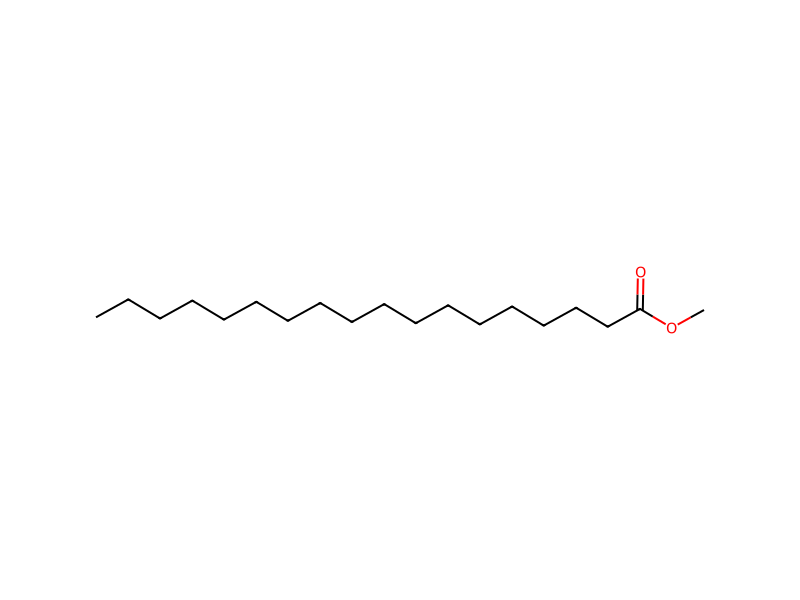
Methyl Stearate

HCID 8201
New noteNew reactionRequest quotes
Print preview

Completing data — refresh the page later to see the latest
Basic informationOverviewNames & identifiersPropertiesSafety & regulationChemistry & industryRelated reactionsCompound notes
Substructure searchFind similar structures

Basic information

CAS
112-61-8
Standard SMILES
CCCCCCCCCCCCCCCCCC(=O)OC
InChIKey
HPEUJPJOZXNMSJ-UHFFFAOYSA-N
Molecular formula
C19H38O2
Average molar mass
298.5 g/mol
Monoisotopic mass
298.28718046

Overview

Methyl stearate appears as white crystals or chunky solid. (NTP, 1992)

Names & identifiers

Preferred name
Methyl Stearate
IUPAC
methyl octadecanoate
English name
Methyl stearate
Molecular formula
C19H38O2
Molecular weight
298.5

Names & synonyms

METHYL STEARATE112-61-8Methyl octadecanoateStearic acid methyl esterStearic acid, methyl esterKemester 9718Methyl n-octadecanoateMetholene 2218Kemester 9018Emery 2218n-Octadecanoic acid methyl esterNSC 9418
Show more names
OCTADECANOIC ACID METHYL ESTERMethyl stearate CRSMETHYL N-OCTANDECANOATEemery2218kemester9018kemester9718Methylstearat
EINECS 203-990-4HSDB 2901UNII-8D4NXF3ZH78D4NXF3ZH7BRN 1786213DTXSID2047640AI3-07960NSC-9418

Database identifiers

CAS
112-61-8
PubChem CID
8201
DTXSID
DTXSID2047640
ChEBI
CHEBI:69188
UNII
8D4NXF3ZH7
EC Number
203-990-4
Nikkaji
J1.997F

Properties

Computed structural propertiesFilling in

XLogP
9
Topological polar surface area
26.3 Ų
Hydrogen bond donors
0
Hydrogen bond acceptors
2
Rotatable bonds
17
Heavy atoms
21
Formal charge
0
Complexity
214

Experimental & physicochemical properties

Chemical ClassesOther Classes -> Stearates
LipidsFatty Acyls [FA] -> Fatty esters [FA07] -> Short fatty esters [FA0710]
CosmeticsEmollient; Skin conditioning
FragrancesFragrance Ingredient (Methyl octadecanoate) -> IFRA transparency List
LogP · 2 items

log Kow= 8.35

8.35

Density · 2 items

0.8498 at 104 °F (NTP, 1992) - Less dense than water; will float

0.8498 @ 40 °C/4 °C

Flavoring AgentsEU Flavoring substances
Color/Form · 2 items

White crystals

Semisolid

Solubility · 3 items

less than 1 mg/mL at 72 °F (NTP, 1992)

Insol in water; sol in alcohol or ether.

Very sol in ether and chloroform

Safety & regulation

Safety information is for reference only and does not replace the supplier’s Safety Data Sheet (SDS), applicable regulations, or professional assessment.

GHS classification

GHS Classification · 3 items

This chemical does not meet GHS hazard criteria for 99.5% (186 of 187) of all reports.

Not Classified

Aggregated GHS information provided per 187 reports by companies from 3 notifications to the ECHA C&L Inventory.

Hazard information

Regulatory Information · 5 items

Chemical: Octadecanoic acid, methyl ester

Commission Regulation (EC) No 1565/2000 (Repealed by Com. Implementing Reg. (EU) No 872/2012)

Octadecanoic acid, methyl ester is listed on the EPA's Chemical Data Reporting (CDR) system. Manufacturers and importers of Octadecanoic acid, methyl ester are required to report information about their production and use of this chemical to the EPA under the Toxic Substances Control Act (TSCA). (40 eCFR Part 711)

Status: Active Update: 04-12-2017 https://echa.europa.eu/registration-dossier/-/registered-dossier/21230

Methyl stearate: Does not have an individual approval but may be used under an appropriate group standard

Other Safety InformationIMAP assessments - Octadecanoic acid, methyl ester: Human health tier I assessment
Fire HazardsThis chemical is combustible. (NTP, 1992)
Fire PotentialCOMBUSTIBLE WHEN EXPOSED TO HEAT OR FLAME ...
Health HazardsACUTE/CHRONIC HAZARDS: When heated to decomposition this compound emits toxic fumes. (NTP, 1992)
Hazards SummaryAn irritant; [MSDSonline] See STEARATES.
Reactive GroupEsters, Sulfate Esters, Phosphate Esters, Thiophosphate Esters, and Borate Esters

Chemistry & industry

Pharmacology

Cellular LocationsExtracellular

Uses & manufacturing

Uses · 4 items

Found in raw beef and as flavoring component of cassava, gari, farine, and clove; Used to make stearic acid detergents, emulsifiers, wetting agents, stabilizers, resins, and plasticizers; Also used as a lubricant in textile and molding trades and in lipstick, nail varnishes, and ointments; [HSDB]

Molding and Core Making [Category: Foundry]

Intermediate for stearic acid detergents, emulsifiers, wetting agents, stabilizers, resins, lubricants, plasticizers.

LUBRICATING OIL COMPONENT; LUBRICANT IN TEXTILE & MOLDING TRADE; COMPONENT IN LIPSTICK, NAIL VARNISHES, & OINTMENTS; CHEMICAL INTERMEDIATE FOR DETERGENTS & EMULSIFIERS

U.S. Production · 3 items

2023: 1,000,000 - <2,500,000 lb

(1972) PROBABLY GREATER THAN 4.54X10+5 GRAMS

(1975) PROBABLY GREATER THAN 4.54X10+5 GRAMS

Consumer UsesNot Known or Reasonably Ascertainable
Industry UsesNot Known or Reasonably Ascertainable
Methods of Manufacturing · 2 items

Method of purification: vacuum fraction distillation.

Esterification of stearic acid with methanol or stearin with methanol.

Formulations/PreparationsGrades: Distilled; Pressed; Technical; Pure (99.8+%). Most technical methyl stearate is 55% stearate and 45% methyl palmitate.
Use Classification · 2 items

Fragrance Ingredients

Cosmetics -> Emollient; Skin conditioning

General Manufacturing Information · 2 items

Related reactions

21 records
New reaction record
HRID 98920 reaction equation
HRID 98920As reactantTraining data from https://doi.org/10.1039/C8SC04228D (2/10)
HRID 144775 reaction equation
HRID 144775As reactantTraining data from https://doi.org/10.1039/C8SC04228D (9/10)
HRID 146065 reaction equation
HRID 146065As reactantTraining data from https://doi.org/10.1039/C8SC04228D (9/10)
HRID 394431 reaction equation
HRID 394431As reactantuspto-grants-2003_08
HRID 622821 reaction equation
HRID 622821As reactantuspto-grants-1988_09
HRID 651365 reaction equation
HRID 651365As reactantuspto-grants-2001_08
HRID 654276 reaction equation
HRID 654276As reactantuspto-grants-1992_07
HRID 654413 reaction equation
HRID 654413As reactantuspto-grants-1992_07
Page 1 of 3

Compound notes

Loading…

On this pageBasic informationOverviewNames & identifiersPropertiesSafety & regulationChemistry & industryRelated reactionsCompound notes
More actions
New noteNew reactionRequest quotes
Flash Point · 2 items

307 °F (NTP, 1992)

307 °F (153 °C)

Boiling Point · 4 items

828 to 829 °F at 747 mmHg (NTP, 1992)

443 °C

Boiling point: 215 °C @ 15 mm Hg

181.00 to 182.00 °C. @ 4.00 mm Hg

DecompositionWhen heated to decomposition it emits acrid smoke and irritating fumes.

Physicochemical properties

Melting point
37 · 37-41 °C(lit.)
Boiling point
215 °C · 215 °C
Density
0 · 0,84 g/cm3
refractive index
1.4241 · 1.4241 (estimate)
FLAVIS Number
9.651 · 09.651 | Methyl octadecanoate
Flash point
230 °F · >230 °F
storage temp.
-20 °C · -20°C
solubility
Chloroform (Sparingly), DMSO (Slightly), Ethyl Acetate (Slightly), Methanol (Slightly)
form
Paste
color
Off-white to cream or light yellow
Odor
100 % · at 100.00 %. oily waxy
Odor Type
waxy
biological source
synthetic
Water Solubility
Soluble in chloroform. Insoluble in water.
Merck
14 · 14,8804
BRN
1786213 · 1786213
Henry's Law Constant
1.7 · 1.7×10-3 mol/(m3Pa) at 25℃, Krop and Velzen (1997)
Cosmetics Ingredients Functions
SKIN CONDITIONINGSKIN CONDITIONING - EMOLLIENT
InChI
1S/C19H38O2/c1-3-4-5-6-7-8-9-10-11-12-13-14-15-16-17-18-19(20)21-2/h3-18H2,1-2H3
InChIKey
HPEUJPJOZXNMSJ-UHFFFAOYSA-N
SMILES
CCCCCCCCCCCCCCCCCC(=O)OC
LogP
8.35 · 8.350
CAS DataBase Reference
112 · 112-61-8(CAS DataBase Reference)
EWG's Food Scores
1 · 1
FDA UNII
8 D4NXF3ZH7 · 8D4NXF3ZH7
EPA Substance Registry System
Methyl stearate (112-61-8)
UNSPSC Code
85151701 · 85151701
NACRES
25 · NA.25
Symbol(GHS)
7 · GHS07
Signal word
Warning
Hazard statements
413 · H413
Precautionary statements
273 · P273-P501
PPE
95 · dust mask type N95 (US), Eyeshields, Gloves
Risk Statements
40 · 40
Safety Statements
22 · 22-24/25
WGK Germany
1 · 1
RTECS
4460000 · WI4460000
TSCA
TSCA listed
HS Code
2915 · 2915 70 50
Storage Class
11 · 11 - Combustible Solids
Hazardous Substances Data
112 · 112-61-8(Hazardous Substances Data)
REACH Registrations
Active
Reactivity Profile · 1 item

METHYL STEARATE is an ester. Esters react with acids to liberate heat along with alcohols and acids. Strong oxidizing acids may cause a vigorous reaction that is sufficiently exothermic to ignite the reaction products. Heat is also generated by the interaction of esters with caustic solutions. Flammable hydrogen is generated by mixing esters with alkali metals and hydrides.

Air and Water ReactionsInsoluble in water.
NFPA Hazard Classification · 3 items

0 - Materials that, under emergency conditions, would offer no hazard beyond that of ordinary combustible materials.

1 - Materials that must be preheated before ignition can occur. Materials require considerable preheating, under all ambient temperature conditions, before ignition and combustion can occur.

0 - Materials that in themselves are normally stable, even under fire conditions.

Hazard Classes and CategoriesNot Classified
Hazardous Reactivities and Incompatibilities · 2 items

... Can react with oxidizing materials.

Incompatible with nitrates. /Esters/

Safety & protection

Fire FightingFires involving this material can be controlled with a dry chemical, carbon dioxide or Halon extinguisher. (NTP, 1992)
First Aid · 1 item

EYES: First check the victim for contact lenses and remove if present. Flush victim's eyes with water or normal saline solution for 20 to 30 minutes while simultaneously calling a hospital or poison control center. Do not put any ointments, oils, or medication in the victim's eyes without specific instructions from a physician. IMMEDIATELY transport the victim after flushing eyes to a hospital even if no symptoms (such as redness or irritation) develop.

Fire Fighting Procedures · 2 items

TO FIGHT FIRE, USE CARBON DIOXIDE, DRY CHEMICAL.

WATER OR FOAM MAY CAUSE FROTHING.

Nonfire Spill Response · 1 item

SMALL SPILLS AND LEAKAGE: Should a spill occur while you are handling this chemical, FIRST REMOVE ALL SOURCES OF IGNITION, then you should dampen the solid spill material with 60-70% ethanol and transfer the dampened material to a suitable container. Use absorbent paper dampened with 60-70% ethanol to pick up any remaining material. Seal the absorbent paper, and any of your clothes, which may be contaminated, in a vapor-tight plastic bag for eventual disposal. Solvent wash all contaminated surfaces with 60-70% ethanol followed by washing with a soap and water solution. Do not reenter the contaminated area until the Safety Officer (or other responsible person) has verified that the area has been properly cleaned.

Disposal Methods · 1 item

SRP: At the time of review, criteria for land treatment or burial (sanitary landfill) disposal practices are subject to significant revision. Prior to implementing land disposal of waste residue (including waste sludge), consult with environmental regulatory agencies for guidance on acceptable disposal practices.

Threshold Limit Values (TLV) · 3 items

8 hr Time Weighted Avg (TWA): 10 mg/cu m. /Stearates; does not include stearates of toxic metals/

Excursion Limit Recommendation: Excursions in worker exposure levels may exceed 3 times the TLV-TWA for no more than a total of 30 minutes during a work day, and under no circumstances should they exceed 5 times the TLV-TWA, provided that the TLV-TWA is not exceeded. /Stearates; does not include stearates of toxic metals/

A4; Not classifiable as a human carcinogen. /Stearates; does not include stearates of toxic metals/

Personal Protective Equipment (PPE) · 1 item

RECOMMENDED RESPIRATOR: Where the neat test chemical is weighed and diluted, wear a NIOSH-approved half face respirator equipped with an organic vapor/acid gas cartridge (specific for organic vapors, HCl, acid gas and SO2) with a dust/mist filter. (NTP, 1992)

Toxicology

Body BurdenMethyl stearate was detected in thrombogenic coronary plaque in 2 of 2 human aorta samples at 3 and 20 ppb(1).
Environmental Fate · 3 items

TERRESTRIAL FATE: Based on a classification scheme(1), an estimated Koc value of 62,000(SRC), determined from a structure estimation method(2), indicates that methyl stearate is expected to be immobile in soil(SRC). Volatilization of methyl stearate from moist soil surfaces is expected to be an important fate process(SRC) given an estimated Henry's Law constant of 0.016 atm-cu m/mole(SRC), using a fragment constant estimation method(3). However, adsorption to soil is expected to attenuate volatilization(SRC). Methyl stearate is not expected to volatilize from dry soil surfaces(SRC) based upon a vapor pressure of 1.36X10⁻⁵ mm Hg(4). Methyl stearate is expected to rapidly biodegrade in aerobic soils as suggested by biodegradation in an aqueous biodegradation screening test(5).

AQUATIC FATE: Based on a classification scheme(1), an estimated Koc value of 62,000(SRC), determined from a structure estimation method(2), indicates that methyl stearate is expected to adsorb to suspended solids and sediment in water(SRC). Volatilization from water surfaces is expected(3) based upon an estimated Henry's Law constant of 0.016 atm-cu m/mole(SRC), developed using a fragment constant estimation method(4). Volatilization half-lives for a model river and model lake are 5 and 164 hours, respectively(SRC), using an estimation method(3). However, volatilization from water surfaces is expected to be attenuated by adsorption to suspended solids and sediment in the water column(SRC). The volatilization half-life from a model pond is estimated to be about 61 hours ignoring adsorption; when considering maximum adsorption the volatilization half-life increases to 17 months(5). According to a classification scheme(5), a /an estimated BCF of W29(SRC), from a log Kow of 8.35(10) and a regression-derived equation(7), suggests the potential for bioconcentration in aquatic organisms is low. Methyl stearate is expected to rapidly biodegrade in aerobic waters based on screening study results(8). An estimated base-catalyzed second-order hydrolysis rate constant of 0.030 L/mole-sec(9,SRC) corresponds to half-lives of 7.3 years and 266 days at pH values of 7 and 8, respectively(9).

ATMOSPHERIC FATE: According to a model of gas/particle partitioning of semivolatile organic compounds in the atmosphere(1), methyl stearate, which has a vapor pressure of 1.36X10⁻⁵ mm Hg at 25 °C(2), will exist in both the vapor and particulate phases in the ambient atmosphere. Vapor-phase methyl stearate is degraded in the atmosphere by reaction with photochemically-produced hydroxyl radicals(SRC); the half-life for this reaction in air is estimated to be 18 hours(SRC) from its estimated rate constant of 2.1X10⁻¹¹ cu cm/molecule-sec at 25 °C(3). Particulate-phase methyl stearate may be removed from the air by wet and dry deposition(SRC).

Food Survey Values · 1 item

Methyl stearate was identified in raw beef samples, concn not provided(1). It was detected as a flavoring constituent of cassava, gari, and farine(2). Methyl stearate was identified as a volatile flavor componenent of clove essential oil(3).

Soil Adsorption/Mobility · 1 item

Using a structure estimation method based on molecular connectivity indices(1), the Koc for methyl stearate can be estimated to be about 62,000(SRC). According to a classification scheme(2), this estimated Koc value suggests that methyl stearate is expected to be immobile in soil.

Natural Pollution SourcesMethyl stearate is a component of raw beef(1) and a flavoring constituent of cassava, gari, farine, and clove(2,3).
Atmospheric ConcentrationsURBAN/SUBURBAN: Methyl stearate was qualitatively detected in ambient air particulate samples collected in Upland CA, Lake Charles, LA, Elizabeth, NJ, and Houston, TX, in 1978(1).
Artificial Pollution SourcesMethyl stearate's production and use as an synthetic intermediate(1) may result in its release to the environment through various waste streams(SRC).
Environmental Biodegradation · 1 item

AEROBIC: Methyl stearate was found to partially biodegrade within 24 hours when inoculated with a mixed activated sludge in a Warburg respirator(1). A close structural analog to methyl stearate, ethyl stearate, was listed as biodegradable in the Japanese MITI test(2).

Sediment/Soil ConcentrationsSOIL: Methyl stearate was qualitatively detected in soil samples from Southern Alberta, Canada, in strata associated with the Mazama volcano eruption which occurred approximately 7000 years ago(1).
Environmental Bioconcentration · 1 item

An estimated BCF of 29 was calculated for methyl stearate(SRC) using a log Kow of 8.35(1) and a regression-derived equation(2). According to a classification scheme(3), this BCF suggests the potential for bioconcentration in aquatic organisms is low.

Volatilization from Water/Soil · 1 item

The Henry's Law constant for methyl stearate is estimated as 0.016 atm-cu m/mole(SRC) using a fragment constant estimation method(1). This Henry's Law constant indicates that methyl stearate is expected to volatilize rapidly from water surfaces(2). Based on this Henry's Law constant, the volatilization half-life from a model river (1 m deep, flowing 1 m/sec, wind velocity of 3 m/sec)(2) is estimated as approximately 5 hours(SRC). The volatilization half-life from a model lake (1 m deep, flowing 0.05 m/sec, wind velocity of 0.5 m/sec)(2) is estimated as approximately 164 hours(SRC). The volatilization half-life from a model pond 2 m deep is estimated to be about 61 hours ignoring adsorption; when considering maximum adsorption the volatilization half-life increases to 17 months(3). Methyl stearate's Henry's Law constant(1) indicates that volatilization from moist soil surfaces may occur although adsorption may attenuate this process(SRC). Methyl stearate is not expected to volatilize from dry soil surfaces(SRC) based upon a vapor pressure of 1.36X10⁻⁵ mm Hg(4).

Evidence for CarcinogenicityA4; Not classifiable as a human carcinogen. /Stearates; does not include stearates of toxic metals/

Safety data

PPE
dust mask type N95 (US), Eyeshields, Gloves
wgk
1
tsca
TSCA listed
rtecs
WI4460000
hs_code
2915 70 50
risk_code
40
Signal word
Warning
Symbol(GHS)
GHS07
safety_code
22-24/25
Storage Class
11 - Combustible Solids
Hazard statements
H413
REACH Registrations
Active
Precautionary statements
P273-P501
Hazardous Substances Data
112-61-8(Hazardous Substances Data)

All Other Basic Organic Chemical Manufacturing

Octadecanoic acid, methyl ester: ACTIVE

Applications · 3 items

UsesMethyl stearate is used as a nonionic surfactant, thereby enhancing the solubility of chemicals by dissociating aggregates and unfolding proteins. It is a fatty acid ester, which is used as an emulsifier and stabilizer.

UsesMethyl Stearate is used as a nonionic surfactant in various experiments in helping solubilize a variety of chemical species by dissociating aggregates and unfolding proteins.

General DescriptionWhite crystals or chunky solid.

Upstream & downstream products

Upstream raw materials

Stearic acidMethanolElaidic acidTriethylsilaneOleic acidSodium stearate

Downstream products

Methyl 2(E)-OctadecenoateStearoylbenzoylmethane

Additional notes

DefinitionChEBI: A natural product found in Neolitsea daibuensis.