
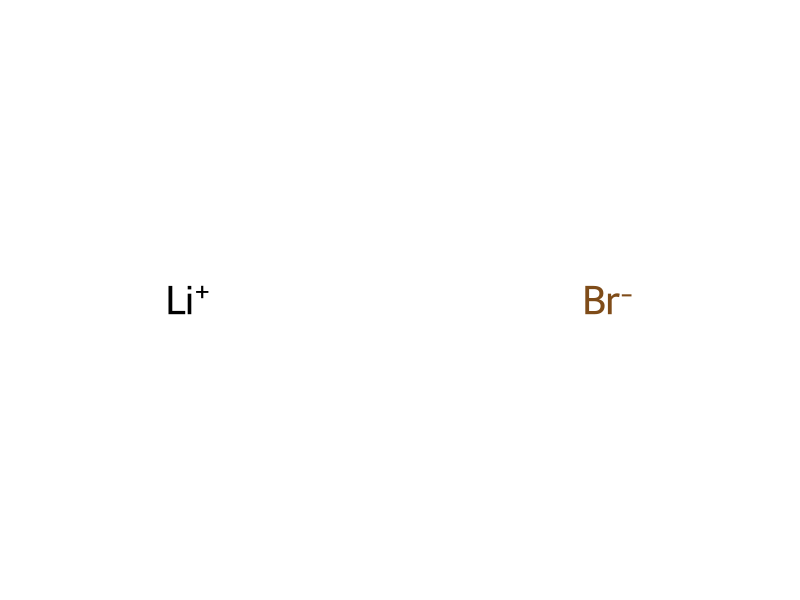
Basic information
- Standard SMILES
[Br-].[Li+]- InChIKey
AMXOYNBUYSYVKV-UHFFFAOYSA-M- Molecular formula
- BrLi
- Average molar mass
- 86.9 g/mol
- Monoisotopic mass
- 85.93434165
Overview
Lithium bromide is a lithium salt in which the counterion is bromide. The anhydrous salt forms cubic crystals similar to common salt. It is a bromide salt and a lithium salt.
Names & identifiers
- Preferred name
- Lithium Bromide
- IUPAC
- lithium bromide
- English name
- Lithium bromide
- Molecular formula
- BrLi
- Molecular weight
- 86.85
Names & synonyms
Lithium bromide7550-35-8Lithium monobromideLithium bromide (LiBr)bromolithiumLITHIUM BROMATUM864G646I84CHEBI:63042DTXSID20892222RefChem:55513DTXCID801079305231-439-8
Show more names
LITHIUM HALIDEAnhydrous lithiuM broMideithium bromideLithiumbromide,dihydrateLITHIUM BROMIDE ANYDROUSLithium bromide, extra pure, 99.999%Lithium bromide anhydrous, free-flowing, Redi-Dri, ReagentPlus, >=99%
LITHIUMBROMIDELiBrlithium;bromideBrLiLithium bromide anhydrousLITHIUM BROMIDE, ANHYDROUSMFCD00011077LIthium bromide solution
Database identifiers
- CAS
7550-35-8- PubChem CID
- 82050
- DTXSID
DTXSID20892222- ChEBI
CHEBI:63042- UNII
- 864G646I84
- EC Number
- 231-439-8
- Nikkaji
- J43.853G
Properties
Computed structural properties
- Topological polar surface area
- 0 Ų
- Hydrogen bond donors
- 0
- Hydrogen bond acceptors
- 1
- Rotatable bonds
- 0
- Heavy atoms
- 2
- Formal charge
- 0
- Complexity
- 2
Experimental & physicochemical properties
Chemical ClassesMetals -> Metals, Inorganic Compounds
SpringerMaterials Propertiesdielectric constant
Density3.464 @25 °C
Melting Point550 °C
Physical Description
Dry Powder; Wet Solid; Dry Powder
Highly deliquescent white solid; [Merck Index] White powder, crystals, or beads; Hygroscopic; [Alfa Aesar MSDS]
Physicochemical properties
- Melting point
- 550 °C · 550 °C (lit.)
- Boiling point
- 1265 °C · 1265 °C
- Density
- 1.57 g/mL · 1.57 g/mL at 25 °C
- vapor pressure
- 1 hPa · 1 hPa ( 748 °C)
- Flash point
- 1265 °C · 1265°C
- storage temp.
- Inert atmosphere,Room Temperature
- solubility
- Methanol (Very Slightly, Heated), Water (Slightly)
- pka
- 2.64 · 2.64[at 20 ℃]
- form
- powder
- Specific Gravity
- 3.464 · 3.464
- color
- White
- PH
- 7 · 7 (20°C, 10g/L)
- Odor
- odorless
- Water Solubility
- 61 g/100 · 61 g/100 mL (25 º C)
- Sensitive
- Hygroscopic
- Merck
- 14 · 14,5526
- Stability
- Stable. Anhydrous form is extremely hygroscopic.
- InChI
- 1S/BrH.Li/h1H;/q;+1/p-1
- InChIKey
- AMXOYNBUYSYVKV-UHFFFAOYSA-M
- SMILES
- [Li+].[Br-]
- LogP
- -0.37 at · -0.37 at 25℃
- CAS DataBase Reference
- 7550 · 7550-35-8(CAS DataBase Reference)
- FDA UNII
- 864 G646I84 · 864G646I84
- NIST Chemistry Reference
- Lithium bromide(7550-35-8)
- EPA Substance Registry System
- Lithium bromide (7550-35-8)
- UNSPSC Code
- 12352302 · 12352302
- NACRES
- 55 · NA.55
- Symbol(GHS)
- 7 · GHS07
- Signal word
- Warning
- Hazard statements
- 315 · H315-H317-H319
- Precautionary statements
- 261 · P261-P264-P272-P280-P302+P352-P305+P351+P338
- Hazard Codes
- Xi
- Risk Statements
- 32 · 32-40-43-36/37 -36/37/38 -36/38
- Safety Statements
- 22 · 22-26-60-24/25-36/37-36/37/39
- WGK Germany
- 2 · 2
- RTECS
- 5755000 · OJ5755000
- F
- 3 · 3
- TSCA
- TSCA listed
- HS Code
- 28275900 · 28275900
- Storage Class
- 13 · 13 - Non Combustible Solids
- Hazard Classifications
- 4 OralEye · Acute Tox. 4 OralEye Irrit. 2Skin Irrit. 2Skin Sens. 1
- REACH Registrations
- Active
Safety & regulation
GHS classification
GHS Classification
Warning
H302 (98.2%): Harmful if swallowed [Warning Acute toxicity, oral]
P261, P264, P264+P265, P270, P272, P280, P301+P317, P302+P352, P305+P351+P338, P321, P330, P332+P317, P333+P317, P337+P317, P362+P364, and P501 (click each P-code to see the statement)
Aggregated GHS information provided per 279 reports by companies from 14 notifications to the ECHA C&L Inventory. Each notification may be associated with multiple companies.
Danger
H302: Harmful if swallowed [Warning Acute toxicity, oral]
Hazard information
Regulatory Information
Chemical: Lithium bromide (LiBr)
Lithium bromide (LiBr) is listed on the EPA's Chemical Data Reporting (CDR) system. Manufacturers and importers of Lithium bromide (LiBr) are required to report information about their production and use of this chemical to the EPA under the Toxic Substances Control Act (TSCA). (40 eCFR Part 711)
Status: Active Update: 13-03-2019 https://echa.europa.eu/registration-dossier/-/registered-dossier/13642
Lithium bromide: Does not have an individual approval but may be used under an appropriate group standard
Other Safety InformationIMAP assessments - Lithium bromide (LiBr): Human health tier I assessment
Hazards Summary
Causes flaccid paralysis with appropriate anesthesia, tetany, and arrhythmias in oral lethal-dose studies of mice; [RTECS] High doses may cause CNS depression and disturbed blood electrolyte balance; Chronic exposure may cause skin eruptions and adverse CNS effects; [Merck Index] A skin and strong eye irritant; Harmful by ingestion; [Alfa Aesar MSDS] See Lithium and Bromine.
Hazard Classes and Categories
Acute Tox. 4 (98.2%)
Acute toxicity (Oral) - Category 4
Skin sensitization - Category 1B
Acute toxicity (Oral) - Category 4
Safety & protection
Exposure Control and Personal Protection0.2 [mg/m3], inhalable fraction, as Li[German Research Foundation (DFG)]
Protective Action Criteria (PAC)
1.5 [mg/m3]
17 [mg/m3]
100 [mg/m3]
Toxicology
Treatment
EYES: irrigate opened eyes for several minutes under running water. INGESTION: do not induce vomiting. Rinse mouth with water (never give anything by mouth to an unconscious person). Seek immediate medical advice. SKIN: should be treated immediately by rinsing the affected parts in cold running water for at least 15 minutes, followed by thorough washing with soap and water. If necessary, the person should shower and change contaminated clothing and shoes, and then must seek medical attention. INHALATION: supply fresh air. If required provide artificial respiration.
Health Effects
Bromine vapour causes irritation and direct damage to the mucous membranes. Elemental bromine also burns the skin. The bromide ion is a central nervous system depressant and chronic exposure produces neuronal effects. This is called bromism and can result in central reactions reaching from somnolence to coma, cachexia, exicosis, loss of reflexes or pathologic reflexes, clonic seizures, tremor, ataxia, loss of neural sensitivity, paresis, papillar edema of the eyes, abnormal speech, cerebral edema, delirium, aggressiveness, and psychoses. (L625, L626, L627)
Adverse EffectsNeurotoxin - Other CNS neurotoxin
Exposure RoutesOral (L626) ; inhalation (L626) ; dermal (L626)
Toxicity Summary
Bromine is a powerful oxidizing agent and is able to release oxygen free radicals from the water in mucous membranes. These free radicals are also potent oxidizers and produce tissue damage. In additon, the formation of hydrobromic and bromic acids will result in secondary irritation. The bromide ion is also known to affect the central nervous system, causing bromism. This is believed to be a result of bromide ions substituting for chloride ions in the in actions of neurotransmitters and transport systems, thus affecting numerous synaptic processes. (L626, L627, A543)
Signs and Symptoms
Bromine vapour causes irritation and direct damage to the mucous membranes. Symptoms include lacrimation, rhinorrhoea, eye irritation with mucous secretions from the oropharyngeal and upper airways, coughing, dyspnoea, choking, wheezing, epistaxis, and headache. The bromide ion is a central nervous system depressant producing ataxia, slurred speech, tremor, nausea, vomiting, lethargy, dizziness, visual disturbances, unsteadiness, headaches, impaired memory and concentration, disorientation and hallucinations. This is called bromism. (L626, L627)
Carcinogen ClassificationNo indication of carcinogenicity to humans (not listed by IARC).
Toxicity DataLD50: 1800 mg/kg (Oral, Rat) (L661)
LD50: 1680 mg/kg (Subcutaneous, Mouse) (L660)
Safety data
- F
- 3
- wgk
- 2
- tsca
- TSCA listed
- rtecs
- OJ5755000
- hs_code
- 28275900
- risk_code
- 32-40-43-36/37 -36/37/38 -36/38
- Signal word
- Warning
- Symbol(GHS)
- GHS07
- hazard_code
- Xi
- safety_code
- 22-26-60-24/25-36/37-36/37/39
- Storage Class
- 13 - Non Combustible Solids
- Hazard statements
- H315-H317-H319
- REACH Registrations
- Active
- Hazard Classifications
- Acute Tox. 4 OralEye Irrit. 2Skin Irrit. 2Skin Sens. 1
- Precautionary statements
- P261-P264-P272-P280-P302+P352-P305+P351+P338
Chemistry & industry
Pharmacology
Metabolism/Metabolites
Bromine is mainly absorbed via inhalation, but may also enter the body through dermal contact. Bromine salts can be ingested. Due to its reactivity, bromine quickly forms bromide and may be deposited in the tissues, displacing other halogens. (L626)
FDA Pharmacological Classification
LITHIUM BROMATUM
Mood Stabilizer [EPC]
Uses & manufacturing
UsesUsed as a humectant and sedative/hypnotic; [Merck Index]
U.S. Production2023: 100,000 - <250,000 lb
Consumer UsesNot Known or Reasonably Ascertainable
Industry UsesIntermediate
General Manufacturing Information
Petroleum Refineries
Lithium bromide (LiBr): ACTIVE
Applications
DescriptionLithium bromide (LiBr) is the chemical compound of lithium and bromine. It has extreme hygroscopic, making it a suitable desiccant in the air conditioning systems. It can also be used in absorption chilling together with water. It is also useful in the organic synthesis such as forming adduct with some pharmaceuticals. In medical fields, it can be used as a sedative and used for the treatment of bipolar disorder. It can be manufactured by the treatment of lithium carbonate with hydrobromic acid.
UsesLithium bromide is used in absorption, refrigeration and air-conditioning systems. A highly concentrated solution of the salt is an efficient absorbent of water vapor. The vapor pressure of such solution is very low. Other applications include the use of the salt as a swelling agent for wool, hair and other organic fibers; as a catalyst in dehydrohalogenation reactions; and as a sedative and hypnotic in medicine.
UsesLithium Bromide finds use as a desiccant in industrial air conditioning systems and industrial drying agents.
UsesIt is used for reconstitution of brines, as swelling agent for proteins and as electrolyte component in lithium battery. Used as brazing and welding flux. Lithium bromide is used as catalyst for the condensation of carbonyl compounds with active methylene compounds in the absence of solvent, operating medium for air-conditioning and industrial drying system. Also used in manufacturing pharmaceuticals and alkylation process. It also plays an important role in the synthesis of dihydropyrimidinones.
UsesAs humectant, in air-conditioning systems. An aqueous solution of lithium bromide containing about 50 % lithium bromide is used as an absorbent in large-scale absorption air conditioning equipment. Lithium bromide is also used in limited amounts by the pharmaceutical industry for dehydrobromination of organic compounds to form olefins.
General DescriptionLiBr/Chlorotrimethylsilane reagent participates in the conversion of alcohols to bromides.
Preparation methods
PreparationLithium bromide is prepared by neutralizing lithium hydroxide or lithium carbonate with an aqueous solution of hydrobromic acid, followed by concentration and crystallization: LiOH + HBr → LiBr + H2O Li2CO3 + HBr → LiBr + CO2 + H2O The salt is usually obtained as hydrates. Anhydrous lithium bromide is obtained by heating hydrated salt under vacuum.
PreparationLithium bromide may be prepared by the reaction of lithium hydroxide monohydrate or lithium carbonate with hydrobromic acid. The resultant solution of lithium bromide may be evaporated and cooled to crystallize a hydrate of lithium bromide, the composition of which depends on the final temperature. The lithium bromide hydrate may be filtered from the mixture and carefully dried by the application of heat in a vacuum desiccator to avoid melting the hydrate.
Upstream & downstream products
Upstream raw materials
Downstream products
Suppliers50 total
梯希爱(上海)化成工业发展有限公司021-67121386 · [email protected]
衢州润东化工有限公司0570-8789886 18892685668 · [email protected]
上海阿拉丁生化科技股份有限公司400-6206333 13167063860 · [email protected]
上海欧金实业有限公司13564718081 13564718081
韶远科技(上海)有限公司021-50795510 4000665055 · [email protected]
科瑞迪化学400-821-5857 021-64326257 · [email protected]
上海迈瑞尔生化科技有限公司4006356688 18621169109 · [email protected]
阿法埃莎(中国)化学有限公司400-6106006 · [email protected]
安耐吉化学&3A(安徽泽升科技股份有限公司)400-0056266 · [email protected]
湖北晟威新材料有限公司15207170057 15207170057
上海景颜化工科技有限公司13817811078 · [email protected]
嘉兴市艾森化工有限公司0573-85285100 18627885956 · [email protected]
Beckmann-Kenko GmbH+49 4241 9308 88 · [email protected]
山东西亚化学有限公司13355009207 13355009207 · [email protected]
玛雅试剂+86 (573) 82222445 (0)18006601000 452520369 · [email protected]
四川库利南科技有限公司400-1166-196 18981987031 · [email protected]
天津希恩思生化科技有限公司400 638 7771 · [email protected]
湖南汇百侍生物科技有限公司0731-85526065 13308475853 · [email protected]
河南多贝化工有限公司0370-2785118 17550508557 · [email protected]
斯百全化学(上海)有限公司021-021-021-67601398-809-809-809 15221380277 · [email protected]
艾科试剂4008-755-333 18080918076 · [email protected]
赛默飞世尔科技(中国)有限公司800-810-5118 · [email protected]
北京伊诺凯科技有限公司400-810-7969 010-59572699 · [email protected]
上海遐瑞医药科技有限公司+86 21 61551611
上海健超生物科技有限公司150-2103-5486 18017383231 · [email protected]
TCI AMERICA800-4238616 · [email protected]
TOKYO CHEMICAL INDUSTRY CO., LTD.03-36680489 · [email protected]
TCI Europe320-37350700 · [email protected]
越林试剂021-62960152 · [email protected]
南京杜莱生物技术有限公司025-84699383-8003;025-846993838003-8003 18013301590 · [email protected]
淄博爱肯新材料科技有限公司0533-4915568 18653327685 · [email protected]
武汉吉业升化工有限公司15927657268 · [email protected]
北京环宇世纪化学科技有限公司hysj_bj.com
安徽科迪达化工有限公司0554-2106669 · [email protected]
HBCChem, Inc.+1-510-219-6317 · [email protected]
日照力德士化工有限公司010-51268198 · [email protected]
美岚实业(上海)有限公司021-58958189 · [email protected]
上海爱蝶实业有限公司021-58957966 18930537195 · [email protected]
湖北瑞今化学有限公司027 83642615 13995607107 · [email protected]
广拓化学(上海)有限公司021-60899189-8001 18918189673 · [email protected]
雷丁试剂0510-85629785 18013409632 · [email protected]
上海御略医药科技有限公司021-60345187 13671753212 · [email protected]
上海麦克林生化科技股份有限公司15221275939 15221275939 · [email protected]
杭州杰恒化工有限公司0571-87396432 · [email protected]
上海嵩爰化工科技有限公司010-1234567 18521000990 · [email protected]
上海有朋化工有限公司021-69005955 13701776567 · [email protected]
北京海力扬化学科技有限公司13718199399 · [email protected]
四川海诺威科技有限公司13708085536 13708085536 · [email protected]
上海凯赛化工有限公司021-33516722 13701817765 · [email protected]
上海彤源化工有限公司021-021-69182866 13701855675 · [email protected]
Additional notes
DefinitionChEBI: A lithium salt in which the counterion is bromide. The anhydrous salt forms cubic crystals similar to common salt.
Related reactions
948 records


Linked notes
Loading…