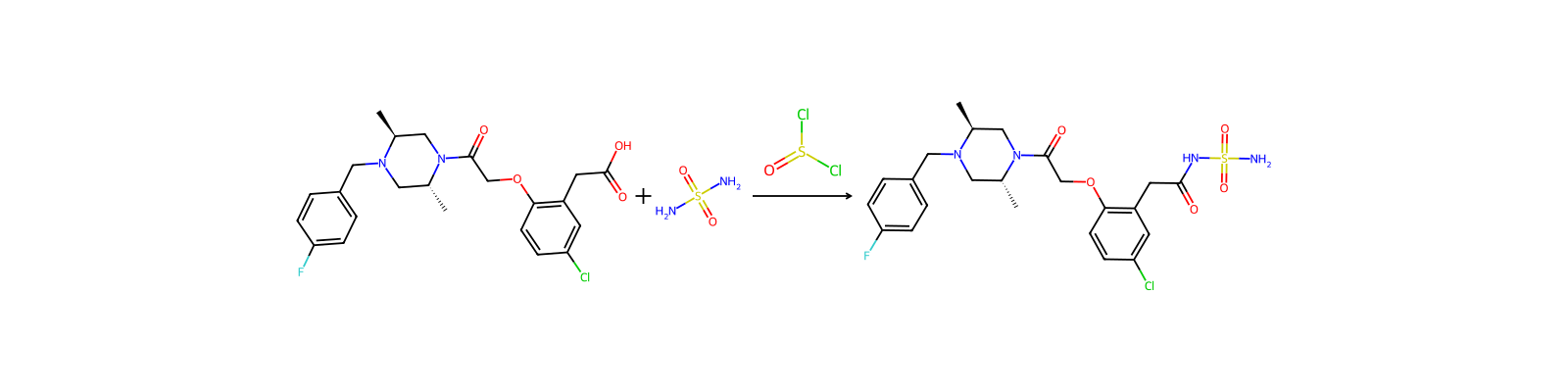
HRID 11655As reactant

7803-58-9NS(N)(=O)=ONVBFHJWHLNUMCV-UHFFFAOYSA-NSulfamide is the simplest of the sulfamic acids consisting of a single sulfur atom covalently bound by single bonds to two amino groups and by double bonds to two oxygen atoms.
7803-58-9DTXSID5064885CHEMBL355001CHEBI:29368Safety information is for reference only and does not replace the supplier’s Safety Data Sheet (SDS), applicable regulations, or professional assessment.
This chemical does not meet GHS hazard criteria for 3.7% (2 of 54) of reports.
Warning
H315 (96.3%): Causes skin irritation [Warning Skin corrosion/irritation]
P261, P264, P264+P265, P271, P280, P302+P352, P304+P340, P305+P351+P338, P319, P321, P332+P317, P337+P317, P362+P364, P403+P233, P405, and P501 (click each P-code to see the statement)
Aggregated GHS information provided per 54 reports by companies from 10 notifications to the ECHA C&L Inventory. Each notification may be associated with multiple companies.
Chemical: Sulfamide
REACH registered substance: Sulphuric diamide (EC: 232-262-9)
DescriptionSulfamide is a white solid substance that is normally produced by reacting sulfuryl chloride with ammonia. Sulfamide is stable under normal conditions and soluble in acetone and DMSO. Sulfamide may also refer to the functional group in organic chemistry, and it consists of at least one group attached to a nitrogen atom of sulfamide. It is a carbonic anhydrase inhibitor and is widely used as a pharmaceutical intermediate. Sulfamide is sensitive to moisture, thus should be kept away from water and humidity. It should also be stored away from oxidizing agents. Sulfamide should be kept in a tightly closed container and placed in a cool, dry, and well-ventilated condition.
UsesSulfamide and its derivatives can also be used to prepare fused thiadiazine systems, Reaction with 2-aminoacetophenones affords IH-2,1,3-benzothia- diazine 2,2-dioxides 77 (65JOC3960). The corresponding 3,4-dihydro deriv- atives are readily available from 2-aminobenzylamines with either sulfuryl chloride (70M1443) or sulfamide (66USP3278532; 71MI055). These kinds of compounds can also be obtained from N-aryl-N'-alkylsulfamides and s-trioxane in a reaction involving cyclization by intramolecular sulfamido- methylation (79JOC2032) (Scheme 30).
UsesSimilar to urea in many of its reactions, but is more acidic, and can act as a dibasic acid.
UsesA carbonic anhydrase inhibitor; used for treatment of cancer.


DefinitionChEBI: The simplest of the sulfamic acids consisting of a single sulfur atom covalently bound by single bonds to two amino groups and by double bonds to two oxygen atoms.