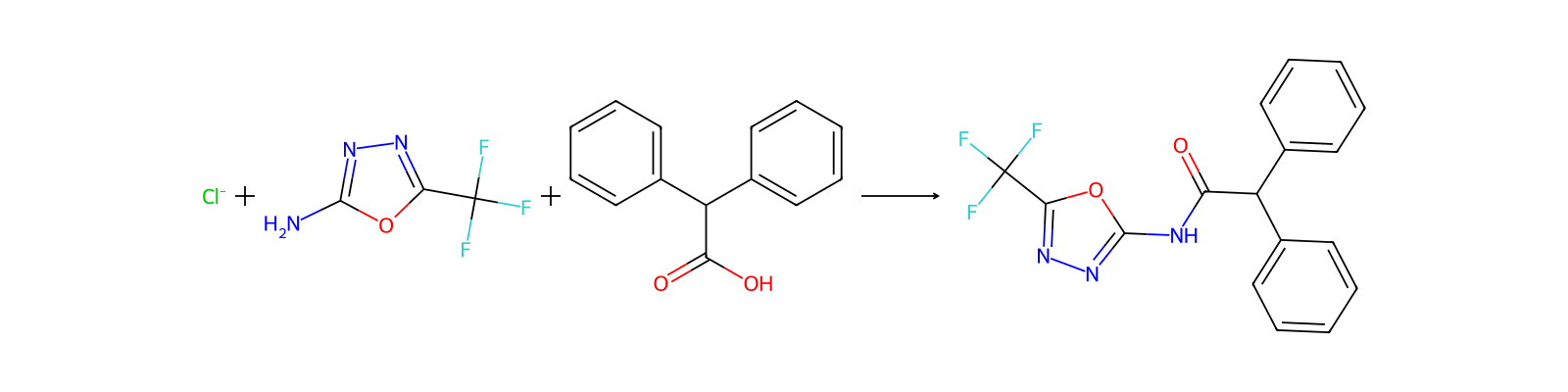
Diphenylacetic acid is a monocarboxylic acid that is acetic acid where the methyl hydrogens have been replaced by two phenyl groups respectively. It has a role as a xenobiotic metabolite. It is functionally related to an acetic acid.
Physical DescriptionSolid; [Merck Index] White powder; [Sigma-Aldrich MSDS]
Physicochemical properties
Melting point
147 · 147-149 °C(lit.)
Boiling point
195 °C · 195°C 25mm
Density
1 · 1,257 g/cm3
vapor pressure
0.001 Pa · 0.001Pa at 25℃
refractive index
1.6 · 1.6000 (estimate)
Flash point
195 °C/25mm · 195°C/25mm
Safety & regulation
Safety information is for reference only and does not replace the supplier’s Safety Data Sheet (SDS), applicable regulations, or professional assessment.
GHS classification
GHS Classification · 4 items
Danger
H302 (52.2%): Harmful if swallowed [Warning Acute toxicity, oral]
P261, P262, P264, P264+P265, P270, P271, P273, P280, P301+P317, P302+P352, P304+P340, P305+P351+P338, P316, P317, P319, P321, P330, P332+P317, P337+P317, P361+P364, P362+P364, P391, P403+P233, P405, and P501 (click each P-code to see the statement)
Aggregated GHS information provided per 23 reports by companies from 9 notifications to the ECHA C&L Inventory. Each notification may be associated with multiple companies.
Diphenylacetic acid: Does not have an individual approval but may be used under an appropriate group standard
Hazards SummaryCauses changes in motor activity and ataxia in oral lethal-dose studies of mice and rats; Causes changes in erythrocyte count in 26-week intermittent oral studies of rats; [RTECS] May cause irritation; [Sigma-Aldrich MSDS]
Hazard Classes and CategoriesAcute Tox. 4 (52.2%)
Safety data
PPE
Eyeshields, Gloves, type N95 (US)
wgk
2
tsca
TSCA listed
rtecs
AH2515000
hs_code
29163900
Toxicity
mouse,LD50,intraperitoneal,500mg/kg (500mg/kg),Farmaco, Edizione Scientifica. Vol. 13, Pg. 286, 1958.
Chemistry & industry
Uses & manufacturing
General Manufacturing InformationBenzeneacetic acid, .alpha.-phenyl-: ACTIVE
Applications · 1 item
UsesKinetic resolution of racemic 1-heteroarylalkanols by asymmetric esterification using diphenylacetic acid with pivalic anhydride and a chiral acyl-transfer catalyst is described. Molecular crystal of acridine and diphenylacetic acid and its absolute asymmetric photodecarboxylating condensation generates chirality in a two-component. The activation parameters for the racemization of a series of ortho-alkyl-substituted diphenylacetic acids are determined.