
2-Amino-1,5-naphthalenedisulfonic acid
Completing data — refresh the page later to see the latest
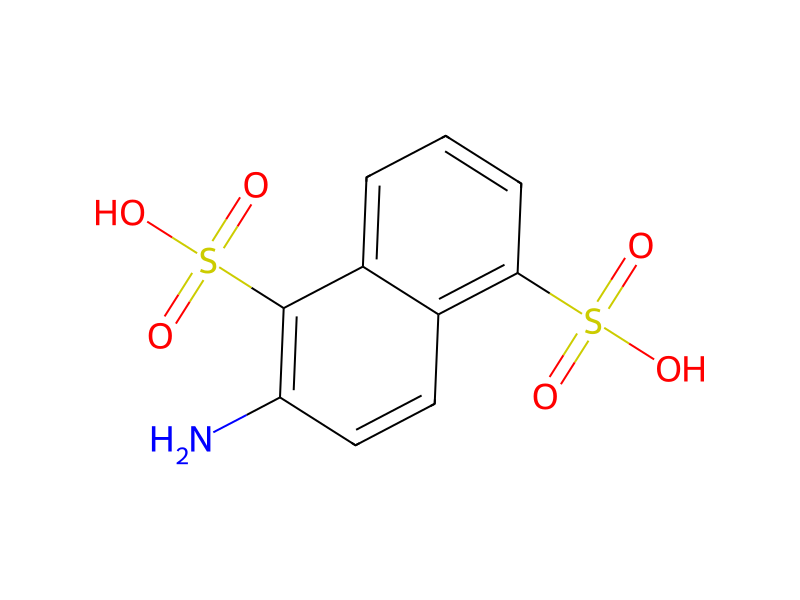
Basic information
- CAS
117-62-4- Standard SMILES
Nc1ccc2c(S(=O)(=O)O)cccc2c1S(=O)(=O)O- InChIKey
YAIKCRUPEVOINQ-UHFFFAOYSA-N- Molecular formula
- C10H9NO6S2
- Average molar mass
- 303.3 g/mol
- Monoisotopic mass
- 302.98712935
Names & identifiers
- Preferred name
- 2-Amino-1,5-naphthalenedisulfonic acid
- IUPAC
- 2-aminonaphthalene-1,5-disulfonic acid
- English name
- 2-Amino-1,5-naphthalenedisulfonic acid
- Molecular formula
- C10H9NO6S2
- Molecular weight
- 303.31
Names & synonyms
2-Amino-1,5-naphthalenedisulfonic acid2-Naphthylamine-1,5-disulfonic acidTobias acid, 5-sulfo-2-Amino-1,5-naphthalene disulfonic acid2-Aminonaphthalene-1,5-disulphonic acid1,5-NAPHTHALENEDISULFONIC ACID, 2-AMINO-Kyselina sulfo-tobiasovaKyselina sulfo-tobiasova [Czech]SULFOTOBIAS ACIDKyselina 2-naftylamin-1,5-disulfonovaEINECS 204-201-6NSC 60279
Show more names
SULFO TOBIAS ACIDD SALT5-sulfo-tobiasaciSULPHOTOBIAS ACIDSulfonic Tobias AcidSulfo Tobias Acid(STA)kyselinasulfo-tobiasovaSulfonated trimeric acid2-amino-1,5-naphthalenedisulfonic2-amino-5-naphthalenedisulfonicacid
NSC-60279BRN 28886451F5J76WY2Dl,5-Naphthalenedisulfonic acid, 2-amino-AI3-52456Kyselina 2-naftylamin-1,5-disulfonova [Czech]2-14-00-00475 (Beilstein Handbook Reference)UNII-1F5J76WY2D
Database identifiers
- CAS
117-62-4- PubChem CID
- 8338
- DTXSID
DTXSID0045040- ChEMBL
CHEMBL1731910- UNII
- 1F5J76WY2D
- EC Number
- 204-201-6
- Nikkaji
- J2.908D
Properties
Computed structural propertiesFilling in
- XLogP
- 0.5
- Topological polar surface area
- 152 Ų
- Hydrogen bond donors
- 3
- Hydrogen bond acceptors
- 7
- Rotatable bonds
- 2
- Heavy atoms
- 19
- Formal charge
- 0
- Complexity
- 531
Experimental & physicochemical properties
Collision Cross Section159.4 Ų [M-H]- [CCS Type: DT; Buffer gas: N2; Ionization: ESI-; Dataset: TOXCAST; Source Identifier: DTXSID9044611]
Physicochemical properties
- Boiling point
- 205.8 °C · 205.8°C (rough estimate)
- Density
- 1.6329 · 1.6329 (rough estimate)
- refractive index
- 1.733 · 1.7330 (estimate)
- storage temp.
- 2 · 2-8°C
- pka
- -0.51 · -0.51±0.40(Predicted)
- Water Solubility
- soluble
- InChI
- InChI=1S/C10H9NO6S2/c11-8-5-4-6-7(10(8)19(15,16)17)2-1-3-9(6)18(12,13)14/h1-5H,11H2,(H,12,13,14)(H,15,16,17)
- InChIKey
- YAIKCRUPEVOINQ-UHFFFAOYSA-N
- SMILES
- C1(S(O)(=O)=O)=C2C(C(S(O)(=O)=O)=CC=C2)=CC=C1N
- LogP
- -1.85 · -1.85
- CAS DataBase Reference
- 117 · 117-62-4(CAS DataBase Reference)
Safety & regulation
Safety information is for reference only and does not replace the supplier’s Safety Data Sheet (SDS), applicable regulations, or professional assessment.
GHS classification
GHS Classification
This chemical does not meet GHS hazard criteria for 6.8% (4 of 59) of reports.
Danger
H318 (15.3%): Causes serious eye damage [Danger Serious eye damage/eye irritation]
P264+P265, P280, P305+P351+P338, P305+P354+P338, P317, and P337+P317 (click each P-code to see the statement)
Aggregated GHS information provided per 59 reports by companies from 3 notifications to the ECHA C&L Inventory. Each notification may be associated with multiple companies.
Hazard information
Regulatory Information
REACH registered substance: 2-aminonaphthalene-1,5-disulphonic acid (EC: 204-201-6)
1,5-Naphthalenedisulfonic acid, 2-amino-: Does not have an individual approval but may be used under an appropriate group standard
Hazard Classes and CategoriesEye Dam. 1 (15.3%)
Safety data
- F
- 8-10
- wgk
- 2
- tsca
- TSCA listed
- rtecs
- QJ6135000
- ridadr
- 1759
- Toxicity
- LD50 oral in rat: 5430mg/kg
- risk_code
- 36-34
- Signal word
- Warning
- Symbol(GHS)
- GHS07
- hazard_code
- Xi,C
- safety_code
- 26-28A
- hazard_class
- 8
Chemistry & industry
Uses & manufacturing
General Manufacturing Information1,5-Naphthalenedisulfonic acid, 2-amino-: ACTIVE
Applications
Description2-Aminonaphthalene-1,5-disulfonic acid [117-62-4]. 5-sulfo-Tobias acid, C10H9NO6S2, Mr 303.32, is purified by crystallization of the dipotassium salt from water. Alkali fusion results in formation of 2-amino-5-hydroxynaphthalene-1-sulfonic acid. Sulfonation (40 % oleum, 100℃) gives 2-aminonaphthalene-1,5,7-trisulfonic acid. Heating with aqueous sulfuric acid produces 2-aminonaphthalene-5- sulfonic acid. The diazo compound is converted to 2-diazo-1-hydroxynaphthalene-5-sulfonic acid on treatment with alkaline hypochlorite.
UsesAs a diazo component in orange and red azo reactive dyes, 2-Amino-1,5-naphthalenedisulfonic acid gives more bathochromic shades than Tobias acid.
Upstream & downstream products
Upstream raw materials
Downstream products
Related reactions
6 records



Compound notes
Loading…