
HomeMCPWorkbenchSkills
HomeWorkbenchNotificationsMe
llms.txt · MCP GuidePrivacy Policy · Terms of Service · Supportv1.8.0
  1. Home
  2. /Compound

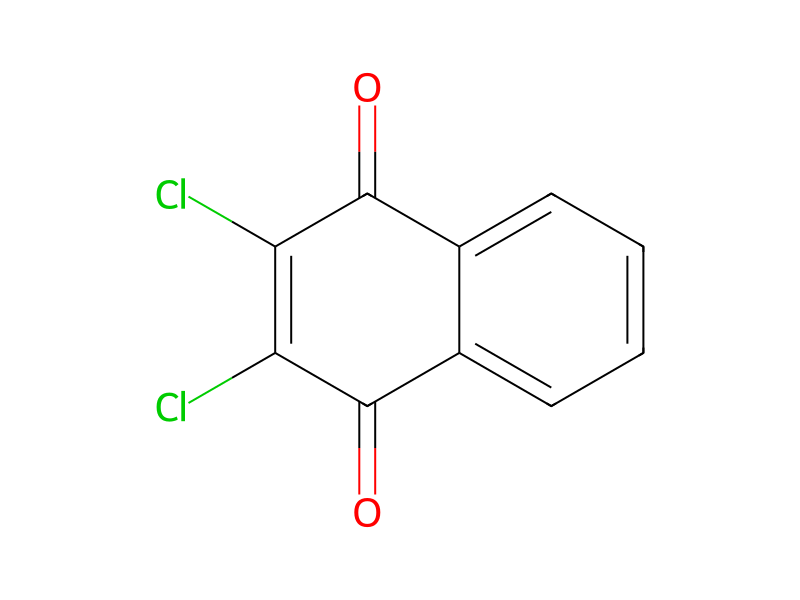
Dichlone

HCID 8342
New noteNew reactionRequest quotes
Print preview
Basic informationOverviewNames & identifiersPropertiesSafety & regulationChemistry & industryRelated reactionsCompound notes
Substructure searchFind similar structures

Basic information

CAS
117-80-6
Standard SMILES
O=C1C(Cl)=C(Cl)C(=O)c2ccccc21
InChIKey
SVPKNMBRVBMTLB-UHFFFAOYSA-N
Molecular formula
C10H4Cl2O2
Average molar mass
227.04 g/mol
Monoisotopic mass
225.9588348

Overview

Dichlone is a yellow crystalline solid dissolved in a water-emulsifiable liquid carrier. Can cause illness by inhalation, skin absorption and/or ingestion. The primary hazard is the threat to the environment. Immediate steps should be taken to limit its spread to the environment. Can easily penetrate the soil and contaminate groundwater and nearby streams. Used as a fungicide.

Names & identifiers

Preferred name
Dichlone
IUPAC
2,3-dichloronaphthalene-1,4-dione
English name
2,3-Dichloro-1,4-naphthoquinone
Molecular formula
C10H4Cl2O2
Molecular weight
227.04

Names & synonyms

2,3-Dichloro-1,4-naphthoquinoneDICHLONE117-80-6PhygonDiclone2,3-DichloronaphthoquinoneAlgistatPhygon XLSanquinonUniroyalPhygon pasteDichloronaphthoquinone
Show more names
2,3-dichloronaphthalene-1,4-dioneCNQusr604ent3776
Quintar1,4-Naphthalenedione, 2,3-dichloro-Compound 604Phygon seed protectant2,3-Dichloro-1,4-naphthalenedioneU.s. rubber 604Quintar 540FUSR 604

Database identifiers

CAS
117-80-6
PubChem CID
8342
DTXSID
DTXSID7020425
ChEMBL
CHEMBL318782
UNII
C28BKZ2J9A
EC Number
204-210-5
Nikkaji
J2.473B

Properties

Computed structural properties

XLogP
3.4
Topological polar surface area
34.1 Ų
Hydrogen bond donors
0
Hydrogen bond acceptors
2
Rotatable bonds
0
Heavy atoms
14
Formal charge
0
Complexity
301

Experimental & physicochemical properties

SpringerMaterials PropertiesFusion temperature
Pesticides · 3 items

Fungicides

Active substance -> EU Pesticides database: Not approved

Pesticides -> Fungicides

Color/FormGolden yellow needles or leaflets from alcohol.
Solubility · 5 items

Slightly sol in alcohol, ether, benzene

About 4% in xylene, o-dichlorobenzene. Moderately soluble in acetone, dioxane

In water, 8.0 mg/L; water buffered to pH 7.4. /Temp not specified/

0.1 mg/L water at 25 °C; 1.0 mg/L and 7 mg/L (temp not specified)

Moderately soluble in ethyl acetate, acetic acid, dimethylformamide; sparingly soluble in alcohols

Boiling Point · 2 items

Sublimes 527 °F (USCG, 1999)

275 °C at 2 mm Hg

DecompositionWhen heated to decomposition it emits toxic fumes of /hydrogen chloride/.
Melting Point · 3 items

379.4 °F (USCG, 1999)

195 °C

Melting Point: greater than or equal to 188 °C /Technical Grade/

Safety & regulation

Safety information is for reference only and does not replace the supplier’s Safety Data Sheet (SDS), applicable regulations, or professional assessment.

GHS classification

GHS Classification · 6 items

Warning

H302: Harmful if swallowed [Warning Acute toxicity, oral]

P264, P264+P265, P270, P273, P280, P301+P317, P302+P352, P305+P351+P338, P321, P330, P332+P317, P337+P317, P362+P364, P391, and P501 (click each P-code to see the statement)

Warning

H302 (100%): Harmful if swallowed [Warning Acute toxicity, oral]

P261, P264, P264+P265, P270, P272, P273, P280, P301+P317, P302+P352, P305+P351+P338, P321, P330, P332+P317, P333+P317, P337+P317, P362+P364, P391, and P501 (click each P-code to see the statement)

Hazard information

Regulatory Information · 5 items

Chemical: 1,4-Naphthalenedione, 2,3-dichloro-

2002/2076

REACH registered substance: Dichlone (EC: 204-210-5)

Dichlone: HSNO Approval: HSR003966 Approved with controls

The New Jersey Worker and Community Right to Know Act requires public and private employers to provide information about hazardous substances at their workplaces. (N.J.S.A. 34:5A-1 et. seq.)

DOT Label · 2 items

Poison

Poison

Fire Hazards · 2 items

Special Hazards of Combustion Products: Highly toxic fumes are imminent. (USCG, 1999)

Excerpt from ERG Guide 151 [Substances - Toxic (Non-Combustible)]:

Health Hazards · 2 items

INHALATION: Irritation to mucous membrane. EYES: Irritation. SKIN: Irritation. INGESTION: Can cause CNS depression. (USCG, 1999)

Excerpt from ERG Guide 151 [Substances - Toxic (Non-Combustible)]:

Hazards SummaryA skin, eye, and mucous membrane irritant; In animal experiments, caused internal bleeding and anemia after feeding 1-3 g/kg; [HSDB] A CNS depressant; [Merck Index] A skin and eye irritant; [eChemPortal: ESIS]

Chemistry & industry

Pharmacology

Mechanism of Action · 5 items

Dichlone can alter the permeability of the cell membrane, which may be one of the sites of action of this pesticide in fibroblastic cells. By a direct interaction with membrane components, dichlone enters the cell rapidly and stimulates oxygen uptake, probably by constituting a bypass of electron transfer.

Experiments indicated that the key oxidation of glucose, acetate, pyruvate, and alpha-ketoglutarate were inhibited by dichlone.

A central nervous system depressant. Reacts with enzyme thiols.

Dichlone is a potent alkylating agent, undergoing substitution reactions with amines.

For more Mechanism of Action (Complete) data for DICHLONE (6 total), please visit the HSDB record page.

Metabolism/Metabolites · 2 items

Exposures to the three 1,4-naphthoquinone (NQs) reduced intracellular glutathione levels in both cell types. For the BF-2 and HepG2 cells, pretreatments with buthionine sulfoximine (BSO), a glutathione-depleting agent, potentiated the cytotoxicity of 5,8-hydroxy-1,4-NQ and dichlone; pretreatment with dicoumarol, an inhibitor of DT-diaphorase, had no effect on toxicity of these two NQs. Apparently, for these two quinones the predominant metabolic pathway in both the BF-2 and HepG2 cells involved redox cycling via a one-electron reduction reaction, generating reactive oxygen intermediates that consumed intracellular glutathione. Pretreatment of the BF-2 cells with BSO, but not with dicoumarol, potentiated the toxicity of 1,4-NQ, again indicating that metabolism occurred via one electron reduction. However, for the HepG2 cells, pretreatment with dicoumarol, but not with BSO, potentiated the cytotoxicity of 1,4-NQ. Apparently, in the HepG2, as compared to the BF-2, cells, 1,4-NQ was metabolized by DT-diaphorase in a reaction involving a two electron reduction.

In plant cells, both chlorine atoms are replaced by sulphydryl groups to give a substituted dimercapto compound.

Absorption, Distribution and Excretion · 2 items

Absorption: Poor from gastrointestinal tract.

It is poorly absorbed ... .

Uses & manufacturing

Related reactions

53 records
New reaction record
HRID 3625 reaction equation
HRID 3625As reactantuspto-grants-1998_03
HRID 97696 reaction equation
HRID 97696As reactantTraining data from https://doi.org/10.1039/C8SC04228D (2/10)
HRID 124778 reaction equation
HRID 124778As reactantTraining data from https://doi.org/10.1039/C8SC04228D (2/10)
HRID 174950 reaction equation
HRID 174950As reactantTraining data from https://doi.org/10.1039/C8SC04228D (6/10)
HRID 257653 reaction equation
HRID 257653As reactantuspto-grants-1993_11
HRID 283288 reaction equation
HRID 283288As reactantTraining data from https://doi.org/10.1039/C8SC04228D (8/10)
HRID 288516 reaction equation
HRID 288516As reactantTraining data from https://doi.org/10.1039/C8SC04228D (8/10)
HRID 304239 reaction equation
HRID 304239As reactantTraining data from https://doi.org/10.1039/C8SC04228D (8/10)
Page 1 of 7

Compound notes

Loading…

On this pageBasic informationOverviewNames & identifiersPropertiesSafety & regulationChemistry & industryRelated reactionsCompound notes
More actions
New noteNew reactionRequest quotes
Vapor Density7.8 (Air = 1)
Vapor Pressure · 2 items

0.0000011 [mmHg]

1.1X10⁻⁶ mm Hg at 25 °C

Physical Description · 3 items

Dichlone is a yellow crystalline solid dissolved in a water-emulsifiable liquid carrier. Can cause illness by inhalation, skin absorption and/or ingestion. The primary hazard is the threat to the environment. Immediate steps should be taken to limit its spread to the environment. Can easily penetrate the soil and contaminate groundwater and nearby streams. Used as a fungicide.

Dichlone, [other than liquid] appears as a yellow crystalline solid. It is a wettable powder. Can cause illness by inhalation, skin absorption and/or ingestion. Used as a herbicide.

Golden yellow solid; [Merck Index] Yellow solid dissolved in water-emulsifiable liquid carrier; [CAMEO] Yellow powder; [MSDSonline]

Stability/Shelf Life · 2 items

Chemically stable, remains algicidally active in water with pH up to 9 or 10.

In the dry state, stable to light and heat. In solution, slowly decomposed by light. Stable in acidic media, but hydrolyzed by alkalis.

Other Experimental Properties · 3 items

In dry state, stable to the light and heat; in solution, slowly decomposed by light. Stable in acidic media, but hydrolyzed by alkalis.

Vapor concentration: 0.02 mg/L at 100 °C

Sublimes at greater than 32 °C

Physicochemical properties

Melting point
194 · 194-197 °C (lit.)
Boiling point
275 °C · 275 °C (2 mmHg)
Density
1.4057 · 1.4057 (rough estimate)
vapor pressure
0 Pa · 0Pa at 20℃
refractive index
1.541 · 1.5410 (estimate)
Flash point
275 °C/2mm · 275°C/2mm
storage temp.
30 °C · Store below +30°C.
form
Fine Crystalline Powder
color
Yellow
Water Solubility
0.008 g/L · 0.008 g/L
Merck
14 · 14,3045
BRN
1073511 · 1073511
Henry's Law Constant
9.7 · 9.7×103 mol/(m3Pa) at 25℃, HSDB (2015)
InChI
1S/C10H4Cl2O2/c11-7-8(12)10(14)6-4-2-1-3-5(6)9(7)13/h1-4H
InChIKey
SVPKNMBRVBMTLB-UHFFFAOYSA-N
SMILES
ClC1=C(Cl)C(=O)c2ccccc2C1=O
LogP
2.9 at · 2.9 at 23℃
CAS DataBase Reference
117 · 117-80-6(CAS DataBase Reference)
EWG's Food Scores
1 · 1-2
FDA UNII
28 BKZ2J9A · C28BKZ2J9A
NIST Chemistry Reference
1 · 1,4-Naphthalenedione, 2,3-dichloro-(117-80-6)
EPA Substance Registry System
Dichlone (117-80-6)
UNSPSC Code
41116107 · 41116107
NACRES
24 · NA.24
Symbol(GHS)
6 · GHS06,GHS08,GHS09
Signal word
Danger
Hazard statements
301 · H301+H311-H315-H319-H410
Precautionary statements
501 · P501-P273-P270-P264-P280-P391-P337+P313-P305+P351+P338-P361+P364-P332+P313-P301+P310+P330-P302+P352+P312-P405
PPE
95 · dust mask type N95 (US), Eyeshields, Faceshields, Gloves
Hazard Codes
Xn,N
Risk Statements
22 · 22-36/38-50/53
Safety Statements
26 · 26-60-61
RIDADR
2811 · UN 2811 6.1/PG 3
WGK Germany
3 · 3
RTECS
7525000 · QL7525000
TSCA
TSCA listed
HazardClass
6.1 · 6.1
PackingGroup
III
HS Code
29147090 · 29147090
Storage Class
6.1 C · 6.1C - Combustible acute toxic Cat.3toxic compounds or compounds which causing chronic effects
Hazard Classifications
3 OralAquatic · Acute Tox. 3 OralAquatic Acute 1Aquatic Chronic 1Eye Irrit. 2Skin Irrit. 2
Hazardous Substances Data
117 · 117-80-6(Hazardous Substances Data)
Toxicity
50 orally · LD50 orally in rats: 1300 mg/kg (Bailey, White)
REACH Registrations
Active
Limited Quantities
5 kg · 5.0 kg (11 lbs) (solid)
Excepted Quantities
Max Inner Pack (30g or 30ml) and Max Outer Pack (1Kg or 1L)
Reactive Group · 2 items

Ketones

Ketones

Special Reports · 1 item

USEPA/OPP; PESTICIDE REGISTRATION STANDARD--2,3-DICHLORO-1,4-NAPHTHOQUINONE (DICHLONE); REPORT; EPA-540/RS-81-001; ORDER NO PB81-207383: 125 (1981). REGISTRATION STD FOR DICHLONE AND REQUIREMENTS FOR REGISTERING OR RE-REGISTERING PESTICIDE CONTAINING THE ACTIVE INGREDIENT ARE GIVEN.

FIFRA Requirements · 1 item

As the federal pesticide law FIFRA directs, EPA is conducting a comprehensive review of older pesticides to consider their health and environmental effects and make decisions about their future use. Under this pesticide reregistration program, EPA examines health and safety data for pesticide active ingredients initially registered before November 1, 1984, and determines whether they are eligible for reregistration. In addition, all pesticides must meet the new safety standard of the Food Quality Protection Act of 1996. Dichlone is found on List A, which contains most food use pesticides and consists of the 194 chemical cases (or 350 individual active ingredients) for which EPA issued registration standards prior to FIFRA '88. Case No: 0008; Pesticide type: fungicide; Case Status: No products containing the pesticide are actively registered. Therefore, we are characterizing the case as "cancelled." Under FIFRA, pesticide producers may voluntarily cancel their registered products. EPA also may cancel pesticide registrations if registrants fail to pay required fees or make/meet certain reregistration commitments, or if EPA reaches findings of unreasonable adverse effects.; Active ingredient (AI): Dichlone; Data Call-in (DCI) Date(s): 10/05/90; AI Status: The active ingredient is no longer contained in any registered products. Thus, we characterize it as "cancelled."

Reactivity Profile · 2 items

DICHLONE is a halogenated ketone. Ketones are reactive with many acids and bases liberating heat and flammable gases (e.g., H2). The amount of heat may be sufficient to start a fire in the unreacted portion of the ketone. Ketones react with reducing agents such as hydrides, alkali metals, and nitrides to produce flammable gas (H2) and heat. Ketones are incompatible with isocyanates, aldehydes, cyanides, peroxides, and anhydrides. They react violently with aldehydes, HNO3, HNO3 + H2O2, and HClO4.

DICHLONE is a chlorinated quinone.

Air and Water Reactions · 2 items

Insoluble in water.

No rapid reaction with air. No rapid reaction with water.

Toxic Combustion ProductsHighly toxic fumes are imminent.
CERCLA Reportable Quantities · 1 item

Persons in charge of vessels or facilities are required to notify the National Response Center (NRC) immediately, when there is a release of this designated hazardous substance, in an amount equal to or greater than its reportable quantity of 1 lb or 0.454 kg. The toll free number of the NRC is (800) 424-8802. The rule for determining when notification is required is stated in 40 CFR 302.4 (section IV. D.3.b).

Safety & protection

Fire Fighting · 2 items

Excerpt from ERG Guide 151 [Substances - Toxic (Non-Combustible)]:

Excerpt from ERG Guide 151 [Substances - Toxic (Non-Combustible)]:

First Aid · 2 items

Call a physician.

Excerpt from ERG Guide 151 [Substances - Toxic (Non-Combustible)]:

Fire Fighting ProceduresIf material involved in fire: Extinguish fire using agent suitable for type of surrounding fire. (Material itself does not burn or burns with difficulty.)
Storage ConditionsKeep out of reach of children. Keep away from food, drink, and animal feeding stuffs.
Cleanup Methods · 2 items

Environmental considerations: Land spill: Dig a pit, pond, lagoon, holding area to contain liquid or solid material. /SRP: If time permits, pits, ponds, lagoons, soak holes, or holding areas should be sealed with an impermeable flexible membrane liner./ Dike surface flow using soil, sand bags, foamed polyurethane, or foamed concrete. Absorb bulk liquid with fly ash or cement powder.

Environmental considerations: Water spill: Use natural barriers or oil spill control booms to limit spill travel. If dissolved, in region of 10 ppm or greater concentration, apply activated carbon at ten times the spilled amount. Remove trapped material with suction hoses.

Nonfire Spill Response · 2 items

Excerpt from ERG Guide 151 [Substances - Toxic (Non-Combustible)]:

Excerpt from ERG Guide 151 [Substances - Toxic (Non-Combustible)]:

Disposal Methods · 2 items

SRP: The most favorable course of action is to use an alternative chemical product with less inherent propensity for occupational exposure or environmental contamination. Recycle any unused portion of the material for its approved use or return it to the manufacturer or supplier. Ultimate disposal of the chemical must consider: the material's impact on air quality; potential migration in soil or water; effects on animal, aquatic, and plant life; and conformance with environmental and public health regulations.

A good candidate for rotary kiln incineration at a temperature range of 820 to 1,600 °C and residence times of seconds for liquids and gases, and hours for solids. Also, a good candidate for fluidized bed incineration at a temperature range of 450 to 980 °C and residence times of seconds for liquids and gases, and longer for solids. /1,4-Naphthoquinone/

Preventive Measures · 5 items

Glycerol or silicone base protective skin cremes are recommended. Lanolin, Vaseline, or oil-based creams should not be used.

If material not involved in fire: Keep material out of water sources and sewers. Build dikes to contain flow as necessary.

Avoid skin contact or breathing dust, spray mist.

SRP: The scientific literature for the use of contact lenses in industry is conflicting. The benefit or detrimental effects of wearing contact lenses depend not only upon the substance, but also on factors including the form of the substance, characteristics and duration of the exposure, the uses of other eye protection equipment, and the hygiene of the lenses. However, there may be individual substances whose irritating or corrosive properties are such that the wearing of contact lenses would be harmful to the eye. In those specific cases, contact lenses should not be worn. In any event, the usual eye protection equipment should be worn even when contact lenses are in place.

SRP: Contaminated protective clothing should be segregated in such a manner so that there is no direct personal contact by personnel who handle, dispose, or clean the clothing. Quality assurance to ascertain the completeness of the cleaning procedures should be implemented before the decontaminated protective clothing is returned for reuse by the workers. Contaminated clothing should not be taken home at end of shift, but should remain at employee's place of work for cleaning.

Isolation and Evacuation · 2 items

Excerpt from ERG Guide 151 [Substances - Toxic (Non-Combustible)]:

Excerpt from ERG Guide 151 [Substances - Toxic (Non-Combustible)]:

Personal Protective Equipment (PPE) · 4 items

Self-contained breathing apparatus, rubber gloves, hats, suits, and boots. (USCG, 1999)

Excerpt from ERG Guide 151 [Substances - Toxic (Non-Combustible)]:

Personnel protection: ... Wear appropriate chemical protective gloves, boots, and goggles.

Self-contained breathing apparatus ... hats, suits ... .

Toxicology

Ecotoxicity Values · 5 items

LC50 Asellus brevicaudus (Aquatic sowbug) 100 ug/L/96 hr; static /formulated product/

LC50 Asellus brevicaudus (Aquatic sowbug) 200 ug/L/48 hr; static /formulated product/

LC50 Palaemonetes kadiakensis (Grass shrimp) 450 ug/L/48 hr; static /formulated product/

LC50 Orconectes nais (Crayfish) 3200 ug/L/48 hr; static /formulated product/

For more Ecotoxicity Values (Complete) data for DICHLONE (26 total), please visit the HSDB record page.

Environmental Fate · 4 items

TERRESTRIAL FATE: Soil adsorption studies utilizing soil thin layer chromatography, soil column leaching and soil drench tests have found dichlone to be relatively immobile in soil(1). Volatilization of dichlone from moist soil surfaces is not expected to be an important fate process(SRC) given an estimated Henry's Law constant of 1.02X10⁻⁹ atm-cu m/mole(SRC), using a fragment constant estimation method(2). Dichlone is not expected to volatilize from dry soil surfaces(SRC) based upon a vapor pressure of 1.1X10⁻⁶ mm Hg(3). In a silt loam soil dissipation study (soil pH 6.4, temperature of 26 °C), loss of dichlone in moist soil followed first order kinetics with an observed rate constant of 0.7/day which corresponds to a half-life of about 1 day(4); in air-dried soil (pH 6.2), dissipation was much slower with 45 percent of initial dichlone remaining after 3 months(4). Results of degradation studies under fieldhouse conditions, utilizing both sterile and non-sterile tests, suggest that disappearance of dichlone in moist soil, freshwater and sewage is primarily abiotic in nature with some biotic involvement(5); in non-sterile samples of moist soil, sewage and fresh water, one-half of added dichlone disappeared in about 4, 3 and 4 days of incubation, respectively(5). The experimentally determined half-life of dichlone in water (pH 7, 29 °C) is 5 days(4), which suggests dichlone is disappearing in moist soil primarily due to aqueous hydrolysis(SRC).

TERRESTRIAL FATE: In a field test, the results of which were somewhat erratic due to lack of analytical sensitivity, dichlone applied to an apple orchard soil declined in concentration during the growing season and was not detected in the soil the following year. During the growing season, some dichlone was detected 4-6 inches below the surface(1).

AQUATIC FATE: Soil adsorption studies have found dichlone to be strongly adsorbed and relatively immobile in soil(1); therefore, dichlone is expected to adsorb to suspended solids and sediment(SRC). Volatilization from water surfaces is not expected(2) based upon an estimated Henry's Law constant of 1.02X10⁻⁹ atm-cu m/mole(SRC), developed using a fragment constant estimation method(3). According to a classification scheme(4), an estimated BCF of 3(SRC), from an estimated log Kow of 2.65(5) and a regression-derived equation(6), suggests the potential for bioconcentration in aquatic organisms is low(SRC). Results of degradation studies, utilizing both sterile and non-sterile tests, suggest that disappearance of dichlone in moist soil, freshwater and sewage is primarily abiotic in nature with some biotic involvement(7); in non-sterile samples of moist soil, sewage and fresh water, one-half of added dichlone disappeared in about 4, 3 and 4 days of incubation, respectively(7). The experimentally determined half-life of dichlone in water (pH 7, 29 °C) is 5 days(8). In solution, dichlone is reported to decompose slowly by light(9).

ATMOSPHERIC FATE: According to a model of gas/particle partitioning of semivolatile organic compounds in the atmosphere(1), dichlone, which has a vapor pressure of 1.1X10⁻⁶ mm Hg at 25 °C(2), will exist in both the vapor and particulate phases in the ambient atmosphere. Vapor-phase dichlone is degraded in the atmosphere by reaction with photochemically-produced hydroxyl radicals(SRC); the half-life for this reaction in air is estimated to be about 12 days(SRC), calculated from its rate constant of 1.34X10⁻¹² cu cm/molecule-sec at 25 °C(SRC) that was derived using a structure estimation method(3). Vapor-phase dichlone is also degraded in the atmosphere by reaction with ozone(SRC); the half-life for this reaction in air is estimated to be about 320 days(SRC), calculated from its rate constant of 3.6X10⁻¹⁹ cu cm/molecule-sec at 25 °C(SRC) that was derived using a structure estimation method(3). Dichlone absorbs at wavelengths >290 nm(4) and therefore is expected to be susceptible to direct photolysis by sunlight(SRC). Particulate-phase dichlone may be removed from the air by wet or dry deposition(SRC).

Food Survey Values · 1 item

In a pesticide residue screening program conducted in San Antonio, TX between 1989 and 1991 on 6970 produce samples collected from a food store, dichlone (at a detection limit of 0.5 ppm) was detected in the following: 1 celery sample (0.5% of all celery samples); celery was one of 81 commodities sampled in the program and dichlone was not reported as being detected in the other 80 commodities(1). Dichlone was reported as detected as part of the US Food and Drug Administration Pesticide Monitoring of Foods during fiscal years 1978-1982 (detection limit, concentrations, specific samples not reported)(2).

Adverse EffectsNeurotoxin - Other CNS neurotoxin
Ecotoxicity Excerpts · 1 item

/OTHER TERRESTRIAL SPECIES/ Southern armyworm, Spodoptera eridania, larvae were provided ad libitum 0.002-0.25% w/w dichlone, 2,3-dichloro-1,4-naphthoquinone (CNQ). Larval mortality occurred in a time-and-dose dependent manner, with an LC17 of 0.01% and an LC50 of 0.26% CNQ at day-5. Extracts of larvae fed control, 0.01, and 0.25% CNQ diets for 5 days were assayed for antioxidant enzymes. While 0.01% CNQ had a mild effect, 0.25% CNQ profoundly increased levels of all antioxidant enzymes that were examined. The increases as compared to control were: 5.3-, 1.9-, 3.2-, 2.6-, 2.8-, and 3.5-fold higher for superoxide dismutase, catalase, glutathione transferase and its peroxidase activity, glutathione reductase and DT-diaphorase, respectively. At 0.01% CNQ, the thiobarbituric acid reactive substances (TBARS) were similar to the control group. However, despite the induction from 0.25% CNQ of all enzymes examined, the lipid peroxidation was not attenuated; the TBARS were 29.7% over the control value. High mortalities and CNQ-induced pathologies reflected in retarded growth, wasting syndrome, and diuresis clearly indicated that the insect sustained severe oxidant-induced injuries before appropriate defenses were fully mobilized. Thus, this quinone causes an oxidative stress in a model insect species analogous to that observed in mammalian species.

Acute Toxicity LinkChemical: DICHLONE
Soil Adsorption/Mobility · 1 item

Dichlone has been shown to be immobile in silty clay loam using soil thin layer chromatography as well as in soil columns and in soil drench tests(1). In one field test in which 0.4 lb/acre of active compound was applied to the soil in an apple orchard, 0.7 ppm dichlone was detected at 4-6 inch depth during the growing season. However the analytic method lacked sensitivity and results were erratic. None of the chemical survived to the next growing season(2).

Atmospheric ConcentrationsRURAL/REMOTE: Dichlone was detected at a concentration of 1.8 ng/cu m in air samples collected in Pekin, IL in 1980(1).
Human Toxicity Excerpts · 3 items

/SIGNS AND SYMPTOMS/ Occupational exposure of humans to dust of 2,3-dichloro-1,4-naphthoquinone in concentration of 0.7-6 mg/cu m caused specific symptoms, including eye irritation, tightness in the chest, burning in the nasal passages, dermatitis, and decrease in number of erythrocytes and SH-groups in the blood.

/SIGNS AND SYMPTOMS/ ...CNS depressant.

/OTHER TOXICITY INFORMATION/ Dichlone (3X10⁻⁵ to 1X10⁻³ molar) induced rapid loss of intracellular potassium from normal human erythrocytes, and leakage of potassium (+) varied with the fungicide and cell concentration. Dichlone also increased osmotic fragility and inhibited sodium(+)-potassium (+)-ATPase, which is associated with active ion transport. Hemolysis occurred at concentrations higher than those which resulted in potassium (+) loss. Hemoglobin loss appeared to be due primarily to osmotic swelling of the treated cells.

Artificial Pollution SourcesDichlone's former use as a seed disinfectant, fungicide for foliage and textiles, and insecticide(1) resulted in its direct release to the environment(SRC).
Environmental Biodegradation · 2 items

AEROBIC: Dichlone is considered to be resistant to degradation according to the biodegradability test of the Japanese Ministry of International Trade and Industry (MITI) which utilizes an inoculum derived from soil, surface water and sewage(1). Utilizing an initial dichlone concentration of 100 mg/L and a 14-day incubation period, the average BOD 0-5%(2).

AEROBIC: Chloranil and dichlone ... were investigated to assess persistence in four tropical ecosystems. Sterile and non-sterile samples of sewage water, fresh water, agricultural soil and sea water were incubated with 50 ug/ml of each fungicide under glasshouse conditions. ... Dichlone was less stable than chloranil in 3 of the 4 ecosystems tested. In non-sterile samples of soil, sewage and fresh water, one-half of added dichlone had disappeared in 4, 3 and 4 days of incubation at 30 °C, respectively; 23 weeks of incubation in sea water was necessary to degrade 50% of dichlone. The disappearance of both pesticides in the samples to be supported by biotic /degradation/ but chemical degradation was not precluded.

Environmental Bioconcentration · 1 item

An estimated BCF of 3 was calculated for dichlone(SRC), using an estimated log Kow of 2.65(1) and a regression-derived equation(2). According to a classification scheme(3), this BCF suggests the potential for bioconcentration in aquatic organisms is low(SRC).

Regulatory information

FIFRA Requirements · 1 item

As the federal pesticide law FIFRA directs, EPA is conducting a comprehensive review of older pesticides to consider their health and environmental effects and make decisions about their future use. Under this pesticide reregistration program, EPA examines health and safety data for pesticide active ingredients initially registered before November 1, 1984, and determines whether they are eligible for reregistration. In addition, all pesticides must meet the new safety standard of the Food Quality Protection Act of 1996. Dichlone is found on List A, which contains most food use pesticides and consists of the 194 chemical cases (or 350 individual active ingredients) for which EPA issued registration standards prior to FIFRA '88. Case No: 0008; Pesticide type: fungicide; Case Status: No products containing the pesticide are actively registered. Therefore, we are characterizing the case as "cancelled." Under FIFRA, pesticide producers may voluntarily cancel their registered products. EPA also may cancel pesticide registrations if registrants fail to pay required fees or make/meet certain reregistration commitments, or if EPA reaches findings of unreasonable adverse effects.; Active ingredient (AI): Dichlone; Data Call-in (DCI) Date(s): 10/05/90; AI Status: The active ingredient is no longer contained in any registered products. Thus, we characterize it as "cancelled."

CERCLA Reportable Quantities · 1 item

Persons in charge of vessels or facilities are required to notify the National Response Center (NRC) immediately, when there is a release of this designated hazardous substance, in an amount equal to or greater than its reportable quantity of 1 lb or 0.454 kg. The toll free number of the NRC is (800) 424-8802. The rule for determining when notification is required is stated in 40 CFR 302.4 (section IV. D.3.b).

Clean Water Act Requirements · 1 item

Dichlone is designated as a hazardous substance under section 311(b)(2)(A) of the Federal Water Pollution Control Act and further regulated by the Clean Water Act Amendments of 1977 and 1978. These regulations apply to discharges of this substance. This designation includes any isomers and hydrates, as well as any solutions and mixtures containing this substance.

Safety data

PPE
dust mask type N95 (US), Eyeshields, Faceshields, Gloves
wgk
3
tsca
TSCA listed
rtecs
QL7525000
ridadr
UN 2811 6.1/PG 3
hs_code
29147090
Toxicity
LD50 orally in rats: 1300 mg/kg (Bailey, White)
risk_code
22-36/38-50/53
Signal word
Danger
Symbol(GHS)
GHS06,GHS08,GHS09
hazard_code
Xn,N
safety_code
26-60-61
hazard_class
6.1
Storage Class
6.1C - Combustible acute toxic Cat.3toxic compounds or compounds which causing chronic effects
packing_group
III
Hazard statements
H301+H311-H315-H319-H410
Limited Quantities
5.0 kg (11 lbs) (solid)
Excepted Quantities
Max Inner Pack (30g or 30ml) and Max Outer Pack (1Kg or 1L)
REACH Registrations
Active
Hazard Classifications
Acute Tox. 3 OralAquatic Acute 1Aquatic Chronic 1Eye Irrit. 2Skin Irrit. 2
Precautionary statements
P501-P273-P270-P264-P280-P391-P337+P313-P305+P351+P338-P361+P364-P332+P313-P301+P310+P330-P302+P352+P312-P405
Hazardous Substances Data
117-80-6(Hazardous Substances Data)
Uses · 6 items

Use as seed disinfectant; as fungicide for foliage and textiles; as insecticide; as organic catalyst; to control blue-green algae in ponds, lakes, and swimming pools; as chemical intermediate; as additive in dye binders; as herbicide; as antifouling agent; [HSDB]

No longer registered with the EPA for use in the US, cancelled status; [HSDB]

Farming (Pesticides) [Category: Industry]

The active ingredient is no longer contained in any registered products. ... "cancelled."

For Dichlone (USEPA/OPP Pesticide Code: 029601) there are 0 labels match. /SRP: Not registered for current use in the U.S., but approved pesticide uses may change periodically and so federal, state and local authorities must be consulted for currently approved uses./

Seed disinfectant, fungicide for foliage and textiles, insecticide /Former/

U.S. Imports · 4 items

(1977) 1.00X10+7 G

(1982) 4.64X10+7 G

(1984) 1.47X10+7 g

(1983) 1.22X10+5 lb

U.S. Production · 2 items

(1986) 10 thousand-500 thousand pounds

(1994) 10 thousand-500 thousand pounds

Consumption Patterns · 3 items

(1975): 9.1X10+7 g.

(1978): 9.1X10+7 g, ... est to have been exclusively for seed treatment of vegetables, mainly tomatoes, peas, and beans.

Apples, 67%; other deciduous fruit and seed treatment, 33% (1982 fungicide use)

Methods of Manufacturing · 2 items

... Oxidation of 4-hydroxynaphthalene-1-sulfonic acid with potassium chlorate in hydrochloric acid

... Chlorination of 1,4-naphthoquinone; ... Sjostrand, US patent 2975196 (1961 to Svenska Oljeslageri Aktiebolaget); by oxidation of 2,3-dichloro-5,8-dihydro-1,4-naphthohydroquinone: Gaertner, US patent 2750427 (1956 to Monsanto); by oxidation of 2,3-dichloro-p-benzoquinone.

Formulations/Preparations · 5 items

50% WP; 1, 1.5, 2, 3, AND 4% DUSTS; 55% PASTE (FOR SEED TREATMENT).

Dichlone 50% wettable powder fungicide, Dichlone-sulfur 1.5-3.0 dust.

Kolo-100 is a mixture of 35 g of dichlone and 754 g of sulfur/kg.

Technical grade /is/ 95% pure.

For more Formulations/Preparations (Complete) data for DICHLONE (10 total), please visit the HSDB record page.

Use ClassificationFUNGICIDES
General Manufacturing Information · 6 items

1,4-Naphthalenedione, 2,3-dichloro-: ACTIVE

Compatible with many common fungicides and wettable-powder insecticides.

It is generally used at dosage of 3/4-1 lb/100 gal. of spray. ... As dry seed treatment ... /rates vary/ from 1-4 oz/100 lb of seed.

Not produced commercially in USA.

Introduced by Uniroyal Inc and by FMC Corp. (US patents 2,302,384; 2,349,772 to Uniroyal).

Yields of up to 96% can be obtained by direct chlorination of 1,4-naphthoquinone if the chlorination is carried out in carbon tetrachloride at 50 °C.

Applications · 5 items

DescriptionDichlone is an obsolete foliar fungicide. It has a low aqueous solubility and is not mobile and, based on its chemical properties, it is unlikely to leach to groundwater. It is not persistent in most soil systems. Dichlone has a moderate mammalian toxicity. Little has been reported regarding its toxicity to biodiversity.

UsesFungicide for agriculture and textiles; herbicide.

UsesFungicide used on fruits, field crops and vegetables

UsesUse in textiles, as organic catalyst, as chemical intermediate, as additive in dye binders. Also used as an important catalyst to produce 3,3-dichlorobenzene.

General Description2,3-Dichloro-1,4-naphthoquinone is a yellow crystalline solid dissolved in a water-emulsifiable liquid carrier. Can cause illness by inhalation, skin absorption and/or ingestion. The primary hazard is the threat to the environment. Immediate steps should be taken to limit its spread to the environment. Can easily penetrate the soil and contaminate groundwater and nearby streams. Used as a fungicide.

Upstream & downstream products

Upstream raw materials

Fuming sulfuric aciddilute sulphuric acidFerric chlorideNaphthionic acid1,4-NaphthoquinoneBromineIron1,3-Dinitrobenzene1,4-Naphthalenedione,2,3-dichloro-2,3-dihydro-9,10-DiMethoxyanthracene2-Chloro-1,4-naphthoquinone

Downstream products

2-(2H-Benzotriazol-2-yl)-4,6-ditertpentylphenol1 4-Dibutoxy-2 3-naphthalenedi-1-Amino-2-methylanthraquinoneUV-320[1,2]benzisothiazolo[2,3,4-lma]benzo[h]quinoxalino[2,3-c]carbazole-11,16-dione 9,9-dioxide3-Benzoyl-2-phenylnaphtho[2,3-b]furan-4,9-dione