HuagongsheHuagongshe Chemistry Print Report · For research reference only
Tris(1,1-dimethylethyl)phosphine
P(t-Bu)3 · TTBP · TRI-T-BUTYLPHOSPHINE · Tri-tert-butyL · Butylphosphine · ri-tert-butylphosphine · Tris(tert-butyl)phosphine · Uncle Ding Jilin
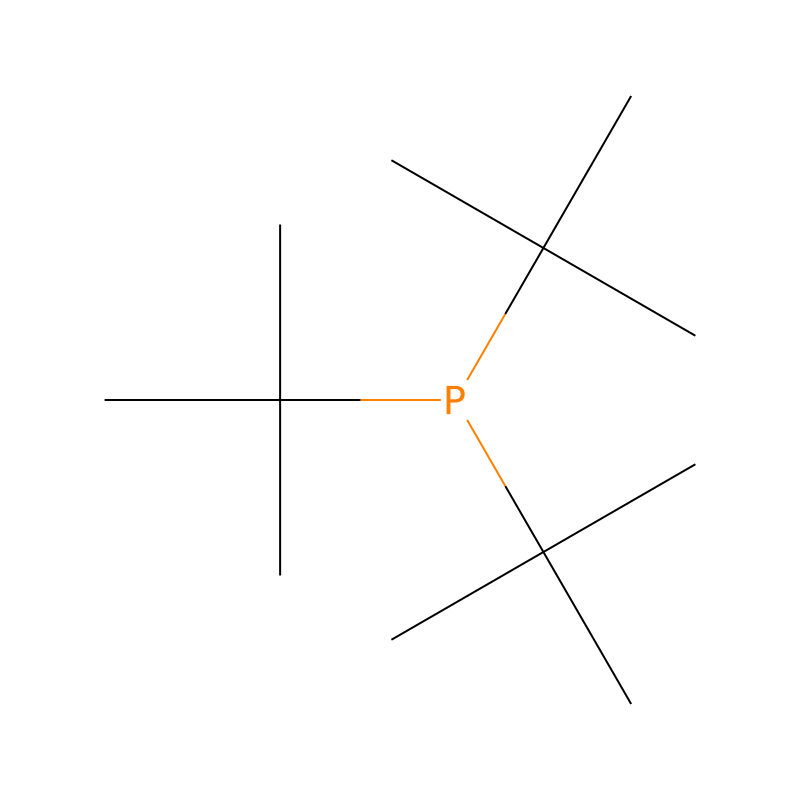
Identifiers & Physical Properties
| CAS No. | 13716-12-6 |
|---|---|
| Molecular formula | C12H27P |
| Average molar mass | 202.32 g/mol |
| Monoisotopic mass | 202.18503749 g/mol |
| SMILES | CC(C)(C)P(C(C)(C)C)C(C)(C)C |
| InChIKey | BWHDROKFUHTORW-UHFFFAOYSA-N |
| PubChem CID | 83681 |
| EC No. | 237-266-4 |
| DTXSID | DTXSID80160090 |
Chemical & Physical Properties
| XLogP | 2.9 |
|---|---|
| Topological polar surface area | 0 |
| Hydrogen bond donors | 0 |
| Hydrogen bond acceptors | 0 |
| Rotatable bonds | 3 |
| Heavy atoms | 13 |
| Formal charge | 0 |
| Complexity | 128 |
| SpringerMaterials Properties | Schoenflies notation |
| Melting point | 30-35 °C(lit.) |
| Boiling point | 102-103 °C13 mm Hg(lit.) |
| Density | 0.861 g/mL at 25 °C |
| Flash point | 1 °F |
| Storage conditions | Flammables area |
| Physical state | solid |
| Specific gravity | 0.68 |
| Solubility | insoluble |
| Sensitivity | Air & Moisture Sensitive |
| Hydrolytic Sensitivity | 9: reacts extremely rapidly with atmospheric moisture - may be pyrophoric - glove box or sealed system required |
| BRN | 1738613 |
| InChI | InChI=1S/C12H27P/c1-10(2,3)13(11(4,5)6)12(7,8)9/h1-9H3 |
| InChIKey | BWHDROKFUHTORW-UHFFFAOYSA-N |
| SMILES | P(C(C)(C)C)(C(C)(C)C)C(C)(C)C |
| CAS DataBase Reference | 13716-12-6(CAS DataBase Reference) |
| NIST Chemistry Reference | Tri-tert-butylphosphine(13716-12-6) |
| UNSPSC Code | 12352128 |
| NACRES | NA.22 |
| GHS pictogram | GHS02,GHS05 |
| Signal word | Danger |
| GHS hazard statements | H250-H314 |
| GHS precautionary statements | P231+P232-P260-P280-P303+P361+P353-P305+P351+P338-P370+P378 |
| Target organs | Respiratory system |
| Hazard symbols | F,C |
| Risk statements (R) | 17-34-67-65-63-48/20-11 |
| Safety statements (S) | 26-45-62-36/37/39-25-43-27-16 |
| UN transport number | UN 2846 4.2/PG 1 |
| Water hazard class (WGK) | 3 |
| F | 10-19-23 |
| Hazard class | 4.2Carc. 2Eye Dam. 1Flam. Liq. 2Pyr. Liq. 1Skin Corr. 1BSTOT SE 3 |
| Packing group | I |
| Customs code | 29319090 |
| Storage class | 4.2 - Pyrophoric and self-heating hazardous materials |
| Excepted quantities | Forbidden |
Safety & Regulations
| GHS classification | DangerH250 (98.2%): Catches fire spontaneously if exposed to air [Danger Pyrophoric liquids]P210, P222, P231, P233, P260, P264, P264+P265, P280, P301+P330+P331, P302+P335+P334, P302+P361+P354, P304+P340, P305+P354+P338, P316, P317, P321, P363, P370+P378, P405, and P501 (click each P-code to see the statement)Aggregated GHS information provided per 57 reports by companies from 6 notifications to the ECHA C&L Inventory. Each notification may be associated with multiple companies. |
|---|---|
| Hazard Classes and Categories | Pyr. Liq. 1 (98.2%) |
| F | 10-19-23 |
| Water hazard class (WGK) | 3 |
| UN transport number | UN 2846 4.2/PG 1 |
| Customs code | 29319090 |
| Risk statements (R) | 17-34-67-65-63-48/20-11 |
| Signal word | Danger |
| GHS pictogram | GHS02,GHS05 |
| Hazard symbols | F,C |
| Safety statements (S) | 26-45-62-36/37/39-25-43-27-16 |
| Hazard class | 4.2Carc. 2Eye Dam. 1Flam. Liq. 2Pyr. Liq. 1Skin Corr. 1BSTOT SE 3 |
| Storage class | 4.2 - Pyrophoric and self-heating hazardous materials |
| Packing group | I |
| Target organs | Respiratory system |
| GHS hazard statements | H250-H314 |
| Excepted quantities | Forbidden |
| GHS precautionary statements | P231+P232-P260-P280-P303+P361+P353-P305+P351+P338-P370+P378 |
Applications & Uses
Uses
Tri-tert-butylphosphine is used primarily in the preparation of mono- and bidentate phosphine ligands in metal complexes for catalytic chiral asymmetric hydrogenations and other asymmetric reactions as well as transition metal coupling reactions. This reagent is also used in the preparation of other phosphines in catalytic polymerization reactions.
Uses
Valuable ligand for several coupling reactions. This product is offered as the THF solution for more convenient handling.