Basic information
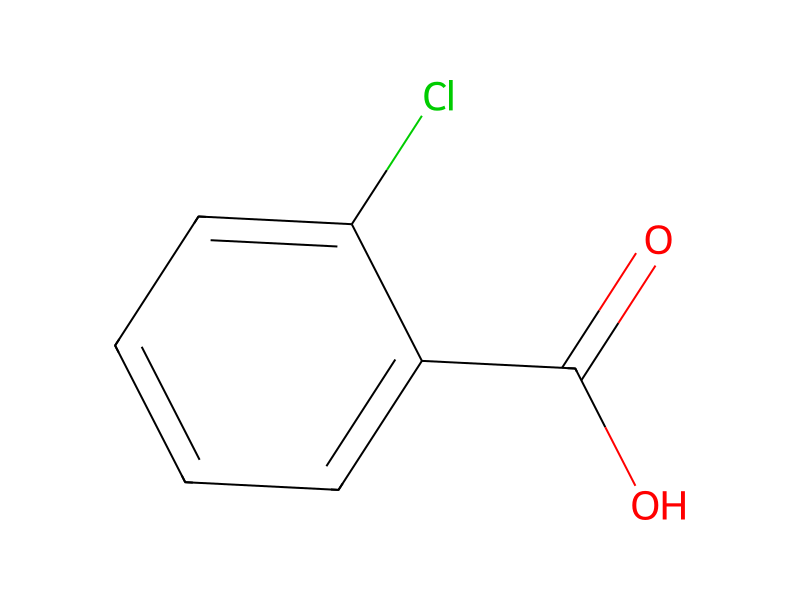
- Standard SMILES
O=C(O)c1ccccc1Cl- InChIKey
IKCLCGXPQILATA-UHFFFAOYSA-N- Molecular formula
- C7H5ClO2
- Average molar mass
- 156.56 g/mol
- Monoisotopic mass
- 155.99780708
Overview
Crystals or fine fluffy white powder. (NTP, 1992)
Names & identifiers
- Preferred name
- 2-Chlorobenzoic Acid
- IUPAC
- 2-chlorobenzoic acid
- English name
- 2-Chlorobenzoic acid
- Molecular formula
- C7H5ClO2
- Molecular weight
- 156.57
Names & synonyms
2-Chlorobenzoic acid118-91-2O-CHLOROBENZOIC ACIDBenzoic acid, 2-chloro-2-CbaBenzoic acid, o-chloro-Kyselina o-chlorbenzoovaDTXSID4024771NSC-15042DTXCID3047718P0867193VCHEBI:30793
Show more names
2-chlorobenzoic2-chlorobenzoate2-Chlorobenzoic acid, 99%NSC 327372-Chlorobenzoiorobenzoic acid
R300100RefChem:855217204-285-4CHLOROBENZOIC ACIDOCBAMFCD00002412Kyselina o-chlorbenzoova [Czech]NSC 15042
Database identifiers
- CAS
118-91-2、26264-09-5- PubChem CID
- 8374
- DTXSID
DTXSID4024771- ChEMBL
CHEMBL115243- ChEBI
CHEBI:30793- UNII
- 8P0867193V
- EC Number
- 204-285-4、247-558-3
- Nikkaji
- J26.900J
Properties
Computed structural properties
- XLogP
- 2.1
- Topological polar surface area
- 37.3 Ų
- Hydrogen bond donors
- 1
- Hydrogen bond acceptors
- 2
- Rotatable bonds
- 1
- Heavy atoms
- 10
- Formal charge
- 0
- Complexity
- 136
Experimental & physicochemical properties
Chemical ClassesOther Classes -> Benzoic Acid Derivatives
SpringerMaterials PropertiesChemical shift
PesticidesEnvironmental transformation -> Pesticide transformation products (metabolite, successor)
LogP
log Kow= 2.05
2.21
Density
1.544 at 68 °F (NTP, 1992) - Denser than water; will sink
1.544 AT 20 °C/4 °C
Color/FormMONOCLINIC PRISMS FROM WATER
Solubility
less than 1 mg/mL at 68 °F (NTP, 1992)
SOL IN 900 PARTS COLD WATER; MORE SOL IN HOT WATER; FREELY SOL IN ALCOHOL, ETHER.
SOL IN ACETONE, BENZENE
SOLUBLE IN METHANOL
2087 mg/l at 25 °C in water
Boiling PointSublimes (NTP, 1992)
Melting Point
288 °F (NTP, 1992)
142 °C
Vapor Pressure
0.00066 [mmHg]
6.6X10⁻⁴ mm Hg at 25 °C (extrapolated)
Physical Description
Crystals or fine fluffy white powder. (NTP, 1992)
Solid; [Merck Index] White powder; [MSDSonline]
Dissociation ConstantsPKA 2.89
Physicochemical properties
- Melting point
- 138 · 138-140 °C (lit.)
- Boiling point
- 285 °C · 285 °C
- Density
- 1.544 · 1.544
- vapor pressure
- 0.001 hPa · 0.001 hPa (25 °C)
- refractive index
- 1.5812 · 1.5812 (estimate)
- Flash point
- 173 °C · 173 °C
- storage temp.
- 30 °C · Store below +30°C.
- solubility
- 900 part · cold water: soluble900 part
- pka
- 2.92 · 2.92(at 25℃)
- form
- Powder
- color
- White to off-white
- PH
- 3.4 · 3.4 (0.2g/l, H2O, 20℃)
- Water Solubility
- soluble in hot water
- Merck
- 14 · 14,2124
- BRN
- 907340 · 907340
- Henry's Law Constant
- 1.5 · 1.5×102 mol/(m3Pa) at 25℃, Duchowicz et al. (2020)
- Stability
- Stable, combustible. Incompatible with strong bases, strong oxidizing agents.
- InChI
- 1S/C7H5ClO2/c8-6-4-2-1-3-5(6)7(9)10/h1-4H,(H,9,10)
- InChIKey
- IKCLCGXPQILATA-UHFFFAOYSA-N
- SMILES
- OC(=O)c1ccccc1Cl
- CAS DataBase Reference
- 118 · 118-91-2(CAS DataBase Reference)
- EWG's Food Scores
- 1 · 1
- FDA UNII
- 8 P0867193V · 8P0867193V
- NIST Chemistry Reference
- 2 · Benzoic acid, 2-chloro-(118-91-2)
- EPA Substance Registry System
- o-Chlorobenzoic acid (118-91-2)
- UNSPSC Code
- 41116107 · 41116107
- NACRES
- 24 · NA.24
- Symbol(GHS)
- 7 · GHS07
- Signal word
- Warning
- Hazard statements
- 315 · H315-H319
- Precautionary statements
- 264 · P264-P280-P302+P352-P305+P351+P338-P332+P313-P337+P313
- Hazard Codes
- Xi
- Risk Statements
- 36 · 36-36/37/38
- Safety Statements
- 26 · 26-37/39
- WGK Germany
- 2 · 2
- RTECS
- 4976000 · DG4976000
- Autoignition Temperature
- 530 °C · 530 °C
- Hazard Note
- Irritant
- TSCA
- TSCA listed
- HS Code
- 29163900 · 29163900
- Storage Class
- 11 · 11 - Combustible Solids
- Hazard Classifications
- 2 Skin · Eye Irrit. 2Skin Irrit. 2
- Hazardous Substances Data
- 118 · 118-91-2(Hazardous Substances Data)
- Toxicity
- 50 orally · LD50 orally in Rabbit: 2465 mg/kg
- REACH Registrations
- Active
Safety & regulation
GHS classification
GHS Classification
Warning
H302 (17.1%): Harmful if swallowed [Warning Acute toxicity, oral]
P261, P264, P264+P265, P270, P271, P280, P301+P317, P302+P352, P304+P340, P305+P351+P338, P319, P321, P330, P332+P317, P337+P317, P362+P364, P403+P233, P405, and P501 (click each P-code to see the statement)
Aggregated GHS information provided per 222 reports by companies from 11 notifications to the ECHA C&L Inventory. Each notification may be associated with multiple companies.
Danger
H302 (100%): Harmful if swallowed [Warning Acute toxicity, oral]
Hazard information
Regulatory Information
Chemical: Benzoic acid, 2-chloro-
Commission Regulation (EC) No 33/2008
Status: Active Update: 09-03-2021 https://echa.europa.eu/registration-dossier/-/registered-dossier/20016
2-Chlorobenzoic acid: Does not have an individual approval but may be used under an appropriate group standard
Fire HazardsFlash point data for this compound are not available; however, it is probably combustible. (NTP, 1992)
Health HazardsSYMPTOMS: Symptoms resulting from exposure to this chemical include skin and eye irritation.
Hazards SummaryA skin, eye, mucous membrane, and upper respiratory tract irritant; [CAMEO] An irritant; [MSDSonline]
Reactive GroupAcids, Carboxylic
Reactivity ProfileO-CHLOROBENZOIC ACID is incompatible with strong oxidizing agents and strong bases. (NTP, 1992)
Atmospheric Standards
This action promulgates standards of performance for equipment leaks of Volatile Organic Compounds (VOC) in the Synthetic Organic Chemical Manufacturing Industry (SOCMI). The intended effect of these standards is to require all newly constructed, modified, and reconstructed SOCMI process units to use the best demonstrated system of continuous emission reduction for equipment leaks of VOC, considering costs, non air quality health and environmental impact and energy requirements. Chlorobenzoic acid is produced, as an intermediate or final product, by process units covered under this subpart. /Chlorobenzoic acid/
Air and Water ReactionsInsoluble in water.
Hazard Classes and CategoriesAcute Tox. 4 (17.1%)
Safety & protection
Fire FightingFires involving this material can be controlled with a dry chemical, carbon dioxide or Halon extinguisher. (NTP, 1992)
First Aid
EYES: First check the victim for contact lenses and remove if present. Flush victim's eyes with water or normal saline solution for 20 to 30 minutes while simultaneously calling a hospital or poison control center. Do not put any ointments, oils, or medication in the victim's eyes without specific instructions from a physician. IMMEDIATELY transport the victim after flushing eyes to a hospital even if no symptoms (such as redness or irritation) develop.
Nonfire Spill Response
SMALL SPILLS AND LEAKAGE: Should a spill occur while you are handling this chemical, FIRST REMOVE ALL SOURCES OF IGNITION, then you should dampen the solid spill material with 60-70% ethanol and transfer the dampened material to a suitable container. Use absorbent paper dampened with 60-70% ethanol to pick up any remaining material. Seal the absorbent paper, and any of your clothes, which may be contaminated, in a vapor-tight plastic bag for eventual disposal. Solvent wash all contaminated surfaces with 60-70% ethanol followed by washing with a soap and water solution. Do not reenter the contaminated area until the Safety Officer (or other responsible person) has verified that the area has been properly cleaned.
Personal Protective Equipment (PPE)
RECOMMENDED RESPIRATOR: Where the neat test chemical is weighed and diluted, wear a NIOSH-approved half face respirator equipped with an organic vapor/acid gas cartridge (specific for organic vapors, HCl, acid gas and SO2) with a dust/mist filter. (NTP, 1992)
Wear rubber gloves, a mask, coveralls, a body shield and self-contained breathing apparatus. /Benzoic acid/
Toxicology
Environmental Fate
TERRESTRIAL FATE: If released to soil, o-chlorobenzoic acid is expected to biodegrade under both aerobic and anaerobic conditions although there may be a lengthy lag period before this process ensues(1-4). Its estimated Henry's Law constant, 3.88X10⁻⁸ atm-cu m/mol(5,SRC), and its extrapolated vapor pressure, 6.6X10⁻⁴ mm Hg at 25 °C(6) indicate that it is not expected to volatilize from either moist or dry soil, respectively, to the atmosphere(SRC). Estimated soil adsorption coefficients of 65 and 310(7-9,SRC) indicate that o-chlorobenzoic acid will display moderate to high mobility in soil(10). The pKa of o-chlorobenzoic acid, 2.89 at 25 °C(11), indicates that it will be found predominately dissociated in moist soil under the typical pH's found in the environment(SRC).
AQUATIC FATE: If released to water, o-chlorobenzoic acid is expected to biodegrade under both aerobic and anaerobic conditions although there may be a lengthy lag period before this process ensues(1,2,3). Its estimated Henry's Law constant, 6.5X10⁻⁸ atm cu m/mol(4,SRC), indicates that it is not expected to significantly volatilize from water to the atmosphere(SRC). The half-life for volatilization from a model river 1 m deep, flowing at 1 m/sec with a wind speed of 3 m/sec is 1180 days(5,SRC). Estimated soil adsorption coefficients of 65 and 310(5,6,7,SRC) indicate that o-chlorobenozic acid will not significantly adsorb to sediment and suspended organic matter(SRC). The pKa of o-chlorobenzoic acid, 2.89 at 25 °C(8), indicates that it will be found predominately dissociated in water under the typical pH's found in the environment(SRC). o-Chlorobenzoic acid may undergo direct photolytic degradation in water(9,SRC).
ATMOSPHERIC FATE: If released to the atmosphere, o-chlorobenzoic acid may undergo a gas-phase reaction with photochemically produced hydroxyl radicals. An estimated rate constant of 5.625X10⁻¹³ cu cm/molec-sec(1,SRC) translates to a half-life of 28.5 days for this process(SRC). The water solubility of o-chlorobenzoic acid, 2087 mg/L at 25 °C(2), indicates that it may undergo atmospheric removal by wet deposition processes(SRC).
Effluent Concentrationso-Chlorobenzoic acid was detected in chlorinated municipal sewage effluent at a concentration of 0.3 ppb(1).
Soil Adsorption/Mobility
Estimated soil adsorption coefficients of 65 and 310(1,SRC) obtained from o-chlorobenzoic acid's water solubility, 2087 mg/L at 25 °C(2), and octanol/water partition coefficient, 2.05(3), respectively, can be obtained using an appropriate regression equation. These values indicate that it will display moderate to high mobility in soil(4).
Natural Pollution Sourceso-Chlorobenzoic acid is an anthropogenic compound and it is not known to occur in nature. (SRC)
Artificial Pollution Sources
o-Chlorobenzoic acid is used as a preservative for glues and paints and as an intermediate in dye, fungicide, saccharin and agricultural chemicals manufacture(1-2). It may be released to the environment as a fugitive emission during its production, formulation or use(SRC). It may also enter the environment as a result of the chlorination of municipal wastewater(3).
Environmental Biodegradation
In a survey of standarized tests, o-chlorobenzoic acid was found to biodegrade in the coupled units test, the Zahn-Wellens test, the MITI test, the Sturm test, the OECD screening test and the trickling filter test but not in the closed bottle test or the AFNOR test(1-4). o-Chlorobenzoic acid was listed as a compound amenable to biodegradation under aerobic conditions(5). o-Chlorobenzoic acid at a concn of 100 mg/L underwent oxidation, as measured by oxygen uptake, when inoculated with microorganisms isolated from soil, compost, or mud obtained from a catalytic cracking plant waste lagoon(6). It underwent 100% removal after 96 hrs when incubated with a mixed microbial seed under aerobic conditions(7). o-Chlorobenzoic acid at a concn of 16 mg/L had a lag perod of 25 days when treated with wastewater sludge supernatant and 14-25 days when inoculated with soil; in the presence of glucose, complete disappearance of 8.4 mg/L o-chlorobenzoic acid was observed within 6 days with the wastewater inoculum(8).
o-Chlorobenzoic acid was found to biodegrade when incubated with an anaerobic river sediment after a lag period of 6 months; the lag period decreased to 2 mos when sediment from a river receiving industrial effluent was used(1). It underwent 16% theoretical gas production after a 14 day lag period when inoculated with a primary digester sludge under anaerobic conditions, time not stated(2). o-Chlorobenzoic acid displayed a 6 day lag period in a continuous flow-through bioreactor using a sewage sludge seed(3). Incubation of o-chlorobenzoic acid with a Niagara silt loam sample required >64 days for disappearance of substrate(4). o-Chlorobenzoic acid was listed as being degradation resistant using the Japanese MITI test(5,6).
Environmental Bioconcentration
Estimated bioconcentration factors of 8 and 21(SRC) obtained from o-chlorobenzoic acid's water solubility, 2087 mg/L at 25 °C(2), and octanol/water partition coefficient, 2.05(3), respectively, can be obtained using a appropriate regression equation. These values indicate that it will not significantly bionconcentrate in fish and aquatic organisms(SRC).
Volatilization from Water/Soil
The extrapolated vapor pressure of o-chlorobenzoic acid, 6.6X10⁻⁴ mm Hg at 25 °C(1) indicates that it is not expected to significantly volatilize from dry soil(SRC). Its estimated Henry's Law constant, 3.88X10⁻⁸ atm cu m/mol(2,SRC), indicates that it will not significantly volatilize from either water or moist soil(SRC). Based on this value, the estimated half-life for volalitilization from a model river 1 m deep, flowing at 1 m/sec and a wind speed of 3 m/sec is 1180 days(3,SRC).
Environmental Abiotic Degradation
IRRADIATION OF O-CHLOROBENZOIC ACID EITHER BY SUNLIGHT OR BY UV LIGHT DID NOT YIELD NEUTRAL OR ALKALINE PRODUCTS.
Laboratory irradiation of o-chlorobenzoic acid in deoxygenated water using a medium pressure mercury lamp produced o-hyroxybenzoic acid and benzoic acid(1). An estimated rate constant for the gas-phase reaction of o-chlorobenzoic acid with photochemically produced hydroxyl radicals of 5.625X10⁻¹³ cu cm/molec/sec(2,SRC)translates to a half-life of 28.5 days(SRC) using an average atmospheric hydroxyl radical concn of 5X10+5 molec/cu cm(2).
Probable Routes of Human Exposure
Occupational exposure to o-chlorobenzoic acid may occur by dermal contact during its production, formulation or use(SRC). Exposure to the general population may occur by ingestion of contaminated drinking water(SRC), as it has been detected in drinking water supplies(1).
Environmental Water ConcentrationsDRINKING WATER: o-Chlorobenzoic acid has been qualitatively detected in U.S. drinking water supplies(1).
Environmental Fate/Exposure Summary
o-Chlorobenzoic acid is an anthropogenic compound which may be released to the environment as a fugitive emission during its production, formulation or use as a perservative and chemical intermediate and may be formed and released during chlorination of wastewater. If released to soil, o-chlorobenzoic acid is expected to biodegrade under both aerobic and anaerobic conditions, although there may be a lengthy lag periods. It is not expected to significantly volatilize from either moist or dry soil to the atmosphere. o-Chlorobenzoic acid is expected to display moderate to high mobility in soil, and it will be found predominately in the dissociated form in moist soil under environmental conditions. If released to water, o-chlorobenzoic acid is expected to biodegrade under both aerobic and anaerobic conditions, although there may be a lengthy lag period. o-Chlorobenzoic acid may undergo direct photolytic degradation in water. It is not expected to significantly volatilize from water to the atmosphere, nor is it expected to significantly adsorb to sediment and suspended organic matter. o-Chlorobenzoic acid will be found predominately in the dissociated form in water under the typical pH's found in the environment. If released to the atmosphere, o-chlorobenzoic acid may undergo a slow gas-phase reaction with photochemically produced hydroxyl radicals with an estimated half-life of 28.5 days. o-Chlorobenzoic acid may also undergo atmospheric removal by wet deposition processes. Occupational exposure to o-chlorobenzoic acid may occur by dermal contact during its production, formulation or use. The general population may be exposed to o-chlorobenzoic acid by the ingestion of contaminated drinking water. (SRC)
Regulatory information
Atmospheric Standards
This action promulgates standards of performance for equipment leaks of Volatile Organic Compounds (VOC) in the Synthetic Organic Chemical Manufacturing Industry (SOCMI). The intended effect of these standards is to require all newly constructed, modified, and reconstructed SOCMI process units to use the best demonstrated system of continuous emission reduction for equipment leaks of VOC, considering costs, non air quality health and environmental impact and energy requirements. Chlorobenzoic acid is produced, as an intermediate or final product, by process units covered under this subpart. /Chlorobenzoic acid/
Safety data
- wgk
- 2
- tsca
- TSCA listed
- rtecs
- DG4976000
- hs_code
- 29163900
- Toxicity
- LD50 orally in Rabbit: 2465 mg/kg
- risk_code
- 36-36/37/38
- Signal word
- Warning
- Symbol(GHS)
- GHS07
- hazard_code
- Xi
- hazard_note
- Irritant
- safety_code
- 26-37/39
- Storage Class
- 11 - Combustible Solids
- Hazard statements
- H315-H319
- REACH Registrations
- Active
- Hazard Classifications
- Eye Irrit. 2Skin Irrit. 2
- Autoignition Temperature
- 530 °C
- Precautionary statements
- P264-P280-P302+P352-P305+P351+P338-P332+P313-P337+P313
- Hazardous Substances Data
- 118-91-2(Hazardous Substances Data)
Chemistry & industry
Pharmacology
Metabolism/MetabolitesYIELDS CATECHOL IN PSEUDOMONAS; YIELDS O-CHLOROBENZOYL-BETA-D-GLUCURONIC ACID & O-CHLOROHIPPURIC ACID IN RABBITS. /FROM TABLE/
Uses & manufacturing
Uses
Used as a preservative (glues and paints) and intermediate (dyes, fungicides, and pharmaceuticals); [HSDB]
Painting (Pigments, Binders, and Biocides) [Category: Paint]
PRESERVATIVE FOR GLUES, PAINTS; INTERMEDIATE IN MFR OF FUNGICIDES & DYES
CHEM INT FOR THIOSALICYLIC ACID
CHEM INT FOR THIORIDAZINE (HUMAN TRANQUILIZER)
CHEM INT FOR 3-CHLORODIPHENYLAMINE
U.S. Imports
(1979) 1.57X10+7 GRAMS (PRINCPL CUSTMS DISTS)
(1981) 4.68X10+7 GRAMS (PRINCPL CUSTMS DISTS)
U.S. Production
(1978) PROBABLY GREATER THAN 2.27X10+6 GRAMS
(1979) PROBABLY GREATER THAN 4.54X10+6 GRAMS
Methods of ManufacturingPREPARED BY POTASSIUM PERMANGANATE OXIDATION OF O-CHLOROTOLUENE
Use ClassificationEnvironmental transformation -> Pesticide transformation products (metabolite, successor)
General Manufacturing InformationBenzoic acid, 2-chloro-: ACTIVE
Applications
Description2-Chlorobenzoic acid is an organic compound with the formula ClC6H4CO2H. It is one of three isomeric chlorobenzoic acids, the one that is the strongest acid. This white solid is used as a precursor to a variety of drugs, food additives, and dyes.
Uses2-Chlorobenzoic acid was used to study the degradation of 2-bromobenzoic acid by Pseudomonas aeruginosa.
UsesThe toxicity of halogenated benzoic acids was found to be directly related to the compound's hydrophobicity. Toxicity and quantitative structure-activity relationships of benzoic acids to Pseudokirchn eriella subcapitata.
UsesPreservative for glues, paints. Intermediate in the manufacture of fungicides and dyes.
General DescriptionCrystals or fine fluffy white powder.
Preparation methods
PreparationIt is prepared by the oxidation of 2-chlorotoluene. The laboratory scale reaction employs potassium permanganate. Alternatively it arises by the hydrolysis of α,α,α-trichloro-2-toluene.The chloride is readily replaced by ammonia to 2-aminobenzoic acid. At elevated temperature it decarboxylates.
Upstream & downstream products
Upstream raw materials
Downstream products
Suppliers50 total
国药集团化学试剂有限公司86-21-63210123 · [email protected]
北京华美互利生物化工010-56205725 · [email protected]
梯希爱(上海)化成工业发展有限公司021-67121386 · [email protected]
衢州润东化工有限公司0570-8789886 18892685668 · [email protected]
上海阿拉丁生化科技股份有限公司400-6206333 13167063860 · [email protected]
武汉格罗丽材料有限公司27-27-59263629 18607197940
上海如吉生物科技发展有限公司+86-21-65211385-8001 36031160 · [email protected]
科瑞迪化学400-821-5857 021-64326257 · [email protected]
上海将来实业股份有限公司400-0066400 13621662912 · [email protected]
Syntechem Co.,Ltd[email protected]
上海迈瑞尔生化科技有限公司4006356688 18621169109 · [email protected]
阿法埃莎(中国)化学有限公司400-6106006 · [email protected]
太原市瑞和丰科贸有限公司+86 351 7031519 · [email protected]
上海德默医药科技有限公司400-021-7337 2355568890 · [email protected]
安耐吉化学&3A(安徽泽升科技股份有限公司)400-0056266 · [email protected]
上海瀚鸿科技股份有限公司021-54306202 13764082696 · [email protected]
上海景颜化工科技有限公司13817811078 · [email protected]
嘉兴市艾森化工有限公司0573-85285100 18627885956 · [email protected]
Pure Chemistry Scientific Inc.001-857-928-2050 or 1-888-588-9418 · [email protected]
BOC Sciences1-631-485-4226; 16314854226 · [email protected]
孝感深远化工有限公司15527621225; 15527621225 · [email protected]
山东西亚化学有限公司13355009207 13355009207 · [email protected]
玛雅试剂+86 (573) 82222445 (0)18006601000 452520369 · [email protected]
四川库利南科技有限公司400-1166-196 18981987031 · [email protected]
天津希恩思生化科技有限公司400 638 7771 · [email protected]
湖南汇百侍生物科技有限公司0731-85526065 13308475853 · [email protected]
南京维奥化工有限公司Please Send Email 18652950785 · [email protected]
河南多贝化工有限公司0370-2785118 17550508557 · [email protected]
斯百全化学(上海)有限公司021-021-021-67601398-809-809-809 15221380277 · [email protected]
艾科试剂4008-755-333 18080918076 · [email protected]
上海思域化工科技有限公司86-21-34053660 · [email protected]
赛默飞世尔科技(中国)有限公司800-810-5118 · [email protected]
北京伊诺凯科技有限公司400-810-7969 010-59572699 · [email protected]
上海特伯化学科技有限公司+86-21-60341587 · [email protected]
TCI AMERICA800-4238616 · [email protected]
TOKYO CHEMICAL INDUSTRY CO., LTD.03-36680489 · [email protected]
TCI Europe320-37350700 · [email protected]
深圳振强药物研发有限公司0755-66853366 13670046396 · [email protected]
深圳康特腾科技有限公司86-0755-86635001 · [email protected]
越林试剂021-62960152 · [email protected]
广州爱纯医药科技有限公司020-39119399 18927568969 · [email protected]
无锡中坤生化科技有限公司+86 0510-85629785
上海皋翔化工有限公司021-57816257 18930243658 · [email protected]
上海倍卓生物科技有限公司021-61119791,13386096464 · [email protected]
上海湄水化工科技有限公司021-60549325 18616193163
上海将来实业股份有限公司400-0066400 13621662912 · [email protected]
上海将来实业股份有限公司021-61552785 · [email protected]
日照力德士化工有限公司010-51268198 · [email protected]
郑州鸿晟医药科技有限公司0371-0371-13526885213 15637198702 · [email protected]
美岚实业(上海)有限公司021-58958189 · [email protected]
Additional notes
DefinitionChEBI: 2-chlorobenzoic acid is a monochlorobenzoic acid having the chloro group at the 2-position. It has a role as a plant hormone and a plant metabolite. It is a monochlorobenzoic acid and a 2-halobenzoic acid. It is a conjugate acid of a 2-chlorobenzoate.
Related reactions
224 records


Linked notes
Loading…