
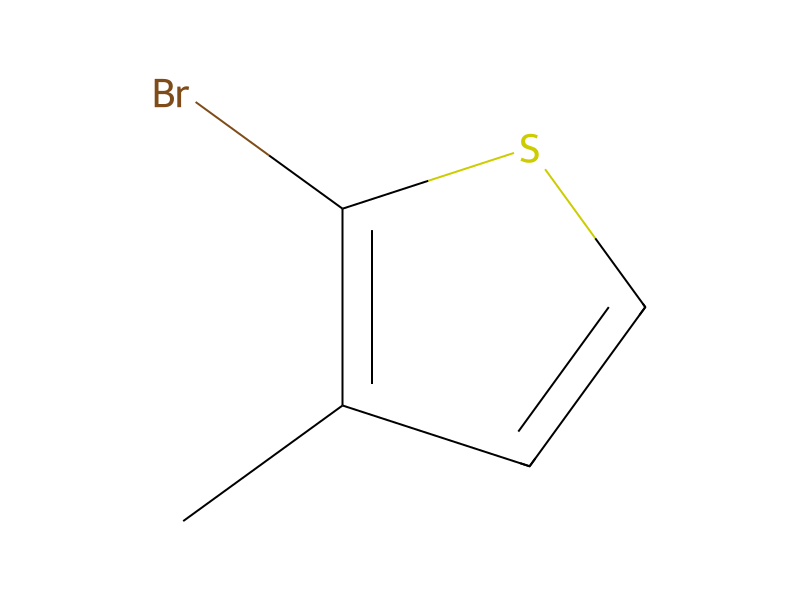
Basic information
- CAS
14282-76-9- Standard SMILES
Cc1ccsc1Br- InChIKey
YYJBWYBULYUKMR-UHFFFAOYSA-N- Molecular formula
- C5H5BrS
- Average molar mass
- 177.06 g/mol
- Monoisotopic mass
- 175.92953326
Names & identifiers
- Preferred name
- 2-Bromo-3-methylthiophene
- IUPAC
- 2-bromo-3-methylthiophene
- English name
- 2-Bromo-3-methylthiophene
- Molecular formula
- C5H5BrS
- Molecular weight
- 177.06
Names & synonyms
2-Bromo-3-methylthiophene14282-76-9Thiophene, 2-bromo-3-methyl-EINECS 238-175-2DTXSID20162194RefChem:85683DTXCID1084685238-175-2YYJBWYBULYUKMR-UHFFFAOYSA-N2-bromo-3-methyl-thiopheneMFCD000597412-Bromo-3-methylthiophene-d3
Show more names
2B3MT178.04TH1-Br2-Bromo-3-methylthio2-bromo-3-methyltiophene3-Methyl-2-bromothiopheneThiophene,2-bromo-3-methyl-2-Bromo-3-methylthiophene>2-Bromo-3-methylthiophene 97%
2-bromo-3-methythiopheneSCHEMBL438162-Bromo-3-methylthiophene #BIDD:GT0358SCHEMBL694060SCHEMBL32865382-Bromo-3-methylthiophene, 95%SBB089226
Database identifiers
- CAS
14282-76-9- PubChem CID
- 84314
- DTXSID
DTXSID20162194- EC Number
- 238-175-2
- Nikkaji
- J149.674C
Properties
Computed structural properties
- XLogP
- 3
- Topological polar surface area
- 28.2 Ų
- Hydrogen bond donors
- 0
- Hydrogen bond acceptors
- 1
- Rotatable bonds
- 0
- Heavy atoms
- 7
- Formal charge
- 0
- Complexity
- 65.1
Experimental & physicochemical properties
SpringerMaterials PropertiesOptical coefficient
Physicochemical properties
- Melting point
- 25 °C · <25 °C
- Boiling point
- 173 · 173-176 °C (lit.)
- Density
- 1.572 g/mL · 1.572 g/mL at 25 °C (lit.)
- refractive index
- 20 · n20/D 1.572(lit.)
- Flash point
- 155 °F · 155 °F
- storage temp.
- 2 · 2-8°C
- Water Solubility
- Insoluble in water
- solubility
- soluble in Chloroform, Ethyl Acetate
- form
- liquid
- color
- Pale yellow
- Specific Gravity
- 1.58 · 1.580
- BRN
- 105719 · 105719
- InChI
- InChI=1S/C5H5BrS/c1-4-2-3-7-5(4)6/h2-3H,1H3
Safety & regulation
GHS classification
GHS Classification
Danger
H302 (97.8%): Harmful if swallowed [Warning Acute toxicity, oral]
P261, P264, P264+P265, P270, P271, P280, P301+P317, P302+P352, P304+P340, P305+P354+P338, P317, P319, P321, P330, P332+P317, P362+P364, P403+P233, P405, and P501 (click each P-code to see the statement)
Aggregated GHS information provided per 46 reports by companies from 4 notifications to the ECHA C&L Inventory. Each notification may be associated with multiple companies.
Hazard information
Hazard Classes and CategoriesAcute Tox. 4 (97.8%)
Safety data
- wgk
- 3
- ridadr
- UN 2810
- hs_code
- 29349990
- risk_code
- 25-41-43-36/37/38-20/21/22
- Signal word
- Danger
- Symbol(GHS)
- GHS05,GHS07
- hazard_code
- T,Xi,Xn
- hazard_note
- Harmful
- safety_code
- 26-36/37/39-45
- hazard_class
- 6.1
- packing_group
- III
- Hazard statements
- H302-H318
- Limited Quantities
- 5.0 L (1.3 gallons) (liquid) or 5.0 kg (11 lbs) (solid)
- Excepted Quantities
- Max Inner Pack (30g or 30ml) and Max Outer Pack (1Kg or 1L)
- Precautionary statements
- P280-P305+P351+P338
Chemistry & industry
Applications
Uses2-Bromo-3-methylthiophene was used in the preparation of poly(3,3′′′-dimethyl-(2,2′:5′,2′:5′,2′′′)tetrathiophene)). It was also used in the preparation of 2-bromo-3-(bromomethyl)thiophene, lachrymatory compound.
General Description2-Bromo-3-methylthiophene is formed (approx. 90%) by bromination of 3-methyl thiophene with N-bromosuccinimide in the absence of benzoyl peroxide.
Preparation methods
Preparation2-Bromo-3-methylthiophene synthesis: To a solution of glacial AcOH (100 mL), acetic anhydride (4.0 g, 0.039 mol), and 3-methylthiophene (9.82 g, 0.100 mol) as a stirred mixture was added NBS (19.6 g, 0.11 mol) in one portion with a slight exotherm to 44 oC. After 20 min the reaction mixture was poured onto ice, neutralized with sodium bisulfite and extracted with ether. The ether layer was washed with water and concentrated to give 11.3 g (64%) of 2-bromo-3-methylthiophene as a tan colored liquid in 88% purity by GC area % analysis: 1H NMR (CDCl3) d 7.1 (d, 1H, J=5.7 Hz), 6.7 (d, 1H, J=5.9 Hz), 2.2 (s, 3H).
Upstream & downstream products
Upstream raw materials
Downstream products
Related reactions
85 records


Compound notes
Loading…