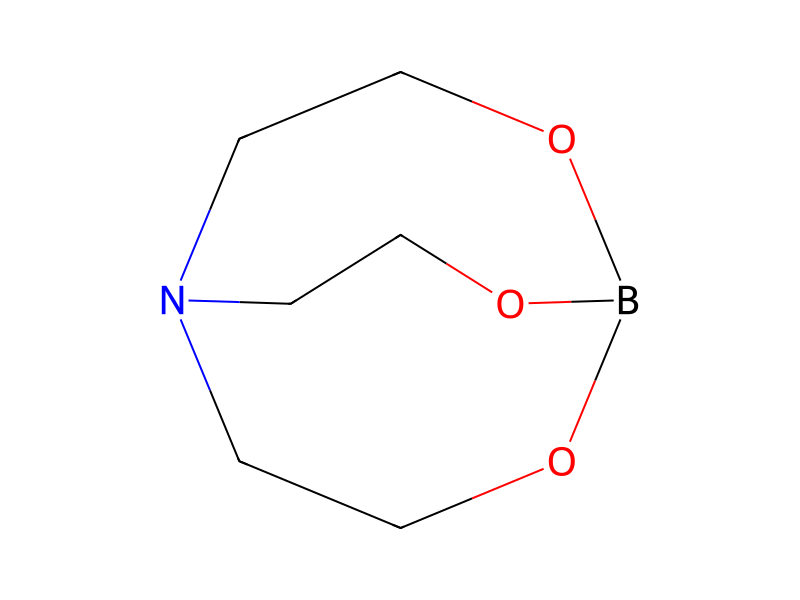
Basic information
- Standard SMILES
C1CN2CCOB(O1)OCC2- InChIKey
NKPKVNRBHXOADG-UHFFFAOYSA-N- Molecular formula
- C6H12BNO3
- Average molar mass
- 156.98 g/mol
- Monoisotopic mass
- 157.09102364
Names & identifiers
- Preferred name
- Triethanolamine borate
- IUPAC
- 2,8,9-trioxa-5-aza-1-borabicyclo[3.3.3]undecane
- English name
- Triethanolamine borate
- Molecular formula
- C6H12BNO3
- Molecular weight
- 156.98
Names & synonyms
Show more names
Database identifiers
- CAS
15277-97-1、283-56-7- PubChem CID
- 84862
- DTXSID
DTXSID701355429- UNII
- 2N1AHN0X56
- EC Number
- 206-003-5、239-317-6
- Nikkaji
- J25F
Properties
Computed structural properties
- Topological polar surface area
- 30.9 Ų
- Hydrogen bond donors
- 0
- Hydrogen bond acceptors
- 4
- Rotatable bonds
- 0
- Heavy atoms
- 11
- Formal charge
- 0
- Complexity
- 111
Physicochemical properties
- Melting point
- 235 · 235-237 °C(lit.)
- Boiling point
- 149.6 · 149.6±39.0 °C(Predicted)
- Density
- 1.13 · 1.13±0.1 g/cm3(Predicted)
- storage temp.
- Room Temperature, under inert atmosphere
- solubility
- slightly soluble in acetone, benzene
- pka
- 6.4 · 6.40±0.20(Predicted)
- form
- Powder
- color
- white
- Odor
- odorless
- BRN
- 774536 · 774536
- InChI
- InChI=1S/C6H12BNO3/c1-4-9-7-10-5-2-8(1)3-6-11-7/h1-6H2
- InChIKey
- NKPKVNRBHXOADG-UHFFFAOYSA-N
- SMILES
- B12OCCN(CCO1)CCO2
- CAS DataBase Reference
- 283 · 283-56-7
- EWG's Food Scores
- 1 · 1
- FDA UNII
- 2 N1AHN0X56 · 2N1AHN0X56
- UNSPSC Code
- 12352103 · 12352103
- NACRES
- 23 · NA.23
- Symbol(GHS)
- 7 · GHS07
- Signal word
- Warning
- Hazard statements
- 315 · H315-H319-H335
- Precautionary statements
- 261 · P261-P264-P271-P280-P302+P352-P305+P351+P338
- target organs
- Respiratory system
- PPE
- 95 · dust mask type N95 (US), Eyeshields, Gloves
- Hazard Codes
- Xi
- Risk Statements
- 36 · 36/37/38
- Safety Statements
- 26 · 26-36/37
- WGK Germany
- 3 · 3
- RTECS
- 8968050 · YJ8968050
- F
- 10 · 10-21
- HS Code
- 29163990 · 29163990
- Storage Class
- 11 · 11 - Combustible Solids
- Hazard Classifications
- 2 Skin · Eye Irrit. 2Skin Irrit. 2STOT SE 3
- Toxicity
- 100 mg/kg · LD ivn-mus: >100 mg/kg EJMCA5 13,207,78
Safety & regulation
GHS classification
GHS Classification
This chemical does not meet GHS hazard criteria for 26.1% (23 of 88) of reports.
Danger
H315 (29.5%): Causes skin irritation [Warning Skin corrosion/irritation]
P261, P264, P264+P265, P271, P280, P302+P352, P304+P340, P305+P351+P338, P305+P354+P338, P317, P319, P321, P332+P317, P337+P317, P362+P364, P403+P233, P405, and P501 (click each P-code to see the statement)
Aggregated GHS information provided per 88 reports by companies from 4 notifications to the ECHA C&L Inventory. Each notification may be associated with multiple companies.
Warning
Hazard information
Hazard Classes and Categories
Skin Irrit. 2 (29.5%)
Skin Irrit. 2 (100%)
Safety data
- F
- 10-21
- PPE
- dust mask type N95 (US), Eyeshields, Gloves
- wgk
- 3
- rtecs
- YJ8968050
- hs_code
- 29163990
- Toxicity
- LD ivn-mus: >100 mg/kg EJMCA5 13,207,78
- risk_code
- 36/37/38
- Signal word
- Warning
- Symbol(GHS)
- GHS07
- hazard_code
- Xi
- safety_code
- 26-36/37
- Storage Class
- 11 - Combustible Solids
- target organs
- Respiratory system
- Hazard statements
- H315-H319-H335
- Hazard Classifications
- Eye Irrit. 2Skin Irrit. 2STOT SE 3
- Precautionary statements
- P261-P264-P271-P280-P302+P352-P305+P351+P338
Chemistry & industry
Uses & manufacturing
Applications
UsesTriethanolamine Borate is an intermediate in the synthesis of Silatrane (S433000) which can be used as a reversible cholinesterase inhibitor. Silatrane and its derivatives can also be used as antitumor agents.
General DescriptionTriethanolamine borate can be formed from the 1:1 aqueous solution of boric acid and triethanolamine. It is used as buffer.
Preparation methods
Preparationtriethanolamine borate synthesis: Adding trimethyl borate into the reaction bottle62.7g (0.6mol), 74.6g (0.5mol) of triethanolamine and 300g of toluene are slowly heated to reflux for 1 hour at room temperature, then distillate is distilled out under normal pressure (65-100°C) while reaction is carried out, sampling is carried out by GC detection, after the reaction is finished, reduced pressure concentration is carried out until no liquid distillation is carried out, acetonitrile is added for recrystallization, filtration and drying are carried out, 68g of white solid is obtained, HPLC (high performance liquid chromatography) is 98.8%, and the yield is 86.6%.
Upstream & downstream products
Upstream raw materials
Downstream products
Suppliers50 total
Related reactions
No reaction records under the current filter.
Linked notes
Loading…