
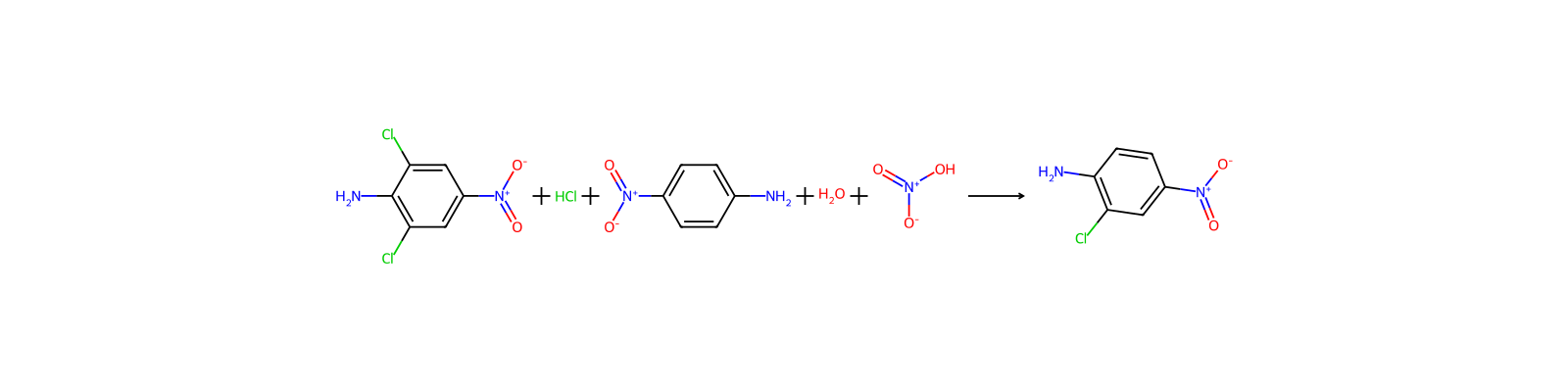
HRID 46494As reactant

121-87-9Nc1ccc([N+](=O)[O-])cc1ClLOCWBQIWHWIRGN-UHFFFAOYSA-N2-chloro-4-nitroaniline is a yellow crystalline powder. (NTP, 1992)
121-87-9DTXSID4021973CHEMBL1893710Nitrogen Compounds -> Nitroanilines
Textile
log Kow = 2.14
2.14
Very soluble in ether, ethanol, acetic acid
Soluble in alcohol, benzene, ether; slightly soluble in water and strong acids
205 °C
Flash point = 205 °C
225 to 228 °F (NTP, 1992)
108 °C
Safety information is for reference only and does not replace the supplier’s Safety Data Sheet (SDS), applicable regulations, or professional assessment.
Warning
H302: Harmful if swallowed [Warning Acute toxicity, oral]
P264, P270, P273, P301+P317, P330, P391, and P501 (click each P-code to see the statement)
Warning
H302 (55.6%): Harmful if swallowed [Warning Acute toxicity, oral]
P264, P270, P273, P280, P301+P317, P302+P352, P317, P321, P330, P362+P364, P391, and P501 (click each P-code to see the statement)
Chemical: Benzenamine, 2-chloro-4-nitro-
REACH registered substance: 2-chloro-4-nitroaniline (EC: 204-502-2)
2-Chloro-4-nitroaniline: Does not have an individual approval but may be used under an appropriate group standard
General anesthetic effect in lethal-dose feeding studies of guinea pigs; [RTECS] Emergency treatment: Methemoglobinemia; [HSDB] Toxic by ingestion and inhalation. [Hawley] A mild skin irritant; Can induce methemoglobinemia; [ICSC] An irritant; May induce methemoglobinemia; [MSDSonline]
European Chemicals Bureau; IUCLID Dataset, 2-Chloro-4-nitroaniline (CAS # 121-87-9) . Describes information supplied to the EU by European industries as of 2000. Available from the Database Query page at: http://ecb.jrc.it/esis/esis.php as of October 1, 2007.
Used to make dyes and the molluscicide Niclodamide; [HSDB] Used in organic synthesis (paints, lacquers, and varnishes industry); [IUCLID]
Painting (Pigments, Binders, and Biocides) [Category: Paint]
Intermediate in manufacture of dyes.
... A diazo component in disperse dyes (e.g., C.I. Disperse Red 65) for polyester or in modified basic dyes (e.g., C.I. Basic Red 18) for acrylic fibers.
... In the manufacture of the molluscicide Niclodamide
UsesIntermediate in manufacture of dyes.
General DescriptionYellow crystalline powder.





2-chloro-4-nitroaniline is a yellow crystalline powder. (NTP, 1992)
Yellow solid; [Hawley] Yellow powder; [MSDSonline]
Pursuant to section 8(d) of TSCA, EPA promulgated a model Health and Safety Data Reporting Rule. The section 8(d) model rule requires manufacturers, importers, and processors of listed chemical substances and mixtures to submit to EPA copies and lists of unpublished health and safety studies. Benzenamine, 2-chloro-4-nitro- is included on this list.
Acute Tox. 4 (55.6%)
Acute toxicity - category 4
Hazardous to the aquatic environment (Acute) - Category 2
Acute Tox. 4 *
EYES: First check the victim for contact lenses and remove if present. Flush victim's eyes with water or normal saline solution for 20 to 30 minutes while simultaneously calling a hospital or poison control center. Do not put any ointments, oils, or medication in the victim's eyes without specific instructions from a physician. IMMEDIATELY transport the victim after flushing eyes to a hospital even if no symptoms (such as redness or irritation) develop.
Sweep spilled substance into containers; if appropriate, moisten first to prevent dusting. Carefully collect remainder, then remove to safe place. (Extra personal protection: P2 filter respirator for harmful particles). Do NOT let this chemical enter the environment.
SMALL SPILLS AND LEAKAGE: If you spill this chemical, use absorbent paper to pick up all liquid spill material. Your contaminated clothing and absorbent paper should be sealed in a vapor-tight plastic bag for eventual disposal. Solvent wash all contaminated surfaces with alcohol followed by washing with a strong soap and water solution. Do not reenter the contaminated area until the Safety Officer (or other responsible person) has verified that the area has been properly cleaned.
SRP: The most favorable course of action is to use an alternative chemical product with less inherent propensity for occupational exposure or environmental contamination. Recycle any unused portion of the material for its approved use or return it to the manufacturer or supplier. Ultimate disposal of the chemical must consider: the material's impact on air quality; potential migration in soil or water; effects on animal, aquatic, and plant life; and conformance with environmental and public health regulations.
MINIMUM PROTECTIVE CLOTHING: When working with this chemical, you should wear an impervious full-body suit equipped with an air line respirator or a self-contained breathing apparatus.
Local exhaust or breathing protection. Protective gloves. Safety spectacles.
EC50 Daphnia magna (/water flea/) 10-18 mg/L/48 hr; immobilization.
EC50 Scenedesmus pannonicus (algae) 12 mg/L/96 hr; growth rate.
LC50 Chaetogammarus marinus (aquatic arthropod) 7.1 mg/L/96 hr. /Conditions of bioassay not specified/
LC50 Poecilia reticulata (/guppy/) 24 mg/L/96 hr; static, freshwater.
For more Ecotoxicity Values (Complete) data for 1-AMINO-2-CHLORO-4-NITROBENZENE (11 total), please visit the HSDB record page.
TERRESTRIAL FATE: Based on a classification scheme(1), an estimated Koc value of 350(SRC), determined from a log Kow of 2.14(2) and a regression-derived equation(3), indicates that 2-chloro-4-nitroaniline is expected to have moderate mobility in soil(SRC). Volatilization of 2-chloro-4-nitroaniline from moist soil surfaces is not expected to be an important fate process(SRC) given a Henry's Law constant of 9.5X10⁻⁹ atm-cu m/mole(4). 2-Chloro-4-nitroaniline is not expected to volatilize from dry soil surfaces(SRC) based upon an estimated vapor pressure of 4.8X10⁻⁴ mm Hg(SRC), determined from a fragment constant method(5). 2-Chloro-4-nitroaniline is regarded as non-biodegradable in the aquatic environment as well as in communal and industrial sewage treatment plants(6); therefore, biodegradation is not an important environmental fate process in soil(SRC).
AQUATIC FATE: Based on a classification scheme(1), an estimated Koc value of 350(SRC), determined from a log Kow of 2.14(2) and a regression-derived equation(3), indicates that 2-chloro-4-nitroaniline is expected to adsorb to suspended solids and sediment(SRC). Volatilization from water surfaces is not expected(3) based upon a Henry's Law constant of 9.5X10⁻⁹ atm-cu m/mole(4). The stability of 2-chloro-4-nitroaniline in standardized aqueous medium was monitored at room temperature; a 12% loss of 2-chloro-4-nitroaniline was noted over a 8 day period due to either volatilization or abiotic transformation of this compound(5). According to a classification scheme(6), an estimated BCF of 9(SRC), from its log Kow(2) and a regression-derived equation(7), suggests the potential for bioconcentration in aquatic organisms is low(SRC). 2-Chloro-4-nitroaniline is regarded as non-biodegradable in the aquatic environment as well as in communal and industrial sewage treatment plants(8); therefore, biodegradation is not an important environmental fate process in water(SRC).
ATMOSPHERIC FATE: According to a model of gas/particle partitioning of semivolatile organic compounds in the atmosphere(1), 2-chloro-4-nitroaniline, which has an estimated vapor pressure of 4.8X10⁻⁴ mm Hg at 25 °C(SRC), determined from a fragment constant method(2), is expected to exist solely as a vapor in the ambient atmosphere. Vapor-phase 2-chloro-4-nitroaniline is degraded in the atmosphere by reaction with photochemically-produced hydroxyl radicals(SRC); the half-life for this reaction in air is estimated to be 4 days(SRC), calculated from its rate constant of 3.9X10⁻¹² cu cm/molecule-sec at 25 °C(SRC) that was derived using a structure estimation method(3). 2-Chloro-4-nitroaniline contains chromophores that absorb at wavelengths >290 nm(4) and therefore may be susceptible to direct photolysis by sunlight(SRC).
/AQUATIC SPECIES/ The Dreissena-Monitor is a biological early warning system for the continuous monitoring of river water quality, based on the valve movements of two groups of 42 zebra mussels (Dreissena polymorpha). Laboratory experiments with ... 2-chloro-4-nitro-aniline were conducted in combination with suspended particles (a mixture of stinging nettle powder, bentonite, and quartz powder). An increase of suspended particles up to a nominal concentration of 540 mg/L within 5 min did not evoke any reactions by the mussels significantly different from normal. The distribution between water and solids was analyzed for ... 2-chloro-4-nitroaniline, with the result that /it/ ... did not bind to the particles at all. The behavior of the zebra mussels revealed that the detection of 2-chloro-4-nitro-aniline was not affected by the presence of suspended matter. ...
The Koc of 2-chloro-4-nitroaniline is estimated as 350(SRC), using a log Kow of 2.14(1) and a regression-derived equation(2). According to a classification scheme(3), this estimated Koc value suggests that 2-chloro-4-nitroaniline is expected to moderate mobility in soil. However, anilines are expected to bind strongly to humus or organic matter in soils due to the high reactivity of the aromatic amino group(4,5), suggesting that mobility may be much lower in some soils(SRC). The log Koc of 2-chloro-4-nitroaniline was measured as 2.36 in Yangtze river sediment (37.1% sand, 49.3% silt, 13.6% clay, 1.28% organic carbon, pH 7.44)(1). The log Koc was also measured as 3.63 in modified clay(6). These values correspond to Koc values of 230 and 4300, respectively(SRC).
2-Chloro-4-nitroaniline's production and use as an intermediate in the manufacture of both disperse and basic dyes(1,2) and in the manufacture of niclosamid, a molluscicide(3), may result in its release to the environment through various waste streams(SRC).
AEROBIC: The biodegradability of 2-chloro-4-nitroaniline was measured using both the semistatic OECD test and the dynamic system, Pitter test. 2-Chloro-4-nitroaniline is considered non-biodegradable (half-life of much greater than 4 weeks) using both non-adapted and adapted inoculum for both tests(1). Using a modification of the Pitter test where the first step is an acclimation of a mixed microbial population to 2-chloro-4-nitroaniline (at 25 mg/L) in a semi-continuous activated sludge system followed by a die-away test in closed flasks, only a slight amount of degradation occurred. The initial inoculum was a 1:1 mixture of activated sludge from a domestic sewage plant and a solution containing organic material extracted from river mud. In the semi-continuous activated sludge system, 80% of the added 2-chloro-4-nitroaniline was still present after 17 days using both the mixed inoculum and an activated sewage sludge(2). 2-Chloro-4-nitroaniline is regarded as non-biodegradable in the aquatic environment as well as in communal and industrial sewage treatment plants(2).
2-Chloro-4-nitroaniline is used in the manufacture of the molluscicide niclosamide(1). Degradation of (14)C-labeled niclosamide was studied in river and pond sediments (water:sediment ratio is 10-20:1) incubated under aerobic and anaerobic conditions over a 128 day period at 25 °C. Niclosamide degraded rapidly under these conditions with a half-life of 1.1 to 3.9 days in sediment; 1-amino-2-chloro-4-nitrobenzene, a hydrolytic product of niclosamide, was detected at concentrations of 1.8 ug (aerobic river sediment), 10.6 ug (aerobic pond sediment), 13.6 (anaerobic river sediment) and 25.6 ug (anaerobic pond sediment), following 32 days exposure to C-14 labelled niclosamide at a concentration of 1ug/mL in the overlying water; 2-chloro-4-nitraniline concentration in all samples was <1.0 ug after 93 days(2).
An estimated BCF of 9 was calculated in fish for 2-chloro-4-nitroaniline(SRC), using a log Kow of 2.14(1) and a regression-derived equation(2). According to a classification scheme(3), this BCF suggests the potential for bioconcentration in aquatic organisms is low(SRC).
The Henry's Law constant for 2-chloro-4-nitroaniline is 9.5X10⁻⁹ atm-cu m/mole(1). This Henry's Law constant indicates that 2-chloro-4-nitroaniline is expected to be essentially nonvolatile from water surfaces(2). 2-Chloro-4-nitroaniline is not expected to volatilize from dry soil surfaces(SRC) based upon an estimated vapor pressure of 4.8X10⁻⁴ mm Hg(SRC), determined from a fragment constant method(3).
/LABORATORY ANIMALS: Acute Exposure/ Not sensitizing /to/ guinea pigs.
/LABORATORY ANIMALS: Acute Exposure/ Slightly irritating /to eyes of/ rabbit.
/LABORATORY ANIMALS: Subchronic or Prechronic Exposure/ When admin orally to rats @ 0.1-0.2 LD50 for 30 days, o-chloro-p-nitroaniline caused transformation of hemoglobin into methemoglobin, nitrosylhemoglobin, and sulfhemoglobin, in addition to decreases in oxyhemoglobin, but total level of hemoglobin remained unchanged.
/ALTERNATIVE and IN VITRO TESTS/ The toxicity of 4-chloro-2-nitroaniline (4C2NA) and 2-chloro-4-nitroaniline (2C4NA) was investigated on isolated rat hepatocytes following 1-3 hours of exposure to 0.2 and/or 2 mM of these xenobiotics. The higher of the two concentrations appeared to induce a statistically significant loss of cellular viability (p less than 0.01 compared to control), judged by Trypan Blue staining, after 3 hours of incubation with these substances means = 58, SD = 7%; and means = SD = 7%; for 4C2NA and 2C4NA, respectively). Furthermore, both chloronitroanilines produced an hepatocellular and microsomal damage demonstrated by conspicuous changes in LDH and G-6-Pase activities (p < 0.01). The exposure to 2 mM of both 4C2NA and/or 2C4NA produced a marked depletion of the intracellular pool of GSH after 3 hours (13 mM/10+6 and 10 mM/10+6 cells, respectively; p < 0.01). ...
For more Non-Human Toxicity Excerpts (Complete) data for 1-AMINO-2-CHLORO-4-NITROBENZENE (7 total), please visit the HSDB record page.
Pursuant to section 8(d) of TSCA, EPA promulgated a model Health and Safety Data Reporting Rule. The section 8(d) model rule requires manufacturers, importers, and processors of listed chemical substances and mixtures to submit to EPA copies and lists of unpublished health and safety studies. Benzenamine, 2-chloro-4-nitro- is included on this list.