
Hepps
Completing data — refresh the page later to see the latest
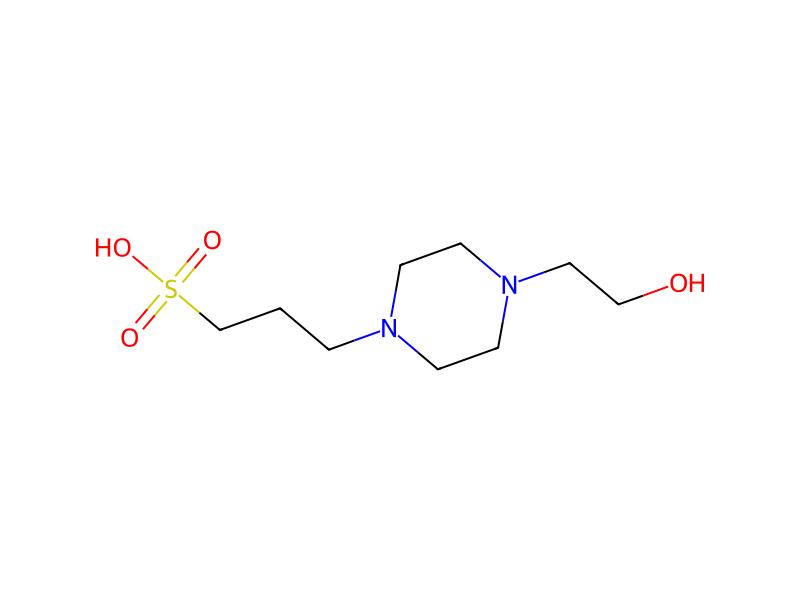
Basic information
- CAS
16052-06-5- Standard SMILES
O=S(=O)(O)CCCN1CCN(CCO)CC1- InChIKey
OWXMKDGYPWMGEB-UHFFFAOYSA-N- Molecular formula
- C9H20N2O4S
- Average molar mass
- 252.33 g/mol
- Monoisotopic mass
- 252.11437812
Overview
HEPPS is a N-(2-hydroxyethyl)piperazine and a N-(sulfoalkyl)piperazine.
Names & identifiers
- Preferred name
- Hepps
- IUPAC
- 3-[4-(2-hydroxyethyl)piperazin-1-yl]propane-1-sulfonic acid
- English name
- HEPPS
- Molecular formula
- C9H20N2O4S
- Molecular weight
- 252.33
Names & synonyms
Hepps16052-06-53-(4-(2-Hydroxyethyl)piperazin-1-yl)propane-1-sulfonic acid1-Piperazinepropanesulfonic acid, 4-(2-hydroxyethyl)-3-[4-(2-HYDROXYETHYL)PIPERAZIN-1-YL]PROPANE-1-SULFONIC ACID3-[4-(2-Hydroxyethyl)-1-piperazinyl]propanesulfonic AcidN-(2-Hydroxyethyl)piperazine-N'-(3-propanesulfonic acid)4-(2-Hydroxyethyl)piperazine-1-propanesulfonic acidEINECS 240-198-88JN5PQW99CBRN 3957385N-2-Hydroxyethylpiperazine-N'-3-propanesulfonic acid
Show more names
EPPS4-(2-HYDROXYETHYL)-1-PIPERAZINEPROPANESULFONIC ACIDHEPEaEPPSEPPS,99%HEPPS(EPPS)HEPPS BufferEPPS USP/EP/BPEPPS SIGMAULTRA
DTXSID3066003CHEBI:42298N-(2-Hydroxyethyl)-1-piperazinepropanesulfonic acidN-2-Hydroxyethylpiperazine-N-3-propanesulfonic acid4-(2-Hydroxyethyl)piperazine-1-propane-3-sulfonic acid3-(4-(2-Hydroxyethyl)-1-piperazinyl)propanesulfonic acidRefChem:145584DTXCID5035169
Database identifiers
- CAS
16052-06-5- PubChem CID
- 85255
- DTXSID
DTXSID3066003- ChEBI
CHEBI:42298- UNII
- 8JN5PQW99C
- EC Number
- 240-198-8
- Nikkaji
- J219.951C
Properties
Computed structural propertiesFilling in
- XLogP
- -3.6
- Topological polar surface area
- 89.5 Ų
- Hydrogen bond donors
- 2
- Hydrogen bond acceptors
- 6
- Rotatable bonds
- 6
- Heavy atoms
- 16
- Formal charge
- 0
- Complexity
- 280
Experimental & physicochemical properties
Chemical ClassesNitrogen Compounds -> Piperazines
Physical DescriptionBeige powder; [Sigma-Aldrich MSDS]
Physicochemical properties
- Melting point
- 237 · 237-239 °C(lit.)
- Density
- 1.2684 · 1.2684 (rough estimate)
- refractive index
- 1.68 · 1.6800 (estimate)
- storage temp.
- Sealed in dry,Room Temperature
- solubility
- 2 O: · H2O: 1 M at 20 °C, clear, colorless
- form
- Powder/Solid
- color
- White
- PH
- 5 · 5.0-6.5 (25℃, 0.1M in H2O)
- pka
- 8 · 8.0(at 25℃)
- PH Range
- 7.3 · 7.3 - 8.7
- Water Solubility
- 25.2 g/L · Soluble in water. 25.2 g/L (20°C)
Safety & regulation
Safety information is for reference only and does not replace the supplier’s Safety Data Sheet (SDS), applicable regulations, or professional assessment.
GHS classification
GHS Classification
This chemical does not meet GHS hazard criteria for 94.2% (65 of 69) of all reports.
Not Classified
Aggregated GHS information provided per 69 reports by companies from 6 notifications to the ECHA C&L Inventory.
Hazard information
Regulatory Information
Chemical: 1-Piperazinepropanesulfonic acid, 4-(2-hydroxyethyl)-
Status: Active Update: 09-09-2021 https://echa.europa.eu/registration-dossier/-/registered-dossier/32799
1-Piperazinepropanesulphonic acid, 4-(2-hydroxyethyl)-: Does not have an individual approval but may be used under an appropriate group standard
Hazards SummaryOral LD50 (quail) > 316 mg/kg; [RTECS] An eye irritant; [Sigma-Aldrich MSDS] See Piperazine and salts. See HEPES.
Hazard Classes and CategoriesNot Classified
Safety data
- PPE
- Eyeshields, Gloves, type N95 (US)
- wgk
- 3
- tsca
- TSCA listed
- rtecs
- TM2649130
- hs_code
- 29335995
- Toxicity
- quail,LD50,oral,> 316mg/kg (316mg/kg),Ecotoxicology and Environmental Safety. Vol. 6, Pg. 149, 1982.
- risk_code
- 36/37/38-22
- Signal word
- Warning
- Symbol(GHS)
- GHS07
- hazard_code
- Xi
Chemistry & industry
Uses & manufacturing
General Manufacturing Information1-Piperazinepropanesulfonic acid, 4-(2-hydroxyethyl)-: ACTIVE
Applications
UsesHEPPS (EPPS) is a commonly used Good's buffer. It is often used as separator in ultrathin isoelectric focusing gels and enhances the resolution of phosphoglucomutase. It is used as a buffering agent in biology and biochemistry. HEPPS is a biological buffer with a useful pH range of 7.3-8.7 and a pKa=8.0 at 25°C. Research on mice with Alzheimer's disease-like amyloid beta plaques has shown that HEPPS can cause the plaques to break up, reversing some of the symptoms in the mice. HEPPS was reported to dissociate amyloid beta oligomers in patients' plasma samples enabling blood diagnosis of Alzheimer's disease.
General DescriptionHEPPS, or N-(2-Hydroxyethyl)piperazine-N′-(3-propanesulfonic acid), is a zwitterionic buffering agent commonly used in biochemical and molecular biology research. Its mechanism of action is rooted in its ability to maintain a stable pH environment, which is crucial for various enzymatic reactions and protein studies. HEPPS is especially favoured for its buffering capacity in the physiological pH range, typically between pH 6.8 and 8.2, making it ideal for biological assays and cell culture experiments. This compound is extensively utilized in preparing cell culture media, where maintaining a consistent pH is essential for cell viability and growth. Additionally, HEPPS is employed in biochemical assays, such as enzyme kinetics studies, where precise pH control is necessary to accurately measure enzymatic activity. Furthermore, HEPPS has found applications in molecular biology techniques, including nucleic acid purification, PCR (polymerase chain reaction), and protein analysis by SDS-PAGE (sodium dodecyl sulfate polyacrylamide gel electrophoresis). Its compatibility with various biological systems and stability under physiological conditions make HEPPS a valuable tool in research laboratories for maintaining optimal pH conditions and ensuring reliable experimental outcomes in various biochemical and molecular biology studies.
Additional notes
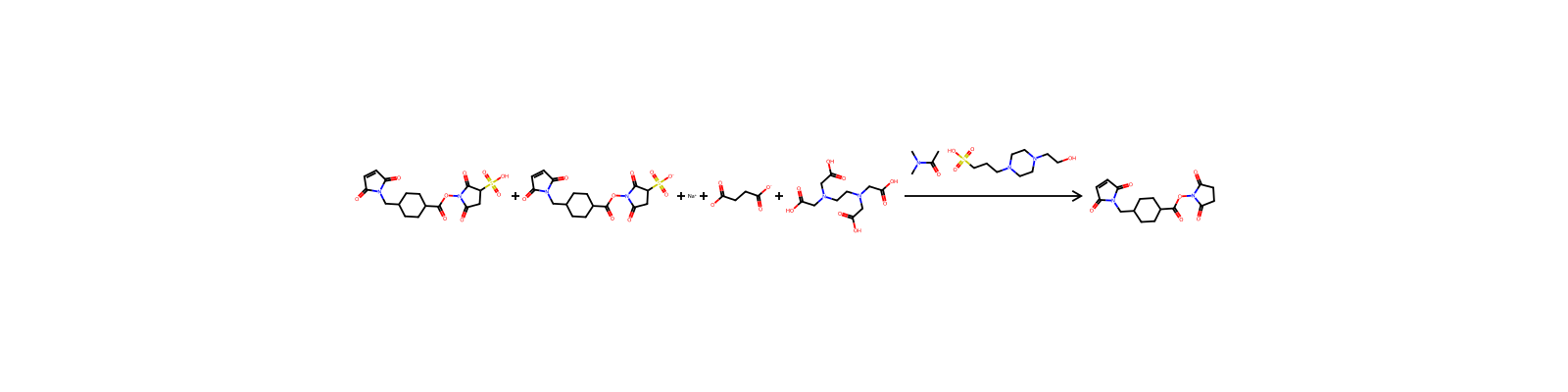
Related reactions
4 records


Compound notes
Loading…