Narceine
NARCEINE · NARCEIN · CI 15511 · NIH 10760 · henyl)acetyl)- · CI 15511,Narceine · Narceine (base and/or unspecified salts) · 4-(methylenedioxy)phenyl)acetyl)-6-((6-(2-(dimethylamino)ethyl)-2-methoxy-
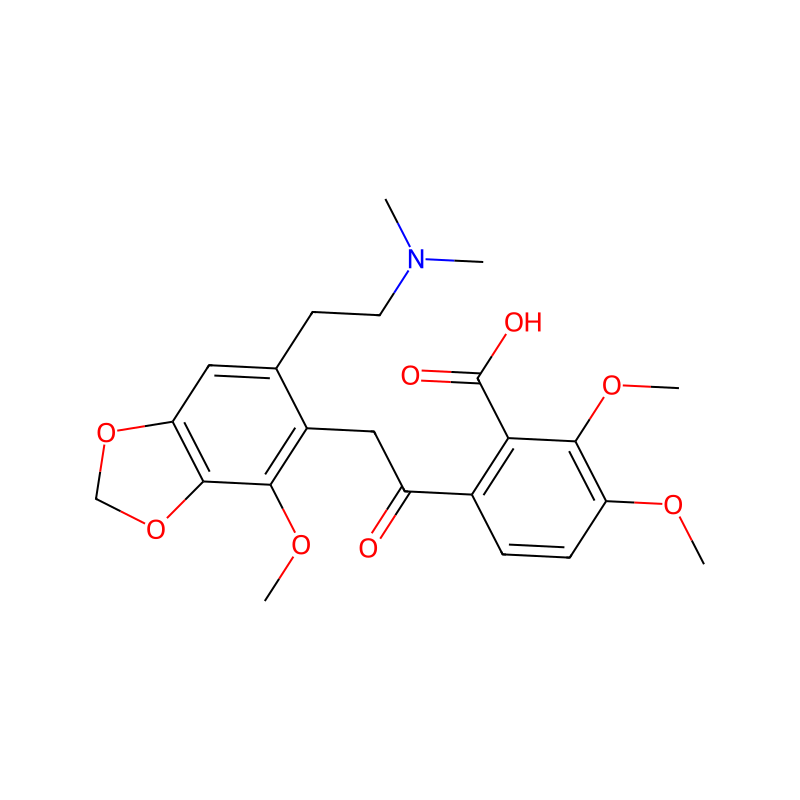
Identifiers & Physical Properties
| CAS No. | 131-28-2 |
|---|---|
| Molecular formula | C23H27NO8 |
| Average molar mass | 445.5 g/mol |
| Monoisotopic mass | 445.17366682 g/mol |
| SMILES | COc1ccc(C(=O)Cc2c(CCN(C)C)cc3c(c2OC)OCO3)c(C(=O)O)c1OC |
| InChIKey | DEXMFYZAHXMZNM-UHFFFAOYSA-N |
| PubChem CID | 8564 |
| ChEMBL | CHEMBL486305 |
| ChEBI | CHEBI:7480 |
| EC No. | 205-021-0 |
| DTXSID | DTXSID40156833 |
Chemical & Physical Properties
| XLogP | 0.5 |
|---|---|
| Topological polar surface area | 104 |
| Hydrogen bond donors | 1 |
| Hydrogen bond acceptors | 9 |
| Rotatable bonds | 10 |
| Heavy atoms | 32 |
| Formal charge | 0 |
| Complexity | 643 |
| Drugs | DEA NFLIS-Drug Category -> Narcotics |
| Solubility | 0.78 mg/mL at 13 °C579.1mg/L(15 ºC) |
| Melting point | 145 °C138°mp 176° |
| Physical Description | Solid |
| Boiling point | 555.14°C (rough estimate) |
| Density | 1.3285 (rough estimate) |
| Refractive index | 1.5614 (estimate) |
| pKa (acidity coefficient) | pKb (20°) = 10.7, pKa = 9.3 |
| CAS DataBase Reference | 131-28-2 |
| FDA UNII | CTT09X2F1M |
Safety & Regulations
| GHS classification | WarningH302 (100%): Harmful if swallowed [Warning Acute toxicity, oral]P261, P264, P264+P265, P270, P271, P280, P301+P317, P302+P352, P304+P340, P305+P351+P338, P319, P321, P330, P332+P317, P337+P317, P362+P364, P403+P233, P405, and P501 (click each P-code to see the statement)Aggregated GHS information provided per 13 reports by companies from 1 notifications to the ECHA C&L Inventory. Each notification may be associated with multiple companies. |
|---|---|
| Hazard Classes and Categories | Acute Tox. 4 (100%) |
Applications & Uses
Description
An alkaloid of opium (Papaver somniferum) was first isolated by Pelletier in 1832 but not characterized until some years later by Couerbe and Anderson, the latter assigning to it the formula C23H2909N which was accepted until Freund showed that it contains H20 of crystallization. The base remains in the mother liquors after removal of the major alkaloids. It forms slender, colourless needles or prisms of the trihydrate, m.p. 170°C. It is optically inactive and dissolves readily in alkalies forming metallic derivatives. It behaves as a weak, monoacidic base forming well-crystallized salts. The hydrochloride crystallizes with 5.5 H20 from cold, dilute HCI, or as the trihydrate from hot solutions. From MeOH it yields crystals with 1 mole of solvent, m.p. 190-2°C. The aurichloride forms reddish-yellow needles, m.p. 130°C and the picrate has m.p. 195°C. With chlorine water, followed by the addition of ammonia, it gives a characteristic blood-red colour while with dilute iodine solution, the solid alkaloid develops a blue colour. With ethyl nitrite, narceine forms an oximino derivative which, on exhaustive methylation, furnishes trimethylamine, hemipinic acid and 2-cyano-3- methoxy-4: s-methylenedioxy-1-vinylbenzene.
Uses
Narceine (Narcein), a quinolone derivative, is an opium alkaloid with anti-diabetic property[1][2].