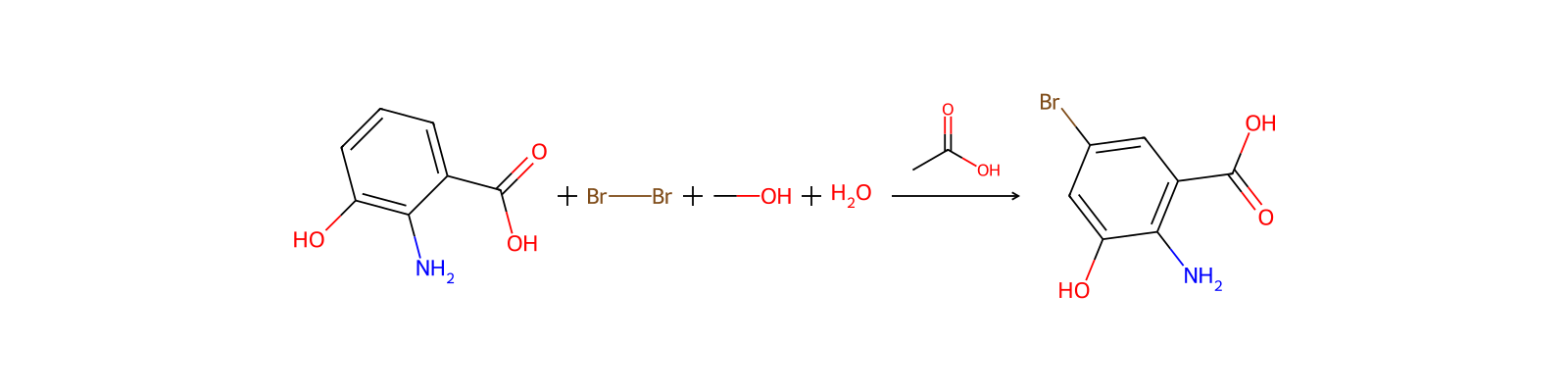
3-Hydroxyanthranilic Acid
HCID 86

Basic information
- CAS
548-93-6- Standard SMILES
Nc1c(O)cccc1C(=O)O- InChIKey
WJXSWCUQABXPFS-UHFFFAOYSA-N- Molecular formula
- C7H7NO3
- Average molar mass
- 153.14 g/mol
- Monoisotopic mass
- 153.04259308
Overview
3-hydroxyanthranilic acid is an aminobenzoic acid that is benzoic acid substituted at C-2 by an amine group and at C-3 by a hydroxy group. It is an intermediate in the metabolism of the amino acid tryptophan. It has a role as a mouse metabolite and a human metabolite. It is an aminobenzoic acid and a monohydroxybenzoic acid. It is functionally related to an anthranilic acid. It is a conjugate acid of a 3-hydroxyanthranilate. It is a tautomer of a 2,3-dihydro-3-oxoanthranilic acid.
Names & identifiers
- Preferred name
- 3-Hydroxyanthranilic Acid
- IUPAC
- 2-amino-3-hydroxybenzoic acid
- English name
- 3-Hydroxyanthranilic acid
- Molecular formula
- C7H7NO3
- Molecular weight
- 153.14
Names & synonyms
2-Amino-3-hydroxybenzoic acid3-Hydroxyanthranilic acid548-93-63-Ohaa3-hydroxyanthranilate2-AMINO-3-HYDROXY-BENZOIC ACIDAnthranilic acid, 3-hydroxy-Benzoic acid, 2-amino-3-hydroxy-1UQB1BT4OTDTXSID40203290NSC-522891CHEBI:15793
Show more names
3-HYDROXY-ANTHRANILATE3-HYDROXYANTHRANILLIC ACIDNSC 522891JACS-548-93-63-oxyanthranilicacid3-Oxyanthranilic acidMesalazine Impurity 413-Hydroxy-anthranilsaeure
CHEBI:365593 Hydroxyanthranilic AcidAcid, 3-HydroxyanthranilicRefChem:94252DTXCID40125781208-962-52-amino-3-hydroxybenzoate3-Hydroxy anthranilic acid
Database identifiers
- CAS
548-93-6- PubChem CID
- 86
- DTXSID
Properties
Computed structural properties
- XLogP
- 0.9
- Topological polar surface area
- 83.6 Ų
- Hydrogen bond donors
- 3
- Hydrogen bond acceptors
- 4
- Rotatable bonds
- 1
- Heavy atoms
- 11
- Formal charge
- 0
- Complexity
- 160
Experimental & physicochemical properties
DrugsPharmaceuticals -> Listed in ZINC15
Color/FormLEAFLETS IN WATER
SolubilitySLIGHTLY SOL IN WATER, SOL IN HOT WATER, ALCOHOL, ETHER; SOL IN CHLOROFORM
Melting Point164 °C
Physical DescriptionSolid
Collision Cross Section
131.2 Ų [M+H]+ [CCS Type: DT; Method: single field calibrated with ESI Low Concentration Tuning Mix (Agilent)]
131.3 Ų [M+H]+
Physicochemical properties
- Melting point
- 240 °C · 240 °C (dec.)(lit.)
- Boiling point
- 276.03 °C · 276.03°C (rough estimate)
- Density
- 1.3585 · 1.3585 (rough estimate)
- refractive index
- 1.55 · 1.5500 (estimate)
- storage temp.
Safety & regulation
Safety information is for reference only and does not replace the supplier’s Safety Data Sheet (SDS), applicable regulations, or professional assessment.
GHS classification
GHS Classification
Warning
H302 (97.6%): Harmful if swallowed [Warning Acute toxicity, oral]
P203, P261, P264, P264+P265, P270, P271, P280, P301+P317, P302+P352, P304+P340, P305+P351+P338, P317, P318, P319, P321, P330, P332+P317, P337+P317, P362+P364, P403+P233, P405, and P501 (click each P-code to see the statement)
Aggregated GHS information provided per 41 reports by companies from 3 notifications to the ECHA C&L Inventory. Each notification may be associated with multiple companies.
Hazard information
Hazard Classes and CategoriesAcute Tox. 4 (97.6%)
Toxicology
Interactions
TRYPTOPHAN ADMIN RAISED OUTPUT OF FREE FORM /OF 3-HYDROXYANTHRANILIC ACID/ PRINCIPALLY IN HUMAN URINE...
EFFECT OF CIGARETTE SMOKING ON (CARCINOGEN) 3-HYDROXY ANTHRANILIC ACID EXCRETION WAS STUDIED ON 20 NORMAL INDIVIDUALS IN FASTING STATE. SMOKING INCR EXCRETION OF THIS METABOLITE IN URINE SIGNIFICANTLY.
Human Toxicity Excerpts
SINCE FREE FORM WITH CARCINOGENIC POTENTIAL WAS EXCRETED...& INCR ONLY IN SUBJECTS TREATED WITH TRYPTOPHAN, RELATIONSHIP /WITH/...CARCINOGENESIS... RELEVANT TO MAN. ... INTAKE OF TRYPTOPHAN &/OR RATE OF TRYPTOPHAN METAB... IMPORTANT, SINCE RATES OF HYDROLYSIS OF 3-HYDROXYANTHRANILIC ACID CONJUGATES ARE TOO SLOW...
PATTERNS OF URINARY EXCRETION OF FREE & CONJUGATED FORMS OF 3-HYDROXYANTHRANILIC ACID CHANGE STRIKINGLY IN DIFFERENT SPECIES OF MAMMALS, & THIS MAY BE IMPORTANT SINCE 3-HYDROXYANTHRANILIC ACID, A TRYPTOPHAN METABOLITE, IS SUSPECTED OF CAUSING BLADDER CANCER.
THE POSSIBLE ROLE OF ENDOGENOUS TRYPTOPHAN METABOLITES & OF 1 TYROSINE METABOLITE IN INDUCING BLADDER CANCER IN HUMANS IS DISCUSSED.
Chemistry & industry
Pharmacology
Metabolism/Metabolites
YIELDS 2-AMINO-3-CARBOXYPHENYL SULFATE IN GUINEA PIGS, MICE & RATS; WATANABE M & MINEGISHI K, BIOCHEM PHARMAC, 21, 1347 (1972). YIELDS CINNABARINIC ACID IN RATS; SUBBA RAO PV & VAIDYANATHAN CS, BIOCHEM J, 99, 317 (1966). IN MICE, MORGAN LR, SINGH R, SYLVES T V & WEIMORTS D, CANCER RES, 27, 2395 (1967). /FROM TABLE/
YIELDS ALPHA-AMINO-BETA-CARBOXYMUCONIC SEMIALDEHYDE IN PIG. WISS O & BETTENDORF G, HOPPE-SEYLER'S Z PHYSIOL CHEM, 306, 10 (1957). YIELDS 2-AMINO-3-CARBOXYPHENYL-BETA-D-GLUCURONIDE IN GUINEA PIGS, MICE, RATS; WATANABE M, CHKUBO K & TAMURA Z, BIOCHEM PHARMAC, 21, 1337 (1972). /FROM TABLE/
INCUBATION OF 3-HYDROXYANTHRANILIC ACID WITH 100,000 G SUPERNATANT OF MALE RAT LIVER, PRODUCED TRACES OF 3-METHOXYANTHRANILIC ACID.
NO SIGNIFICANT DIFFERENCES IN LEVEL OF ACTIVITY WERE FOUND AMONG STRAINS FOR HYDROXYANTHRANILATE OXYGENASE.
MeSH Pharmacological ClassificationSubstances that eliminate free radicals. Among other effects, they protect PANCREATIC ISLETS against damage by CYTOKINES and prevent myocardial and pulmonary REPERFUSION INJURY.
Absorption, Distribution and Excretion
SIGNIFICANT PERCENTAGE OF PT WITH NON-OCCUPATIONAL 'SPONTANEOUS' BLADDER CANCER EXCRETE HIGHER AMT OF...3-HYDROXYANTHRANILIC ACID THAN NORMAL CONTROL INDIVIDUALS...
...EXCRETED MAINLY IN FREE FORM IN HUMAN SUBJECTS, AS SULFATE ESTERS IN RATS, & AS GLUCURONIDES IN GUINEA-PIGS.
FOLLOWING IP INJECTION OF 0.2 MUMOLE (14)C-3-HYDROXYANTHRANILIC ACID TO MICE, 54 & 64% OF (14)C RECOVERED WAS FOUND IN CO2, AFTER 1 & 24 HR, RESPECTIVELY. AT 24 HR CARCASS & FECES CONTAINED 19% OF (14)C, & ONLY 17% WAS FOUND IN URINE.
AFTER SC INJECTION OF (3)H-LABELED 3-HYDROXYANTHRANILIC ACID INTO MICE, (3)H WAS DISTRIBUTED MAINLY IN LIVER & KIDNEYS, & AFTER 6 HR, (3)H REMAINED IN LYMPHOID ORGANS.
For more Absorption, Distribution and Excretion (Complete) data for 2-AMINO-3-HYDROXY-BENZOIC ACID (6 total), please visit the HSDB record page.
Tissue LocationsBladder
Cellular LocationsCytoplasm
Related reactions
39 records


