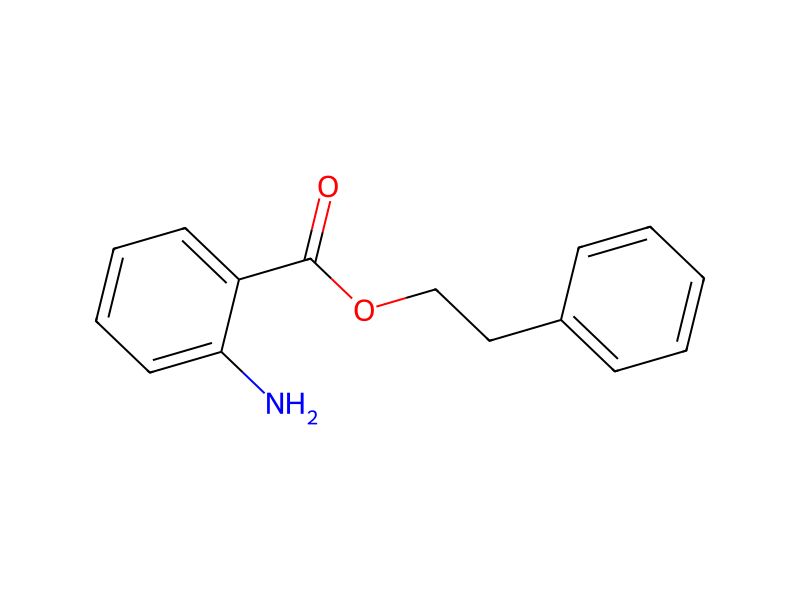
Basic information
- Standard SMILES
Nc1ccccc1C(=O)OCCc1ccccc1- InChIKey
PXWNBAGCFUDYBE-UHFFFAOYSA-N- Molecular formula
- C15H15NO2
- Average molar mass
- 241.28 g/mol
- Monoisotopic mass
- 241.11027872
Overview
Phenethyl anthranilate is a colorless solid with an odor of grape and orange. Insoluble in water. (NTP, 1992)
Names & identifiers
- Preferred name
- Phenethyl anthranilate
- IUPAC
- 2-phenylethyl 2-aminobenzoate
- English name
- Phenylethyl Anthranilate
- Molecular formula
- C15H15NO2
- Molecular weight
- 241.29
Names & synonyms
Show more names
Database identifiers
- CAS
133-18-6- PubChem CID
- 8615
- DTXSID
DTXSID5025861- ChEMBL
CHEMBL1488668- ChEBI
CHEBI:191913- UNII
- 8HBK71OD81
- EC Number
- 205-098-0
- Nikkaji
- J10.045E
Properties
Computed structural properties
- XLogP
- 4.2
- Topological polar surface area
- 52.3 Ų
- Hydrogen bond donors
- 1
- Hydrogen bond acceptors
- 3
- Rotatable bonds
- 5
- Heavy atoms
- 18
- Formal charge
- 0
- Complexity
- 261
Experimental & physicochemical properties
Solubility
Insoluble (<1 mg/ml at 68.0 °F) (NTP, 1992)
Insoluble in water
Soluble (in ethanol)
Physical Description
Phenethyl anthranilate is a colorless solid with an odor of grape and orange. Insoluble in water. (NTP, 1992)
Solid
Fused, colourless to pale yellow-amber crystaline mass; Neroli, grape undertone
Physicochemical properties
- Melting point
- 39 · 39-44 °C(lit.)
- Boiling point
- 226 °C · 226 °C(lit.)
- Density
- 1.0944 · 1.0944 (rough estimate)
- refractive index
- 1.52 · 1.5200 (estimate)
- FEMA
- 2859 · 2859 | PHENYLETHYL ANTHRANILATE
- FLAVIS Number
- 9.723 · 09.723 | Phenethyl anthranilate
- Flash point
- 230 °F · >230 °F
- solubility
- Insoluble in water, soluble in alcohol and oils.
- pka
- 2.16 · 2.16±0.10(Predicted)
- Specific Gravity
- 1.14 · 1.14 (liquid)
- color
- White to yellow crystals
- Odor
- grape odor
- Odor Type
- floral
- JECFA Number
- 1543 · 1543
- Cosmetics Ingredients Functions
- PERFUMING
- LogP
- 4.06 · 4.06
- Substances Added to Food (formerly EAFUS)
- PHENETHYL ANTHRANILATE
- FDA 21 CFR
- 172.515 · 172.515
- EWG's Food Scores
- 1 · 1
- FDA UNII
- 8 HBK71OD81 · 8HBK71OD81
- EPA Substance Registry System
- 2 · 2-Phenylethyl anthranilate (133-18-6)
- Symbol(GHS)
- 7 · GHS07,GHS09
- Signal word
- Warning
- Hazard statements
- 400 · H400-H315-H335-H319
- Precautionary statements
- 264 · P264-P280-P302+P352-P321-P332+P313-P362-P264-P280-P305+P351+P338-P337+P313P-P273-P391-P501
- Hazard Codes
- Xi,N
- Risk Statements
- 36 · 36/37/38-50/53
- Safety Statements
- 26 · 26-37/39-60-61
- RIDADR
- 3077 · UN 3077 9/PG 3
- WGK Germany
- 2 · 2
- RTECS
- 3720000 · CB3720000
- TSCA
- TSCA listed
- Toxicity
- 500 mg/24H · skn-rbt 500 mg/24H MOD FCTXAV 14,659,76
Safety & regulation
GHS classification
GHS Classification
This chemical does not meet GHS hazard criteria for 69.8% (90 of 129) of all reports.
Warning
H315 (30.2%): Causes skin irritation [Warning Skin corrosion/irritation]
P261, P264, P264+P265, P271, P273, P280, P302+P352, P304+P340, P305+P351+P338, P319, P321, P332+P317, P337+P317, P362+P364, P391, P403+P233, P405, and P501 (click each P-code to see the statement)
Aggregated GHS information provided per 129 reports by companies from 3 notifications to the ECHA C&L Inventory. Each notification may be associated with multiple companies.
Hazard information
Regulatory Information
Chemical: Benzoic acid, 2-amino-, 2-phenylethyl ester
Commission Regulation (EC) No 1565/2000 (Repealed by Com. Implementing Reg. (EU) No 872/2012)
Benzoic acid, 2-amino-, 2-phenylethyl ester: Does not have an individual approval but may be used under an appropriate group standard
Safety & protection
First Aid
EYES: First check the victim for contact lenses and remove if present. Flush victim's eyes with water or normal saline solution for 20 to 30 minutes while simultaneously calling a hospital or poison control center. Do not put any ointments, oils, or medication in the victim's eyes without specific instructions from a physician. IMMEDIATELY transport the victim after flushing eyes to a hospital even if no symptoms (such as redness or irritation) develop.
Nonfire Spill Response
SMALL SPILLS AND LEAKAGE: Should a spill occur while you are handling this chemical, you should dampen the solid spill material with alcohol, then transfer the dampened material to a suitable container. Use absorbent paper dampened with alcohol to pick up any remaining material. Seal the absorbent paper, and any of your clothes, which may be contaminated, in a vapor-tight plastic bag for eventual disposal. Solvent wash all contaminated surfaces with alcohol followed by washing with a strong soap and water solution. Do not reenter the contaminate area until the Safety Officer (or other responsible person) has verified that the area has been properly cleaned.
Personal Protective Equipment (PPE)
RECOMMENDED RESPIRATOR: Where the neat test chemical is weighed and diluted, wear a NIOSH-approved half face respirator equipped with an organic vapor/acid gas cartridge (specific for organic vapors, HCl, acid gas and SO2) with a dust/mist filter. (NTP, 1992)
Safety data
- wgk
- 2
- tsca
- TSCA listed
- rtecs
- CB3720000
- ridadr
- UN 3077 9/PG 3
- Toxicity
- skn-rbt 500 mg/24H MOD FCTXAV 14,659,76
- risk_code
- 36/37/38-50/53
- Signal word
- Warning
- Symbol(GHS)
- GHS07,GHS09
- hazard_code
- Xi,N
- safety_code
- 26-37/39-60-61
- Hazard statements
- H400-H315-H335-H319
- Precautionary statements
- P264-P280-P302+P352-P321-P332+P313-P362-P264-P280-P305+P351+P338-P337+P313P-P273-P391-P501
Chemistry & industry
Pharmacology
Uses & manufacturing
Use Classification
Fragrance Ingredients
Flavouring Agent -> FLAVOURING_AGENT -> JECFA Functional Classes
Flavoring Agents -> JECFA Flavorings Index
Flavouring Agent -> FLAVOURING_AGENT -> JECFA Functional Classes
Applications
OccurrenceHas apparently not been reported to occur in nature.
UsesPhenylethyl Anthranilate is a synthetic flavoring agent that is a stable, white to yellow crystal of grape and orange blossom odor. It should be stored in glass or polyethylene-lined containers. It is used for flavors such as grape and cherry in applications such as beverages, ice cream, candy, and baked goods at 2–6 ppm.
General DescriptionColorless solid with an odor of grape and orange. Insoluble in water.
Preparation methods
PreparationBy direct esterification of anthranilic acid with phenylethyl alcohol; pure material from phenylethyl alcohol plus isatoic anhydride; also from phenylethyl alcohol and methylanthranilate.
Upstream & downstream products
Upstream raw materials
Suppliers8 total
Additional notes
DefinitionChEBI: 2-Phenylethyl 2-aminobenzoate is a benzoate ester.
Related reactions
No reaction records under the current filter.
Linked notes
Loading…