
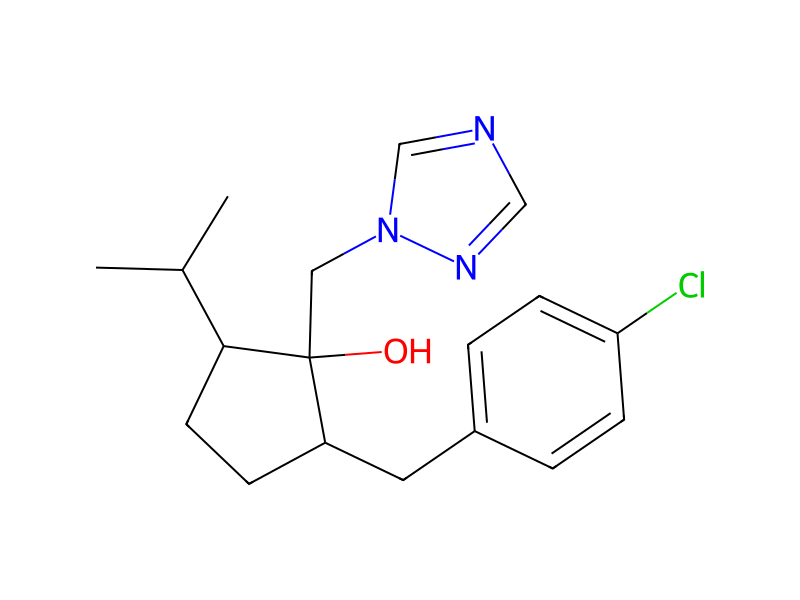
Basic information
- Standard SMILES
CC(C)C1CCC(Cc2ccc(Cl)cc2)C1(O)Cn1cncn1- InChIKey
QTYCMDBMOLSEAM-UHFFFAOYSA-N- Molecular formula
- C18H24ClN3O
- Average molar mass
- 333.9 g/mol
- Monoisotopic mass
- 333.1607901
Names & identifiers
- Preferred name
- Ipconazole
- IUPAC
- 2-[(4-chlorophenyl)methyl]-5-propan-2-yl-1-(1,2,4-triazol-1-ylmethyl)cyclopentan-1-ol
- English name
- IPCONAZOLE
- Molecular formula
- C18H24ClN3O
- Molecular weight
- 333.86
Names & synonyms
Ipconazole125225-28-7DTXSID7034674DTXCID5014674CHEBI:81770FC61260G4Q2-((4-chlorophenyl)methyl)-5-(1-methylethyl)-1-(1H-1,2,4-triazol-1-ylmethyl)cyclopentanol2-[(4-chlorophenyl)methyl]-5-(1-methylethyl)-1-(1H-1,2,4-triazol-1-ylmethyl)cyclopentanolCyclopentanol, 2-((4-chlorophenyl)methyl)-5-(1-methylethyl)-1-(1H-1,2,4-triazol-1-ylmethyl)-RefChem:1087420603-038-1ipconazole (ISO); (1RS,2SR,5RS;1RS,2SR,5SR)-2-(4-chlorobenzyl)-5-isopropyl-1-(1H-1,2,4-triazol-1-ylmethyl)cyclopentanol
Show more names
knf-317IpcozoleIpconazole SolutionIPCONAZOLE STANDARDC14365000 Ipconazoleipconazole (bsi, pa e-iso)Ipconazole in AcetonitrileIpconazole 100 μg/ml Acetonitrile
2-[(4-chlorophenyl)methyl]-5-propan-2-yl-1-(1,2,4-triazol-1-ylmethyl)cyclopentan-1-olIpconazole [ISO]RanconaUNII-FC61260G4QZr(HMDS)2Cl2Zr[N(SiMe3)2]2Cl2SCHEMBL21696orb1738353
Database identifiers
- CAS
125225-28-7- PubChem CID
- 86211
- DTXSID
DTXSID7034674- ChEMBL
CHEMBL3185422- ChEBI
CHEBI:81770- EC Number
- 603-038-1
- Nikkaji
- J576.490D
Properties
Computed structural properties
- XLogP
- 4.1
- Topological polar surface area
- 50.9 Ų
- Hydrogen bond donors
- 1
- Hydrogen bond acceptors
- 3
- Rotatable bonds
- 5
- Heavy atoms
- 23
- Formal charge
- 0
- Complexity
- 386
Experimental & physicochemical properties
Collision Cross Section
173.8 Ų [M+H]+ [CCS Type: DT; Buffer gas: N2; Ionization: APCI+; Dataset: TOXCAST; Source Identifier: DTXSID7034674];173.8 Ų [M+H]+ [CCS Type: DT; Buffer gas: N2; Ionization: ESI+; Dataset: TOXCAST; Source Identifier: DTXSID7034674];179.6 Ų [M+Na]+ [CCS Type: DT; Buffer gas: N2; Ionization: ESI+; Dataset: TOXCAST; Source Identifier: DTXSID7034674]
Physicochemical properties
- Melting point
- 86 · 86~92℃
- Boiling point
- 486 · 486.0±41.0 °C(Predicted)
- Density
- 1.24 · 1.24±0.1 g/cm3(Predicted)
- vapor pressure
- 3.58 x · 3.58 x l0-6 Pa (isomer pair I); 6.99 x l0-6Pa (isomer pair 11) (25 °C)
- Water Solubility
- 6.93 mg · 6.93 mg l-1 (20 °C)
- pka
- 13.76 · 13.76±0.60(Predicted)
- form
- powder
- color
- white to off-white
- Henry's Law Constant
- 3.9 · 3.9×103 mol/(m3Pa) at 25℃, Duchowicz et al. (2020)
- InChI
- InChI=1S/C18H24ClN3O/c1-13(2)17-8-5-15(9-14-3-6-16(19)7-4-14)18(17,23)10-22-12-20-11-21-22/h3-4,6-7,11-13,15,17,23H,5,8-10H2,1-2H3
- InChIKey
- QTYCMDBMOLSEAM-UHFFFAOYSA-N
- SMILES
- CC(C)C1CCC(C1(CN2C=NC=N2)O)CC3=CC=C(C=C3)Cl
- FDA UNII
- 61260 G4Q · FC61260G4Q
- Pesticides Freedom of Information Act (FOIA)
- Ipconazole
- EPA Substance Registry System
- Ipconazole (125225-28-7)
- UNSPSC Code
- 51101500 · 51101500
- NACRES
- 41 · NA.41
- Symbol(GHS)
- 8 · GHS08,GHS07,GHS09
- Signal word
- Danger
- Hazard statements
- 302 · H302-H360D-H373-H410
- Precautionary statements
- 264 · P264-P270-P301+P312-P330-P501-P260-P314-P501-P273-P391-P501
- target organs
- Eyes,Skin,Liver
- WGK Germany
- 3 · WGK 3
- HS Code
- 29339900 · 29339900
- Storage Class
- 6.1 C · 6.1C - Combustible acute toxic Cat.3toxic compounds or compounds which causing chronic effects
- Hazard Classifications
- 4 OralAquatic · Acute Tox. 4 OralAquatic Acute 1Aquatic Chronic 1Repr. 1BSTOT RE 2
Safety & regulation
GHS classification
GHS Classification
Danger
H302: Harmful if swallowed [Warning Acute toxicity, oral];H360D: May damage the unborn child [Danger Reproductive toxicity];H373: May causes damage to organs through prolonged or repeated exposure [Warning Specific target organ toxicity, repeated exposure];H410: Very toxic to aquatic life with long lasting effects [Warning Hazardous to the aquatic environment, long-term hazard]
P203, P260, P264, P270, P273, P280, P301+P317, P318, P319, P330, P391, P405, and P501 (click each P-code to see the statement)
Danger
Hazard information
Regulatory Information
Hazard Traits - Reproductive Toxicity;Authoritative List - EC Annex VI CMRs - Cat. 1B;Report - if used as a fragrance or flavor ingredient
Regulation (EC) No 1107/2009 (amended)
Ipoconazole is listed in the dataset of EPA Human Health Benchmarks for Pesticides under the Safe Drinking Water Act (40 eCFR 141)
Commission Regulation (EU) 2021/618, Dir 08/20/EC, Reg (EU) 2023/939, Reg. (EU) 2018/155, Reg. (EU) 2020/1295, Reg. (EU) 2020/2007, Reg. (EU) No 571/2014
Hazard Classes and Categories
Acute Tox. 4 (84.7%);Acute Tox. 4 (30.1%);Repr. 1B (55.8%);Repr. 2 (13.7%);STOT RE 2 (63.1%);Aquatic Acute 1 (22.1%);Aquatic Chronic 1 (77.9%)
Acute toxicity (Oral) - Category 4;Reproductive toxicity - Category 1B;Specific target organ toxicity - Single exposure - Category 2 (systemic);Specific target organ toxicity - Repeated exposure - Category 1 (respiratory organs), Category 2 (eye, liver, kidney, skin);Hazardous to the aquatic environment (Acute) - Category 2;Hazardous to the aquatic environment (Long-term) - Category 1
Repr. 1B;Acute Tox. 4;STOT RE 2;Aquatic Chronic 1
Toxicology
RAIS Toxicity Values
0.1
OPP
0.015
OPP
EPA Human Health Benchmarks for Pesticides
Ipoconazole
0.1
3000
Females 13-49 yrs
0.015
89
Regulatory information
Regulatory Information
Hazard Traits - Reproductive Toxicity;Authoritative List - EC Annex VI CMRs - Cat. 1B;Report - if used as a fragrance or flavor ingredient
Regulation (EC) No 1107/2009 (amended)
Ipoconazole is listed in the dataset of EPA Human Health Benchmarks for Pesticides under the Safe Drinking Water Act (40 eCFR 141)
Commission Regulation (EU) 2021/618, Dir 08/20/EC, Reg (EU) 2023/939, Reg. (EU) 2018/155, Reg. (EU) 2020/1295, Reg. (EU) 2020/2007, Reg. (EU) No 571/2014
Safety data
- wgk
- WGK 3
- hs_code
- 29339900
- Signal word
- Danger
- Symbol(GHS)
- GHS08,GHS07,GHS09
- Storage Class
- 6.1C - Combustible acute toxic Cat.3toxic compounds or compounds which causing chronic effects
- target organs
- Eyes,Skin,Liver
- Hazard statements
- H302-H360D-H373-H410
- Hazard Classifications
- Acute Tox. 4 OralAquatic Acute 1Aquatic Chronic 1Repr. 1BSTOT RE 2
- Precautionary statements
- P264-P270-P301+P312-P330-P501-P260-P314-P501-P273-P391-P501
Chemistry & industry
Applications
UsesIpconazole controls a wide range of seed diseases in rice and other crops and is particularly effective against 'Bakanae disease', Helminthosporum leaf spot and blast on rice.
UsesIpconazole is a fungicide used in pesticide compositions.
Suppliers33 total
湖北万得化工有限公司15377098680 15377098680 · [email protected]
广州佳途科技股份有限公司81960175 18933936954 · [email protected]
江苏艾康生物医药研发有限公司025-025-66113011 15955137747 · [email protected]
广东元丰化学试剂有限公司0751-2829979 13318593351 · [email protected]
上海艾梯西生物科技有限公司18721763493
湖北广奥生物科技有限公司027-02702759223056 18162699093 · [email protected]
湖北成海化工有限公司027-59220433 18327245847 · [email protected]
上海毕楷科技有限公司18516304666
广东元丰化学试剂有限公司0751-2829979 13376591640 · [email protected]
成都思天德生物科技有限公司028-83243028 19136088901 · [email protected]
天津阿尔塔科技有限公司022-6537-8550 15522853686 · [email protected]
上海源叶生物科技有限公司13636370518 · [email protected]
上海陶术生物科技股份有限公司13564774135 · [email protected]
湖北齐飞医药化工有限公司027-59322506 18071128681 · [email protected]
山东西亚化学有限公司4009903999 13395398332 · [email protected]
BOC Sciences[email protected]
深圳聚合生化科技有限公司+86-400-002-6226 · [email protected]
上海智乾生物科技有限公司[email protected]
上海右肯医药科技有限公司021-37910267 15821801668 · [email protected]
TargetMol中国(陶术生物)4008200310 15002144251 · [email protected]
湖北拓邦化工有限公司027-59106185 13986192185 · [email protected]
上海陌孚医药科技有限公司4000862158 18117107507 · [email protected]
Longyan Tianhua Biological Technology Co., Ltd0086 18039857276 18039857276
广东元丰化学试剂有限公司0751-2829979 13318584237 · [email protected]
北京勤诚亦信科技开发有限公司010-67787816; 13811243025 · [email protected]
SUZHOU SENFEIDA CHEMICAL CO.,LTD+86-0512-83500002 +86-15195660023 · [email protected]
陕西缔都医药有限责任公司81148925 17391631969 · [email protected]
济南思考化学有限公司0531-0000 · [email protected]
上海安谱实验科技股份有限公司18502138905 · [email protected]
上海杰股生物科技有限公司021-51698675 · [email protected]
南京枫景晴生物科技有限公司15062262630 · [email protected]
北京百灵威科技有限公司18210857532 18210857532 · [email protected]
武汉青衫合源生物科技有限公司027-18327024450 18327024450 · [email protected]
Additional notes
DefinitionChEBI: A member of the class of cyclopentanols carrying 1,2,4-triazol-1-ylmethyl, 4-chlorobenzyl and isopropyl substituents at positions 1, 2 and 5 respectively. Used to control a range of seed diseases in rice, vegetables and other, mainly non-food, crops.
Related reactions
2 records

Linked notes
Loading…