Azimsulfuron
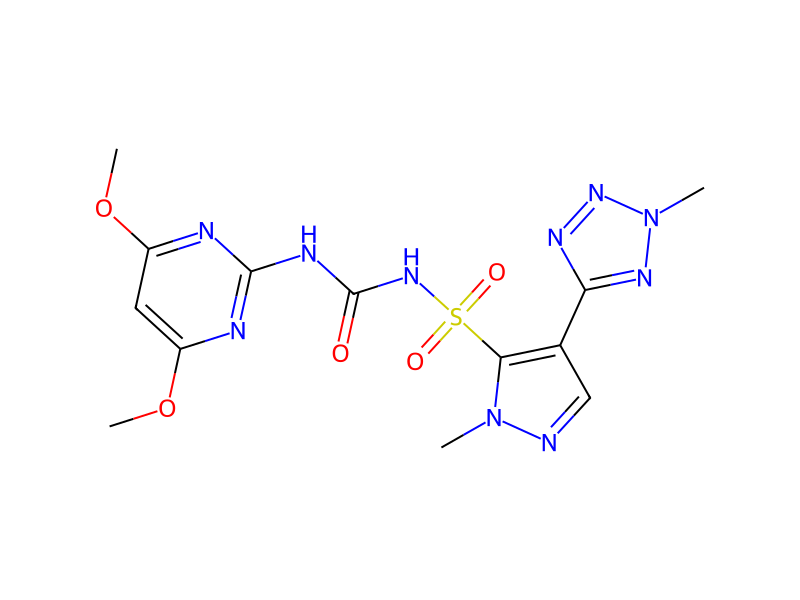
Basic information
- CAS
120162-55-2- Standard SMILES
COc1cc(OC)nc(NC(=O)NS(=O)(=O)c2c(-c3nnn(C)n3)cnn2C)n1- InChIKey
MAHPNPYYQAIOJN-UHFFFAOYSA-N- Molecular formula
- C13H16N10O5S
- Average molar mass
- 424.4 g/mol
- Monoisotopic mass
- 424.10258461
Overview
Azimsulfuron is an N-sulfonylurea that is urea in which a nitrogen attached to one of the nitrogens has been replaced by a 4,6-dipyrimidin-2-yl group while a hydrogen attached to the other urea nitrogen has been replaced by a [1-methyl-4-(2-methyl-2H-tetrazol-5-yl)-1H-pyrazol-5-yl]sulfonyl group. An acetolactate synthase inhibitor, it is used as a herbicide for the control of a variety of broad-leaved and sedge weeds in paddy fields and other aquatic situations. It has a role as an EC 2.2.1.6 (acetolactate synthase) inhibitor and a herbicide. It is an aromatic ether, a member of tetrazoles, a pyrazole pesticide, a biaryl and a N-sulfonylurea.
Names & identifiers
- Preferred name
- Azimsulfuron
- IUPAC
- 1-(4,6-dimethoxypyrimidin-2-yl)-3-[1-methyl-4-(2-methyltetrazol-5-yl)pyrazol-5-yl]sulfonylurea
- English name
- Azimsulfuron
- Molecular formula
- C13H16N10O5S
- Molecular weight
- 424.4
Names & synonyms
Azimsulfuron120162-55-2DPX 47DPX-A 8947IN-A 894A 8947A-8947A8947N-(((4,6-Dimethoxy-2-pyrimidinyl)amino)carbonyl)-1-methyl-4-(2-methyl-2H-tetrazol-5-yl)-1H-pyrazole-5-sulfonamideR959I3139CDTXSID8041614CHEBI:81746
Show more names
dpx47ExpretJS 458GULLIVERin-a8947dpx-a8947AZIMSULPHURON
1-(4,6-DIMETHOXYPYRIMIDIN-2-YL)-3-(1-METHYL-4-(2-METHYL-2H-TETRAZOL-5-YL)PYRAZOL-5-YLSULFONYL)UREA1-(4,6-dimethoxypyrimidin-2-yl)-3-[1-methyl-4-(2-methyl-2H-tetrazol-5-yl)pyrazol-5-ylsulfonyl]ureaN-((4,6-dimethoxy-2-pyrimidinyl)carbamoyl)-1-methyl-4-(2-methyl-2H-tetrazol-5-yl)-1H-pyrazole-5-sulfonamide1-(4,6-dimethoxypyrimidin-2-yl)-3-(1-methyl-4-(2-methyl-2H-1,2,3,4-tetrazol-5-yl)-1H-pyrazole-5-sulfonyl)urea1-(4,6-dimethoxypyrimidin-2-yl)-3-[1-methyl-4-(2-methyl-2H-1,2,3,4-tetrazol-5-yl)-1H-pyrazole-5-sulfonyl]urean-[[(4,6-dimethoxy-2-pyrimidinyl)amino]carbonyl]-1-methyl-4-(2-methyl-2h-tetrazol-5-yl)-1h-pyrazole-5-sulfonamideRefChem:116120DTXCID6021614
Database identifiers
- CAS
120162-55-2
Properties
Computed structural properties
- XLogP
- 0.3
- Topological polar surface area
- 189 Ų
- Hydrogen bond donors
- 2
- Hydrogen bond acceptors
- 11
- Rotatable bonds
- 6
- Heavy atoms
- 29
- Formal charge
- 0
- Complexity
- 665
Experimental & physicochemical properties
Pesticides
Agrochemicals -> Pesticide active substances
Active substance -> EU Pesticides database: Not approved
Pesticide (Azimsulfuron) -> USDA PDB
LogP0.65
Solubility1050 mg/L @ 20 °C (exp)
Endocrine DisruptorsPotential endocrine disrupting compound
Melting Point170 °C
Physical DescriptionSolid
Physicochemical properties
- Melting point
- 170 ° · 170°
- Density
- 1.74 · 1.74±0.1 g/cm3(Predicted)
- storage temp.
- 2 · Sealed in dry,2-8°C
- solubility
- Solubility in organic solvents (g/l at 25 °C) Acetone 26.4 Acetonitrile 13.9 Ethyl acetate 13.0 Dichloromethane 65.9 n‐Hexane <0.2 Methanol 2.1 Toluene 1.8
Safety & regulation
Safety information is for reference only and does not replace the supplier’s Safety Data Sheet (SDS), applicable regulations, or professional assessment.
GHS classification
GHS Classification
Warning
H400: Very toxic to aquatic life [Warning Hazardous to the aquatic environment, acute hazard]
P273, P391, and P501 (click each P-code to see the statement)
Warning
H400 (100%): Very toxic to aquatic life [Warning Hazardous to the aquatic environment, acute hazard]
P273, P391, and P501 (click each P-code to see the statement)
Hazard information
Regulatory Information
Commission Regulation (EC) No 737/2007
1999/80/EC, 2007/21/EC, 2010/54/EU, Reg. (EU) 2022/801, Reg. (EU) No 540/2011, Reg. (EU) No 704/2011
Hazard Classes and Categories
Aquatic Acute 1 (100%)
Hazardous to the aquatic environment (acute) - category 1
Aquatic Acute 1
Safety data
- PPE
- dust mask type N95 (US), Eyeshields, Gloves
- wgk
- WGK 2
- ridadr
- UN 3077 9 / PGIII
- hs_code
- 29350090
- Toxicity
- LD50 in rats, bobwhite quail, mallard duck (mg/kg): >5000, >2250, >2250 orally; in rats (mg/kg): >2000 dermally (Marquez); LC50 (96 hr) in carp, bluegill sunfish, rainbow trout (ppm): >300, >1000, 154 (Marquez)
- risk_code
- 50/53
- Signal word
- Warning
- Symbol(GHS)
- GHS09
- hazard_code
- N
- safety_code
Chemistry & industry
Pharmacology
MeSH Pharmacological ClassificationPesticides used to destroy unwanted vegetation, especially various types of weeds, grasses (POACEAE), and woody plants. Some plants develop HERBICIDE RESISTANCE.
Cellular LocationsCytoplasm
Applications
DescriptionA sulfonylurea herbicide for the control of a range of broadleaved and sedge weeds in paddy fields and other crops. It is highly soluble in water, semi-volatile and, based on its physico-chemical properties, appears to have potential for leaching to groundwater. It is not expected to be persistent in the field but can be persistent in water systems. It has a low mammalian toxicity but has high potential for bioaccumulation. No adverse health effects have been identified. Azimsulfuron is moderately toxic to algae, honeybees and earthworms but less so to birds and fish.
UsesHerbicide.
UsesAzimsulfuron may be used as an analytical reference standard for the determination of the pesticide in:Paddy field water by direct injection using liquid chromatography-hybrid triple quadrupole-linear ion trap-mass spectrometry (LC-QqLIT-MS).Tap and leaching water samples by solid-phase extraction (SPE), followed by LC coupled to tandem mass spectrometry (LC-MS/MS).
General DescriptionAzimsulfuron is a sulfonylurea based pesticide.
Upstream & downstream products
Upstream raw materials
Related reactions
0 records
No reaction records under the current filter.
Compound notes
Loading…