
Syringaldehyde

Basic information
- CAS
134-96-3- Standard SMILES
COc1cc(C=O)cc(OC)c1O- InChIKey
KCDXJAYRVLXPFO-UHFFFAOYSA-N- Molecular formula
- C9H10O4
- Average molar mass
- 182.17 g/mol
- Monoisotopic mass
- 182.0579088
Overview
Syringaldehyde is a hydroxybenzaldehyde that is 4-hydroxybenzaldehyde substituted by methoxy groups at positions 3 and 5. Isolated from Pisonia aculeata and Panax japonicus var. major, it exhibits hypoglycemic activity. It has a role as a hypoglycemic agent and a plant metabolite. It is a hydroxybenzaldehyde and a dimethoxybenzene.
Names & identifiers
- Preferred name
- Syringaldehyde
- IUPAC
- 4-hydroxy-3,5-dimethoxybenzaldehyde
- English name
- Syringaldehyde
- Molecular formula
- C9H10O4
- Molecular weight
- 182.17
Names & synonyms
SYRINGALDEHYDE134-96-34-Hydroxy-3,5-dimethoxybenzaldehyde3,5-Dimethoxy-4-hydroxybenzaldehydeSyringic aldehydeSyringylaldehydeBenzaldehyde, 4-hydroxy-3,5-dimethoxy-SyringealdehydeGallaldehyde 3,5-dimethyl ether2ZR01KTT21NSC-411532,6-DIMETHOXY-4-FORMYLPHENOL
Show more names
Lilac aldehydeFEMA 4049SYRINGA ALDEHYDESyringSyringaL
DTXSID2059643FEMA NO. 4049CHEBI:67380SYALRefChem:187004DTXCID60341824-H-3,5-DMBA205-167-5
Database identifiers
- CAS
134-96-3- PubChem CID
- 8655
- DTXSID
DTXSID2059643- ChEMBL
CHEMBL225303- ChEBI
CHEBI:67380- UNII
- 2ZR01KTT21
- EC Number
- 205-167-5
- Nikkaji
- J5.601D
Properties
Computed structural properties
- XLogP
- 0
- Topological polar surface area
- 55.8 Ų
- Hydrogen bond donors
- 1
- Hydrogen bond acceptors
- 4
- Rotatable bonds
- 3
- Heavy atoms
- 13
- Formal charge
- 0
- Complexity
- 157
Experimental & physicochemical properties
Chemical ClassesBiological Agents -> Plant Oils and Extracts
SpringerMaterials PropertiesChemical shift
Food AdditivesFLAVORING AGENT OR ADJUVANT -> FDA Substance added to food
Flavoring AgentsEU Flavoring substances
Solubility
Insoluble in water
Soluble (in ethanol)
Endocrine DisruptorsPotential endocrine disrupting compound
Physical Description
Pale yellow solid; [Merck Index]
Very pale green needles; Alcoholic aroma
Physicochemical properties
- Melting point
- 110 · 110-113 °C(lit.)
- Boiling point
- 192 · 192-193 °C14 mm Hg(lit.)
Safety & regulation
Safety information is for reference only and does not replace the supplier’s Safety Data Sheet (SDS), applicable regulations, or professional assessment.
GHS classification
GHS Classification
Warning
H302 (97.6%): Harmful if swallowed [Warning Acute toxicity, oral]
P261, P264, P264+P265, P270, P271, P280, P301+P317, P302+P352, P304+P340, P305+P351+P338, P319, P321, P330, P332+P317, P337+P317, P362+P364, P403+P233, P405, and P501 (click each P-code to see the statement)
Aggregated GHS information provided per 1484 reports by companies from 18 notifications to the ECHA C&L Inventory. Each notification may be associated with multiple companies.
Hazard information
Regulatory Information
Chemical: Benzaldehyde, 4-hydroxy-3,5-dimethoxy-
Commission Regulation (EC) No 1565/2000 (Repealed by Com. Implementing Reg. (EU) No 872/2012)
REACH registered substance: 4-hydroxy-3,5-dimethoxybenzaldehyde (EC: 205-167-5)
Benzaldehyde, 4-hydroxy-3,5-dimethoxy-: Does not have an individual approval but may be used under an appropriate group standard
Hazards Summary
Causes altered sleep time (including change in righting reflex) in intraperitoneal lethal-dose studies of mice (LD50 = 1,000 mg/kg); [RTECS] Safe when used as a flavoring agent in food; [JECFA] A skin and strong eye irritant; [Alfa Aesar MSDS]
Hazard Classes and CategoriesAcute Tox. 4 (97.6%)
Safety data
- wgk
- 3
- tsca
- TSCA listed
- rtecs
- CU5760000
- hs_code
- 29124900
- risk_code
- 22-36/37/38
- Signal word
Chemistry & industry
Uses & manufacturing
UsesWidely distributed in plants. [Merck Index] Used as flavoring agent or adjuvant; [FDA]
Use Classification
Flavouring Agent -> FLAVOURING_AGENT -> JECFA Functional Classes
Flavoring Agents -> JECFA Flavorings Index
General Manufacturing InformationBenzaldehyde, 4-hydroxy-3,5-dimethoxy-: ACTIVE
Applications
DescriptionSyringaldehyde is an important constituent of many plant isolates and has widespread occurrence in wood products. It can be easily converted to trimethoxy-benzaldehyde which is an essential intermediate of the antibacterial drug trimethoprim. It is also used in the colorimetric determination of free chlorine in water.
OccurrenceReported found in pineapple, beer, wine, grape brandy, rum, many different whisky products, sherry, roasted barley and hardwood smoke
UsesSyringaldehyde is used in biological studies for the isolation and structural characterization of milled wood lignin, dioxane lignin, and cellulolytic lignin preparation from Brewer''s spent grain.
UsesSyringaldehyde may be used as an analytical reference standard for the determination of the analyte in guacoextracts and pharmaceutical preparations,(1) cognacs and wines,(2) plum brandies,(4) and wheat straw(5) by various chromatography techniques.
General DescriptionSyringaldehyde is an aromatic phenolic aldehyde and a degradation product of lignin. It exhibits antioxidant activity and is reported to inhibit prostaglandin synthetase enzyme. The synthetic form of syringaldehyde is commercially used in pharmaceuticals, food, cosmetics, textiles, pulp and paper industries.
Preparation methods
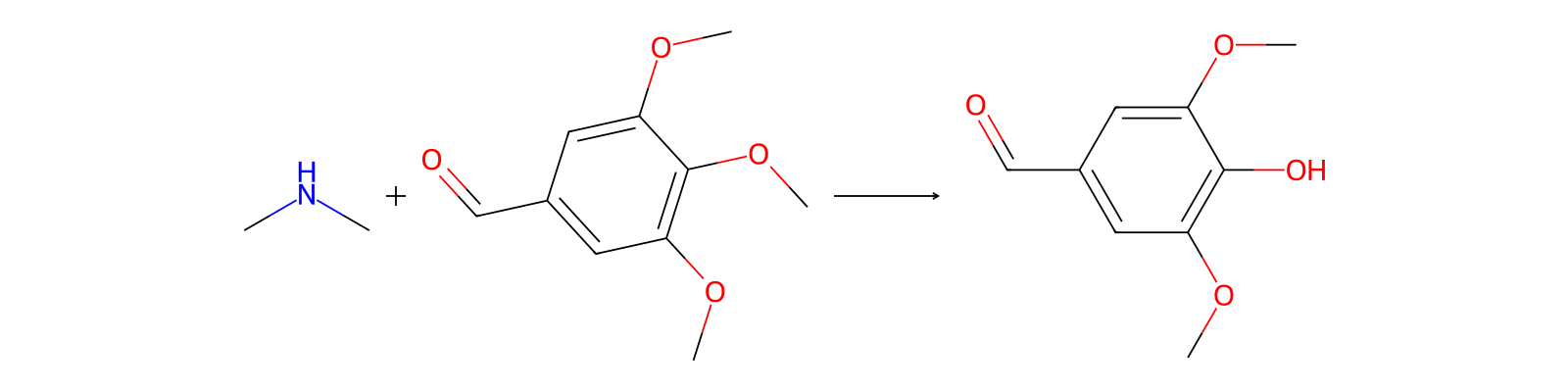
Vanillin is converted to 5-iodovanillin, which is treated with sodium methoxide to form 4-hydroxy-3,5- dimethyxybenzaldehyde.
Related reactions
115 records


Compound notes
Loading…