
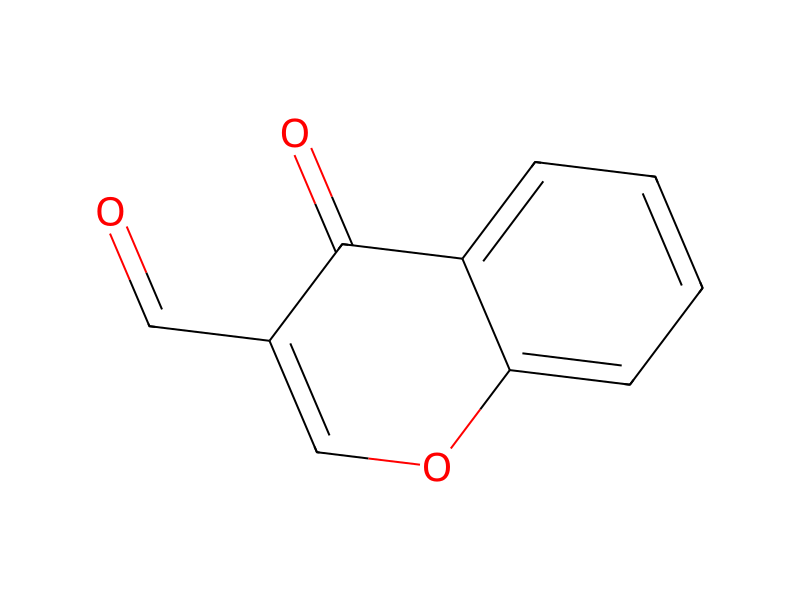
Basic information
- CAS
17422-74-1- Standard SMILES
O=Cc1coc2ccccc2c1=O- InChIKey
FSMYWBQIMDSGQP-UHFFFAOYSA-N- Molecular formula
- C10H6O3
- Average molar mass
- 174.15 g/mol
- Monoisotopic mass
- 174.03169405
Names & identifiers
- Preferred name
- 3-Formylchromone
- IUPAC
- 4-oxochromene-3-carbaldehyde
- English name
- Chromone-3-carboxaldehyde
- Molecular formula
- C10H6O3
- Molecular weight
- 174.15
Names & synonyms
17422-74-1Chromone-3-carboxaldehyde3-Formylchromone4-oxochromene-3-carbaldehydeBLA42VBH65NSC-291317DTXSID30169795RefChem:1067847DTXCID1092286241-451-54-Oxo-4H-chromene-3-carbaldehyde4-Oxo-4H-1-benzopyran-3-carboxaldehyde
Show more names
KAN-104141AKOS B022468AURORA KA-4820BUTTPARK 29\06-40AKOS BBS-000069523-Formylchromone 97%3-CHROMONECARBALDEHYDECHROMONE-3-CARBOXALDEHYD
4H-1-Benzopyran-3-carboxaldehyde, 4-oxo-MFCD00014667EINECS 241-451-5NSC291317UNII-BLA42VBH65CHEMBL869054-oxo-chromene-3-carbaldehyde4-oxo-1-benzopyran-3-carboxaldehyde
Database identifiers
- CAS
17422-74-1- PubChem CID
- 87112
- DTXSID
DTXSID30169795- ChEMBL
CHEMBL86905- UNII
- BLA42VBH65
- EC Number
- 241-451-5
- Nikkaji
- J287.046K
Properties
Computed structural properties
- XLogP
- 1.2
- Topological polar surface area
- 43.4 Ų
- Hydrogen bond donors
- 0
- Hydrogen bond acceptors
- 3
- Rotatable bonds
- 1
- Heavy atoms
- 13
- Formal charge
- 0
- Complexity
- 267
Experimental & physicochemical properties
SpringerMaterials PropertiesChemical shift
Physicochemical properties
- Melting point
- 151 · 151-153 °C (lit.)
- Boiling point
- 245.11 °C · 245.11°C (rough estimate)
- Density
- 1.2135 · 1.2135 (rough estimate)
- refractive index
- 1.45 · 1.4500 (estimate)
- storage temp.
- Keep in dark place,Sealed in dry,Room Temperature
- form
- Crystalline Powder
- color
- Orange
- Sensitive
- Air Sensitive
- BRN
- 472849 · 472849
- InChI
- InChI=1S/C10H6O3/c11-5-7-6-13-9-4-2-1-3-8(9)10(7)12/h1-6H
- InChIKey
- FSMYWBQIMDSGQP-UHFFFAOYSA-N
- SMILES
- C1OC2=CC=CC=C2C(=O)C=1C=O
- CAS DataBase Reference
- 17422 · 17422-74-1(CAS DataBase Reference)
- FDA UNII
- 42 VBH65 · BLA42VBH65
- UNSPSC Code
- 12352100 · 12352100
- NACRES
- 22 · NA.22
- Symbol(GHS)
- 7 · GHS07
- Signal word
- Warning
- Hazard statements
- 315 · H315-H319
- Precautionary statements
- 264 · P264-P280-P302+P352-P337+P313-P305+P351+P338-P362+P364-P332+P313
- PPE
- 95 · Eyeshields, Gloves, type N95 (US)
- Hazard Codes
- Xi
- Safety Statements
- 24 · 24/25
- WGK Germany
- 3 · 3
- Hazard Note
- Irritant
- HS Code
- 29329900 · 29329900
- Storage Class
- 11 · 11 - Combustible Solids
Safety & regulation
GHS classification
GHS Classification
Warning
H302 (100%): Harmful if swallowed [Warning Acute toxicity, oral]
P261, P264, P264+P265, P270, P271, P280, P301+P317, P302+P352, P304+P340, P305+P351+P338, P319, P321, P330, P332+P317, P337+P317, P362+P364, P403+P233, P405, and P501 (click each P-code to see the statement)
The GHS information provided by 1 company from 1 notification to the ECHA C&L Inventory.
Hazard information
Hazard Classes and CategoriesAcute Tox. 4 (100%)
Safety data
- PPE
- Eyeshields, Gloves, type N95 (US)
- wgk
- 3
- hs_code
- 29329900
- Signal word
- Warning
- Symbol(GHS)
- GHS07
- hazard_code
- Xi
- hazard_note
- Irritant
- safety_code
- 24/25
- Storage Class
- 11 - Combustible Solids
- Hazard statements
- H315-H319
- Precautionary statements
- P264-P280-P302+P352-P337+P313-P305+P351+P338-P362+P364-P332+P313
Chemistry & industry
Applications
Uses3-Formylchromone may be used in the following studies:Preparation of library of novel (E)-3-(2-arylcarbonyl-3-(arylamino)allyl)-4H-chromen-4-ones, by three-component domino reactions with (E)-3-(dimethylamino)-1-arylprop-2-en-1-ones and anilines under catalyst-free conditions.Facile and ecofriendly synthesis of new chromonyl chalcones.Synthesis of 3-(2-hydroxybenzoyl)quinolines and 7H-chromeno[3,2-c]quinolin-7-ones.
General DescriptionElectrospray ionization mass spectrometry (ESI-MS) of protonated 3-formylchromone (3-FC) shows loss of H2 as a major fragmentation route to yield a ketene cation, which on reaction with water forms a protonated carboxylic acid. The invivo salubrious effects of 3-FC against nitrosodiethylamine (NDEA) mediated early hepatocellular carcinogenesis has been investigated. Synthesis and characterization of 3-FC and its derivatives has been reported.
Upstream & downstream products
Upstream raw materials
Downstream products
Suppliers94 total
上海康恩博医药科技有限公司17510465506 · [email protected]
梯希爱(上海)化成工业发展有限公司021-67121386 · [email protected]
上海阿拉丁生化科技股份有限公司400-6206333 13167063860 · [email protected]
重庆欣博曜生物科技有限公司19122915778 · [email protected]
毕佳索(上海毕得医药科技股份有限公司)400-6005915 · [email protected]
上海麦克林生化科技股份有限公司021-50706066 15221275939 · [email protected]
温州共赢化学有限公司+86-0086-577-64498589 +86-15355981851 · [email protected]
普善实业(陕西)有限公司029-81310890 18165209495 · [email protected]
Suzhou ARTK Medchem Co., Ltd.+86-18168183658 · [email protected]
Dayang Chem (Hangzhou) Co.,Ltd.+86-0571-88938639 17705817739 · [email protected]
郑州鸿晟医药科技有限公司0371-55695890 15637198702 · [email protected]
Syntechem Co.,Ltd[email protected]
上海迈瑞尔生化科技有限公司4006356688 18621169109 · [email protected]
北京索莱宝科技有限公司010-50973130 17801761073 · [email protected]
上海辅欣医药科技有限公司+86-021-021-50872116 · [email protected]
阿法埃莎(中国)化学有限公司400-6106006 · [email protected]
江苏弘和药物研发有限公司5108538618 · [email protected]
安耐吉化学&3A(安徽泽升科技股份有限公司)400-0056266 · [email protected]
武汉凯威斯科技有限公司86-027-67849912 · [email protected]
上海瀚鸿科技股份有限公司021-54306202 13764082696 · [email protected]
广东方信生物科技有限公司0751-2838688 13376594225 · [email protected]
烟台盛凯伦生物制品有限公司13356901049 · [email protected]
重庆科脉材料科技有限公司17830741407 · [email protected]
天津狄克特科技有限公司22-58627059 13920586291 · [email protected]
吉林中科研伸科技有限公司18143011203 · [email protected]
无锡丽恒昇生物医药科技有限公司15250805028 15250805028 · [email protected]
菏泽博纳医药科技有限公司15865805009 · [email protected]
山东西亚化学有限公司13355009207 13355009207 · [email protected]
上海健超生物科技有限公司15021035486 18081542813 · [email protected]
天津希恩思生化科技有限公司400 638 7771 · [email protected]
广东元丰化学试剂有限公司0751-2829979 13376591640 · [email protected]
成都海品信医药科技有限公司85114309 18982182443 · [email protected]
赛默飞世尔科技(中国)有限公司800-810-5118 · [email protected]
TCI AMERICA800-4238616 · [email protected]
TOKYO CHEMICAL INDUSTRY CO., LTD.03-36680489 · [email protected]
TCI Europe320-37350700 · [email protected]
河南赢创生物科技有限公司15672878902 · [email protected]
瑞博生化科技有限公司+86-15861285899 · [email protected]
PT CHEM GROUP LIMITED+86-85511178; +86-85511178 · [email protected]
上海毕得医药科技股份有限公司400-164-7117 18317119277 · [email protected]
上海御略医药科技有限公司021-60345187 13671753212 · [email protected]
陕西缔都医药化工有限公司029-81024372 17792795018 · [email protected]
Sigma-Aldrich西格玛奥德里奇(上海)贸易有限公司021-61415566 800-8193336 · [email protected]
连云港康诚生物科技有限公司18151258299 · [email protected]
无锡丽康生物医药科技有限公司15250805028 · [email protected]
北京汇科盈生物科技有限公司15210661751 · [email protected]
sgtlifesciences pvt ltd+91-8790379245 · [email protected]
郑州阿尔法化工有限公司0371-53765687 18937137882 · [email protected]
武汉凯威斯科技有限公司027-67849912 · [email protected]
上海前衍生物科技有限公司02781293128 · [email protected]
Related reactions
13 records


Compound notes
Loading…