HomeMCPWorkbenchSkills
HomeWorkbenchNotificationsMe
llms.txt · MCP GuidePrivacy Policy · Terms of Service · Supportv1.8.3
  1. Home
  2. /Compound

1,4-Butanediol monovinyl ether

HCID 87329
New reaction
Print
Basic informationNames & identifiersPropertiesSafety & regulationChemistry & industryRelated reactionsCompound notes
Substructure searchFind similar structures

Basic information

CAS
17832-28-9
Standard SMILES
C=COCCCCO
InChIKey
HMBNQNDUEFFFNZ-UHFFFAOYSA-N
Molecular formula
C6H12O2
Average molar mass
116.16 g/mol
Monoisotopic mass
116.08372962

Names & identifiers

Preferred name
1,4-Butanediol monovinyl ether
IUPAC
4-ethenoxybutan-1-ol
English name
1,4-Butanediol vinyl ether
Molecular formula
C6H12O2
Molecular weight
116.16

Names & synonyms

17832-28-91-Butanol, 4-(ethenyloxy)-4-(Vinyloxy)butan-1-ol4-Hydroxybutyl vinyl ether4-(Ethenyloxy)butan-1-ol4-(Vinyloxy)-1-butanolTetramethylene Glycol Monovinyl Ether1,4-Butanediol monovinyl etherDTXSID60448548LGM5RZX0NRAPI-CURE HBVEEINECS 241-793-5
Show more names
HBVEHYDROXYBUTYL VINYL ETHERBUTANEDIOL MONOVINYL ETHER4-VINYLOXYBUTANOL4-Vinyloxy-1-butanol5-Oxa-6-heptene-1-ol4-vinyloxy-butan-1-ol
4-(VINYLOXY)BUTANOL4-ETHENYLOXY-1-BUTANOLDTXCID4024854EC 241-793-51-BUTANOL, 4-(VINYLOXY)-RefChem:4164971,4-Butanediol vinyl ether4-ethenoxybutan-1-ol

Database identifiers

CAS
17832-28-9
PubChem CID
87329
DTXSID
DTXSID6044854
ChEMBL
CHEMBL3182123
UNII
8LGM5RZX0N
EC Number
241-793-5
Nikkaji
J51.553A

Properties

Computed structural properties

XLogP
0.9
Topological polar surface area
29.5 Ų
Hydrogen bond donors
1
Hydrogen bond acceptors
2
Rotatable bonds
5
Heavy atoms
8
Formal charge
0
Complexity
52.5

Experimental & physicochemical properties

SpringerMaterials PropertiesViscosity
Physical DescriptionLiquid

Physicochemical properties

Melting point
-33 °C · -33 °C
Boiling point
86 °C/13 · 86 °C/13 mmHg
Density
0.95 · 0.95
vapor pressure
0.3 hPa · 0.3 hPa (20 °C)
refractive index
1.44 · 1.44
Flash point
80 °C · 80 °C
storage temp.
20 °C · Store at <= 20°C.
solubility
75 g/l · 75g/l
form
clear liquid
pka
15.04 · 15.04±0.10(Predicted)
Specific Gravity
0.93 · 0.93
color
Colorless to Light yellow

Safety & regulation

Safety information is for reference only and does not replace the supplier’s Safety Data Sheet (SDS), applicable regulations, or professional assessment.

GHS classification

GHS Classification · 5 items

This chemical does not meet GHS hazard criteria for 3.5% (6 of 171) of reports.

Warning

H302 (90.6%): Harmful if swallowed [Warning Acute toxicity, oral]

P264, P264+P265, P270, P273, P280, P301+P317, P305+P351+P338, P330, P337+P317, and P501 (click each P-code to see the statement)

Aggregated GHS information provided per 171 reports by companies from 9 notifications to the ECHA C&L Inventory. Each notification may be associated with multiple companies.

Hazard information

Regulatory Information · 3 items

1-Butanol, 4-(ethenyloxy)- is listed on the EPA's Chemical Data Reporting (CDR) system. Manufacturers and importers of 1-Butanol, 4-(ethenyloxy)- are required to report information about their production and use of this chemical to the EPA under the Toxic Substances Control Act (TSCA). (40 eCFR Part 711)

Status: Active Update: 30-10-2020 https://echa.europa.eu/registration-dossier/-/registered-dossier/11952

1,4-Butanediolmonovinylether: Does not have an individual approval but may be used under an appropriate group standard

Hazard Classes and CategoriesAcute Tox. 4 (90.6%)

Safety data

PPE
Eyeshields, Faceshields, Gloves, type ABEK (EN14387) respirator filter
wgk
1
tsca
TSCA listed
ridadr
NA 1993 / PGIII
hs_code
2909499000
Toxicity
LD50 orally in Rabbit: 1738 mg/kg LD50 dermal Rat > 2000 mg/kg
risk_code

Chemistry & industry

Uses & manufacturing

U.S. Production2023: 1,000,000 - <8,500,000 lb
Industry UsesMonomers
General Manufacturing Information · 2 items

All Other Basic Organic Chemical Manufacturing

1-Butanol, 4-(ethenyloxy)-: ACTIVE

Applications · 1 item

Uses4-Hydroxybutylvinyl ether is a commercially available polymer chemical, polymer material, and organic synthesis intermediate. It can undergo self-polymerization under the action of sulfonic acid. In synthetic transformation, its hydroxyl groups can be converted into aldehyde groups under Swern oxidation conditions.

Upstream & downstream products

Upstream raw materials

1,4-Bis(vinyloxy)-butane

Related reactions

10 records
New reaction record
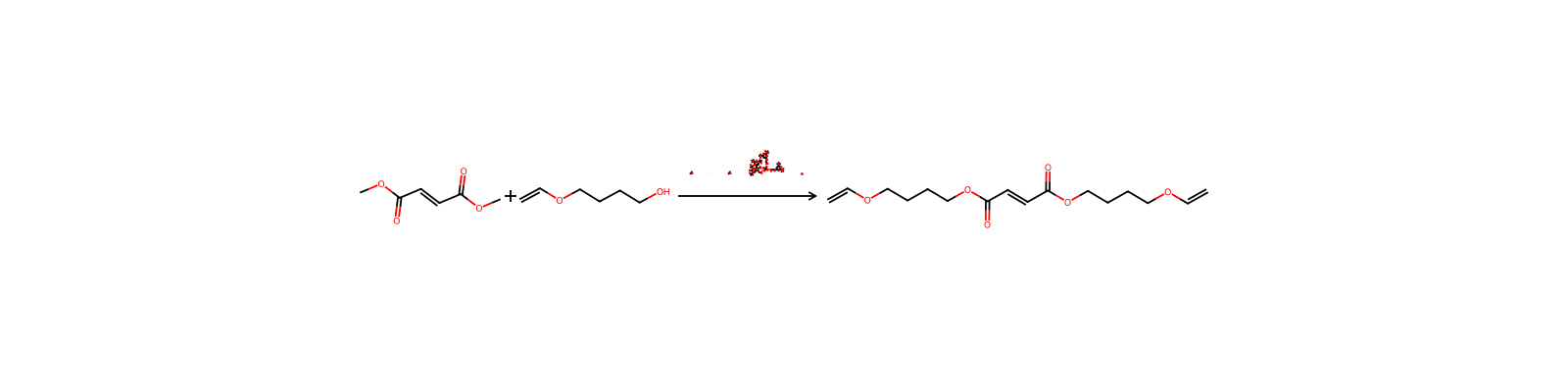
HRID 270241 reaction equation
HRID 270241As reactant
HRID 368803 reaction equation
HRID 368803As reactant
HRID 643185 reaction equation
HRID 643185As reactant
HRID 748683 reaction equation
HRID 748683As reactant
HRID 942803 reaction equation
HRID 942803As reactant
HRID 1053685 reaction equation
HRID 1053685As reactant
HRID 1694527 reaction equation
HRID 1694527As reactant
HRID 1823641 reaction equation
HRID 1823641As reactant
PreviousPage 1 of 2

Compound notes

On this pageBasic informationNames & identifiersPropertiesSafety & regulationChemistry & industryRelated reactionsCompound notes
explosive limit
1.4 · 1.4-9.9%(V)
Water Solubility
75 g/L · 75 g/L (20 ºC)
InChI
1S/C6H12O2/c1-2-8-6-4-3-5-7/h2,7H,1,3-6H2
InChIKey
HMBNQNDUEFFFNZ-UHFFFAOYSA-N
SMILES
OCCCCOC=C
LogP
0.43 at · 0.43 at 25℃
CAS DataBase Reference
17832 · 17832-28-9(CAS DataBase Reference)
FDA UNII
8 LGM5RZX0N · 8LGM5RZX0N
EPA Substance Registry System
1 · 1-Butanol, 4-(ethenyloxy)- (17832-28-9)
UNSPSC Code
12162002 · 12162002
NACRES
23 · NA.23
Symbol(GHS)
7 · GHS07
Signal word
Warning
Hazard statements
302 · H302-H319-H412
Precautionary statements
264 · P264-P270-P273-P280-P301+P312-P305+P351+P338
PPE
Eyeshields, Faceshields, Gloves, type ABEK (EN14387) respirator filter
Hazard Codes
Xn
Risk Statements
20 · 20/21/22-36/37/38-22-52/53
Safety Statements
26 · 26-36-24/25-61
RIDADR
1993 · NA 1993 / PGIII
WGK Germany
1 · 1
Autoignition Temperature
225 °C · 225 °C DIN 51794
TSCA
TSCA listed
HS Code
2909499000 · 2909499000
Storage Class
10 · 10 - Combustible liquids
Hazard Classifications
4 OralAquatic · Acute Tox. 4 OralAquatic Chronic 3Eye Irrit. 2
Toxicity
50 orally · LD50 orally in Rabbit: 1738 mg/kg LD50 dermal Rat > 2000 mg/kg
REACH Registrations
Active
20/21/22-36/37/38-22-52/53
Signal word
Warning
Symbol(GHS)
GHS07
hazard_code
Xn
safety_code
26-36-24/25-61
Storage Class
10 - Combustible liquids
Hazard statements
H302-H319-H412
REACH Registrations
Active
Hazard Classifications
Acute Tox. 4 OralAquatic Chronic 3Eye Irrit. 2
Autoignition Temperature
225 °C DIN 51794
Precautionary statements
P264-P270-P273-P280-P301+P312-P305+P351+P338