
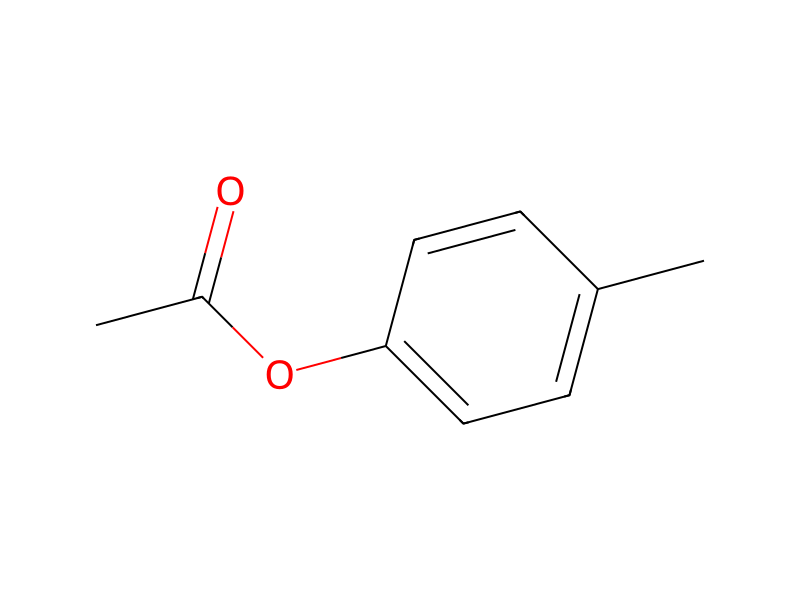
Basic information
- Standard SMILES
CC(=O)Oc1ccc(C)cc1- InChIKey
CDJJKTLOZJAGIZ-UHFFFAOYSA-N- Molecular formula
- C9H10O2
- Average molar mass
- 150.17 g/mol
- Monoisotopic mass
- 150.06807956
Names & identifiers
- Preferred name
- 4-Methylphenyl acetate
- IUPAC
- (4-methylphenyl) acetate
- English name
- P-TOLYL ACETATE
- Molecular formula
- C9H10O2
- Molecular weight
- 150.17
Names & synonyms
p-Tolyl acetatep-Cresyl acetate140-39-6Acetic acid, 4-methylphenyl esterNarceol4-Methylphenyl acetatep-AcetoxytolueneCresyl acetateParacresyl acetateAcetic acid, p-tolyl esterFEMA No. 307342I5PWW20C
Show more names
FEMA 30734-METHYL PHENYL ACETATEnarcelop-cresylp-Tolylacetatp-Toylacetatep-cresolacetate
NSC-43244NSC-65594para-cresyl acetateRefChem:858038205-413-14-Tolyl acetatep-Cresol acetate4-Acetoxytoluene
Database identifiers
- CAS
140-39-6- PubChem CID
- 8797
- DTXSID
DTXSID0046567- ChEMBL
CHEMBL501246- ChEBI
CHEBI:9627- UNII
- 42I5PWW20C
- EC Number
- 205-413-1
- Nikkaji
- J3.631E
Properties
Computed structural properties
- XLogP
- 2.1
- Topological polar surface area
- 26.3 Ų
- Hydrogen bond donors
- 0
- Hydrogen bond acceptors
- 2
- Rotatable bonds
- 2
- Heavy atoms
- 11
- Formal charge
- 0
- Complexity
- 134
Experimental & physicochemical properties
LogP2.11
Density1.044-1.052
Solubility
slightly soluble in water; soluble in oils
miscible (in ethanol)
Boiling Point
208.00 to 212.00 °C. @ 760.00 mm Hg
208-212 °C
Vapor Pressure0.16 [mmHg]
Refractive Index1.499-1.503
Physical Description
Colorless liquid; [Sigma-Aldrich MSDS]
Clear, colourless liquid, strong floral odour
Kovats Retention Index
1142;1146;1135.9;1136.5;1151;1142;1142.4;1146;1150;1150
1171.4;1166
1670;1722.3;1722.9;1741;1684;1700;1700;1713.7
Physicochemical properties
- Melting point
- 48.5 °C · 48.5 °C
- Boiling point
- 210 · 210-211 °C(lit.)
- Density
- 1.047 g/mL · 1.047 g/mL at 25 °C(lit.)
- vapor pressure
- 21.864 Pa · 21.864Pa at 25℃
- refractive index
- 20 · n20/D 1.501(lit.)
- FEMA
- 3073 · 3073 | P-TOLYL ACETATE
- FLAVIS Number
- 9.036 · 09.036 | p-Tolyl acetate
- Flash point
- 194 °F · 194 °F
- storage temp.
- Sealed in dry,Room Temperature
- solubility
- Insoluble in water
- form
- powder to lump to clear liquid
- Specific Gravity
- 1.052 · 1.052 (20/4℃)
- color
- White or Colorless to Almost white or Almost colorless
- Odor
- 1 % · at 1.00 % in dipropylene glycol. narcissus phenolic animal
- Odor Type
- floral
- Viscosity
- 11.88 mm2/s · 11.88mm2/s
- Water Solubility
- 1.195 g/L · 1.195g/L at 25℃
- JECFA Number
- 699 · 699
- Cosmetics Ingredients Functions
- PERFUMING
- InChI
- 1S/C9H10O2/c1-7-3-5-9(6-4-7)11-8(2)10/h3-6H,1-2H3
- InChIKey
- CDJJKTLOZJAGIZ-UHFFFAOYSA-N
- SMILES
- CC(=O)Oc1ccc(C)cc1
- LogP
- 2.11 at · 2.11 at 25℃
- CAS DataBase Reference
- 140 · 140-39-6(CAS DataBase Reference)
- Substances Added to Food (formerly EAFUS)
- P-TOLYL ACETATE
- FDA UNII
- 42 I5PWW20C · 42I5PWW20C
- NIST Chemistry Reference
- 4 · Acetic acid, 4-methylphenyl ester(140-39-6)
- EPA Substance Registry System
- 4 · Acetic acid, 4-methylphenyl ester (140-39-6)
- UNSPSC Code
- 12352100 · 12352100
- NACRES
- 22 · NA.22
- Symbol(GHS)
- 7 · GHS07
- Signal word
- Warning
- Hazard statements
- 302 · H302
- Precautionary statements
- 264 · P264-P270-P301+P312-P501
- PPE
- Eyeshields, Faceshields, Gloves, type ABEK (EN14387) respirator filter
- Hazard Codes
- Xn
- Risk Statements
- 22 · 22-36/37/38
- Safety Statements
- 26 · 26-36/37/39
- RIDADR
- 1993 · NA 1993 / PGIII
- WGK Germany
- 2 · 2
- RTECS
- 7570000 · AJ7570000
- TSCA
- TSCA listed
- HS Code
- 2915.39 · 2915.39.3500
- HazardClass
- 3 · 3
- Storage Class
- 10 · 10 - Combustible liquids
- Hazard Classifications
- 4 Oral · Acute Tox. 4 Oral
- Toxicity
- 50 in · The acute oral LD50 in rats was reported as 1.9 (1.12-3.23) g/kg (Denine, 1973). The acute dermal LD50 in rabbits was reported as 2.1 (1.24-3.57) g/kg (Denine, 1973).
- REACH Registrations
- Inactive
- Limited Quantities
- 5 L · 5.0 L (1.3 gallons) (liquid)
- Excepted Quantities
- Max Inner Pack (30g or 30ml) and Max Outer Pack (1Kg or 1L)
Safety & regulation
GHS classification
GHS Classification
Warning
H302 (100%): Harmful if swallowed [Warning Acute toxicity, oral]
P264, P270, P301+P317, P330, and P501 (click each P-code to see the statement)
Aggregated GHS information provided per 1855 reports by companies from 2 notifications to the ECHA C&L Inventory.;Information may vary between notifications depending on impurities, additives, and other factors. The percentage value in parenthesis indicates the notified classification ratio from companies that provide hazard codes. Only hazard codes with percentage values above 10% are shown. For more detailed information, please visit ECHA C&L website.
Hazard information
Regulatory Information
Chemical: Acetic acid, 4-methylphenyl ester
Commission Regulation (EC) No 1565/2000 (Repealed by Com. Implementing Reg. (EU) No 872/2012)
2004/129/EC
Status: Cease Manufacture Update: 30-06-2018 https://echa.europa.eu/registration-dossier/-/registered-dossier/18821
Acetic acid, 4-methylphenyl ester: Does not have an individual approval but may be used under an appropriate group standard
Other Safety InformationIMAP assessments - Acetic acid, 4-methylphenyl ester: Human health tier I assessment
Hazards SummarySafe when used as a flavoring agent in food; [JECFA] A skin and strong eye irritant; Harmful by ingestion; [Sigma-Aldrich MSDS]
Hazard Classes and CategoriesAcute Tox. 4 (100%)
Regulatory information
Regulatory Information
Chemical: Acetic acid, 4-methylphenyl ester
Commission Regulation (EC) No 1565/2000 (Repealed by Com. Implementing Reg. (EU) No 872/2012)
2004/129/EC
Status: Cease Manufacture Update: 30-06-2018 https://echa.europa.eu/registration-dossier/-/registered-dossier/18821
Acetic acid, 4-methylphenyl ester: Does not have an individual approval but may be used under an appropriate group standard
Safety data
- PPE
- Eyeshields, Faceshields, Gloves, type ABEK (EN14387) respirator filter
- wgk
- 2
- tsca
- TSCA listed
- rtecs
- AJ7570000
- ridadr
- NA 1993 / PGIII
- hs_code
- 2915.39.3500
- Toxicity
- The acute oral LD50 in rats was reported as 1.9 (1.12-3.23) g/kg (Denine, 1973). The acute dermal LD50 in rabbits was reported as 2.1 (1.24-3.57) g/kg (Denine, 1973).
- risk_code
- 22-36/37/38
- Signal word
- Warning
- Symbol(GHS)
- GHS07
- hazard_code
- Xn
- safety_code
- 26-36/37/39
- hazard_class
- 3
- Storage Class
- 10 - Combustible liquids
- Hazard statements
- H302
- Limited Quantities
- 5.0 L (1.3 gallons) (liquid)
- Excepted Quantities
- Max Inner Pack (30g or 30ml) and Max Outer Pack (1Kg or 1L)
- REACH Registrations
- Inactive
- Hazard Classifications
- Acute Tox. 4 Oral
- Precautionary statements
- P264-P270-P301+P312-P501
Chemistry & industry
Pharmacology
Cellular LocationsCytoplasm;Extracellular
Uses & manufacturing
UsesUsed as a flavoring agent; [FDA]
Household ProductsInformation on 2 consumer products that contain Cresyl Acetate in the following categories is provided:;• Auto Products;• Commercial / Institutional
Use Classification
Fragrance Ingredients
Flavoring Agents -> JECFA Flavorings Index
Flavouring Agent -> FLAVOURING_AGENT -> JECFA Functional Classes
Flavouring Agent -> FLAVOURING_AGENT -> JECFA Functional Classes
General Manufacturing InformationAcetic acid, 4-methylphenyl ester: ACTIVE
Applications
OccurrenceReported as a constituent of the essential oils of wallflower, cananga and ylang-ylang.
UsesPerfumery, flavoring.
Usesp-Tolyl acetate has been used in the total synthesis of ()-incrustoporin.
General DescriptionThe Fries rearrangement of p-tolyl acetate has been investigated using the H-form of various zeolites as catalysts. Mechanism of photo-Fries rearrangement of p-tolyl acetate has been studied.
Preparation methods
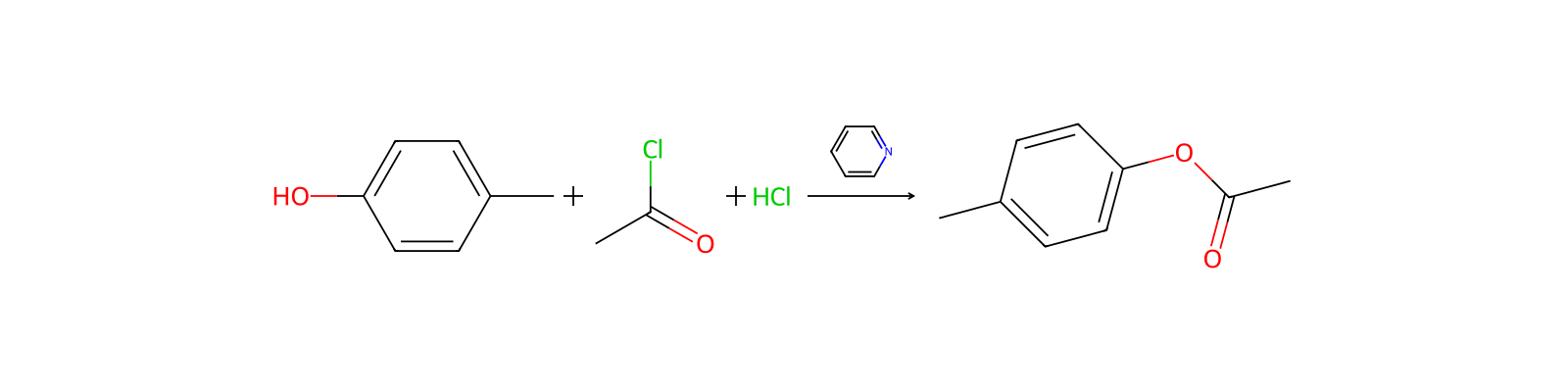
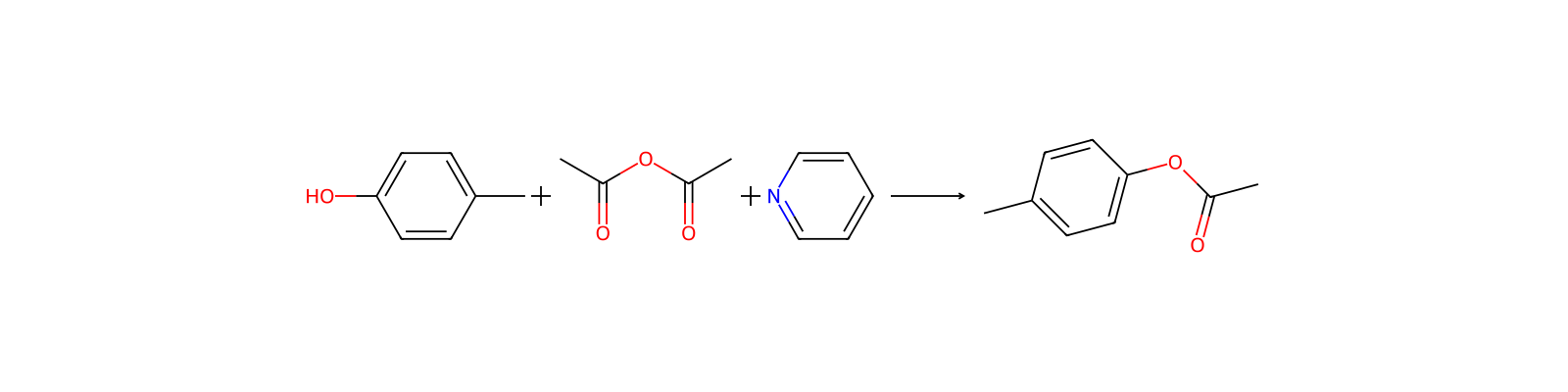
PreparationBy acetylation of p-cresol.
Upstream & downstream products
Upstream raw materials
Downstream products
Suppliers50 total
梯希爱(上海)化成工业发展有限公司021-67121386 · [email protected]
上海阿拉丁生化科技股份有限公司400-6206333 13167063860 · [email protected]
南京凯美西化工有限公司02558748998 18951874644 · [email protected]
南通润丰石油化工有限公司66017690 19952660367 · [email protected]
上海麦克林生化科技股份有限公司021-50706066 15221275939 · [email protected]
河南赢创生物科技有限公司16650615803 · [email protected]
武汉欣扬瑞和化学科技有限公司153-07155313 15307155313 · [email protected]
清宁生物(江苏博泉生物科技有限公司)19352250998 · [email protected]
杭州研富贸易有限公司15990061515
爱斯特(成都)生物制药股份有限公司+86-28-85122536 85324413 · [email protected]
Baoji Guokang Healthchem co.,ltd+8615604608665 15604608665 · [email protected]
Dayang Chem (Hangzhou) Co.,Ltd.+86-0571-88938639 17705817739 · [email protected]
北京安司莫森技术有限公司010-82954736 13391601435 · [email protected]
淮安嘉目生物科技有限公司0517-83187139 18205232085 · [email protected]
毕佳索(上海毕得医药科技股份有限公司)400-6005915 · [email protected]
北京索莱宝科技有限公司010-50973130 17801761073 · [email protected]
武汉易泰科技有限公司上海分公司18930552037 · [email protected]
安耐吉化学&3A(安徽泽升科技股份有限公司)400-0056266 · [email protected]
上海瀚鸿科技股份有限公司021-54306202 13764082696 · [email protected]
江西林缘香料有限公司13879661494 13879661494
山东洛克化工有限公司17653113209 13065062079 · [email protected]
吉良化学21-62165282 · [email protected]
杭州璟皓生物科技有限公司(原河南辛迪加生物)17513242016 · [email protected]
烟台正信新材料科技有限公司13854547682 13854547682 · [email protected]
湖北微斯汀科技有限公司027-61182895 13367240285 · [email protected]
上海毕楷科技有限公司18516304666
山东西亚化学有限公司13355009207 13355009207 · [email protected]
广东大小化工有限公司1866-171603 18666171603 · [email protected]
玛雅试剂+86 (573) 82222445 (0)18006601000 452520369 · [email protected]
四川库利南科技有限公司400-1166-196 18981987031 · [email protected]
TargetMol 中国(陶术生物)400-821-0310 15002144251 · [email protected]
江苏艾康生物医药研发有限公司025-66113011 13913916777 · [email protected]
上海健超生物科技有限公司150-2103-5486 18017383231 · [email protected]
TCI AMERICA800-4238616 · [email protected]
TOKYO CHEMICAL INDUSTRY CO., LTD.03-36680489 · [email protected]
TCI Europe320-37350700 · [email protected]
康迪斯化工(湖北)有限公司13125172151 · [email protected]
上海拓目化工有限公司13391076197 · [email protected]
青岛海智微元生物科技有限公司18317699790 18317699790 · [email protected]
Sigma-Aldrich西格玛奥德里奇(上海)贸易有限公司021-61415566 800-8193336 · [email protected]
海南瀚海致远生物科技有限公司18171012772 · [email protected]
九鼎化学(上海)科技有限公司4009209199 · [email protected]
西安美川生物科技有限公司029-89275612 +8618991951683 · [email protected]
湖北世腾化工科技有限公司18971850150 19086915685 · [email protected]
湖北中隆康盛精细化工有限公司027-027-83850368 18140587623 · [email protected]
山东智尚新材料有限公司+8617653113209 · [email protected]
山东利腾生物科技有限公司15020019777 18663721413 · [email protected]
sgtlifesciences pvt ltd+91-8790379245 · [email protected]
安那莱(齐河)新材料科技有限公司18600642180(微信同) 13391601435 · [email protected]
上海炎泽化工有限公司15345144255 19901447308 · [email protected]
Additional notes
DefinitionChEBI: Tolylacetate is a member of phenols and a benzoate ester.
Related reactions
18 records


Linked notes
Loading…