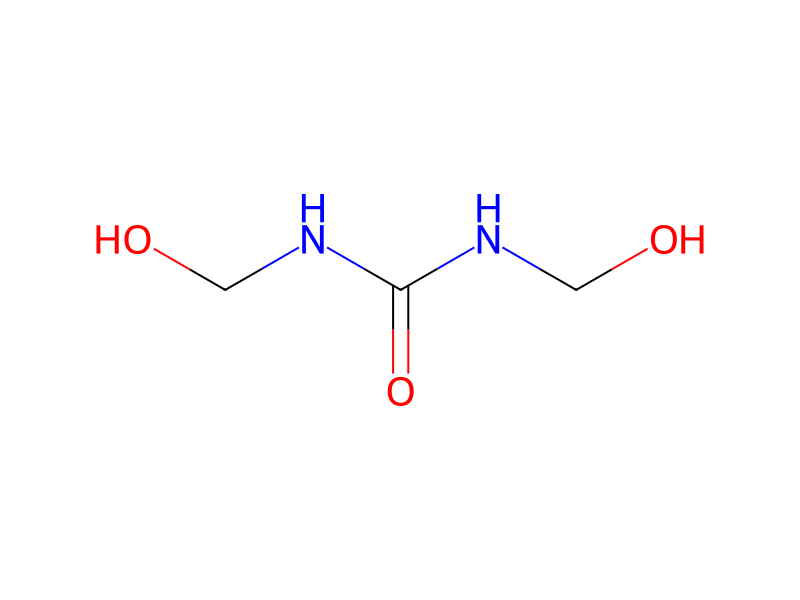
Basic information
- CAS
140-95-4- Standard SMILES
O=C(NCO)NCO- InChIKey
QUBQYFYWUJJAAK-UHFFFAOYSA-N- Molecular formula
- C3H8N2O3
- Average molar mass
- 120.11 g/mol
- Monoisotopic mass
- 120.05349212
Overview
Oxymethurea is a member of ureas.
Names & identifiers
- Preferred name
- Carbamol
- IUPAC
- 1,3-bis(hydroxymethyl)urea
- English name
- Dimethylolurea
- Molecular formula
- C3H8N2O3
- Molecular weight
- 120.11
Names & synonyms
Show more names
Database identifiers
- CAS
140-95-4- PubChem CID
- 8827
- DTXSID
DTXSID6025141- ChEMBL
CHEMBL3185052- ChEBI
CHEBI:134755- UNII
- N68H97CAWG
- EC Number
- 205-444-0
- Nikkaji
- J10.647J
Properties
Computed structural properties
- XLogP
- -1.8
- Topological polar surface area
- 81.6 Ų
- Hydrogen bond donors
- 4
- Hydrogen bond acceptors
- 3
- Rotatable bonds
- 2
- Heavy atoms
- 8
- Formal charge
- 0
- Complexity
- 66.9
Experimental & physicochemical properties
Physicochemical properties
- Melting point
- 125 °C · 125 °C (dec.)(lit.)
- Boiling point
- 224.08 °C · 224.08°C (rough estimate)
- Density
- 1.34 · 1.34
- refractive index
- 1.461 · 1.4610 (estimate)
- Flash point
- 100 °C · 100 °C
- storage temp.
- 2 · 2-8°C
- pka
- 12.14 · 12.14±0.46(Predicted)
- form
- powder to crystal
- color
- White to Almost white
- Water Solubility
- 150 g/L · 150 g/L
- Merck
- 14 · 14,6968
- BRN
- 1811870 · 1811870
- Cosmetics Ingredients Functions
- ANTIMICROBIAL
- InChI
- 1S/C3H8N2O3/c6-1-4-3(8)5-2-7/h6-7H,1-2H2,(H2,4,5,8)
- InChIKey
- QUBQYFYWUJJAAK-UHFFFAOYSA-N
- SMILES
- OCNC(=O)NCO
- LogP
- -2.61 · -2.610 (est)
- CAS DataBase Reference
- 140 · 140-95-4(CAS DataBase Reference)
- EWG's Food Scores
- 4 · 4
- FDA UNII
- 68 H97CAWG · N68H97CAWG
- NIST Chemistry Reference
- Dimethanolurea(140-95-4)
- EPA Substance Registry System
- Dimethylolurea (140-95-4)
- UNSPSC Code
- 12352100 · 12352100
- NACRES
- 22 · NA.22
- Symbol(GHS)
- 7 · GHS07
- Signal word
- Warning
- Hazard statements
- 319 · H319
- Precautionary statements
- 264 · P264-P280-P305+P351+P338-P337+P313
- Hazard Codes
- T
- Risk Statements
- 45 · 45
- Safety Statements
- 24 · 24/25-45-53
- WGK Germany
- 3 · 3
- RTECS
- 2716350 · YS2716350
- TSCA
- TSCA listed
- HS Code
- 29241990 · 29241990
- Storage Class
- 13 · 13 - Non Combustible Solids
- Hazard Classifications
- 2 · Eye Irrit. 2
- REACH Registrations
- Active
Safety & regulation
GHS classification
GHS Classification
This chemical does not meet GHS hazard criteria for 48.4% (104 of 215) of reports.
Warning
H319 (51.2%): Causes serious eye irritation [Warning Serious eye damage/eye irritation]
P264+P265, P280, P305+P351+P338, and P337+P317 (click each P-code to see the statement)
Aggregated GHS information provided per 215 reports by companies from 7 notifications to the ECHA C&L Inventory.
Hazard information
Regulatory Information
Chemical: Urea, N,N'-bis(hydroxymethyl)-
Urea, N,N'-bis(hydroxymethyl)- is listed on the EPA's Chemical Data Reporting (CDR) system. Manufacturers and importers of Urea, N,N'-bis(hydroxymethyl)- are required to report information about their production and use of this chemical to the EPA under the Toxic Substances Control Act (TSCA). (40 eCFR Part 711)
REACH registered substance: 1,3-bis(hydroxymethyl)urea (EC: 205-444-0)
Carbamol: Does not have an individual approval but may be used under an appropriate group standard
Hazards Summary
A formaldehyde releaser, dimethylol urea can cause allergic contact dermatitis in workers handling durable press chemical finishes used on fabrics for wrinkle resistance; Cases were reported in the 1950s before the textile industry started using finishes releasing less formaldehyde; [Kanerva, p. 397-408]
Toxicology
Safety data
- wgk
- 3
- tsca
- TSCA listed
- rtecs
- YS2716350
- hs_code
- 29241990
- risk_code
- 45
- Signal word
- Warning
- Symbol(GHS)
- GHS07
- hazard_code
- T
- safety_code
- 24/25-45-53
- Storage Class
- 13 - Non Combustible Solids
- Hazard statements
- H319
- REACH Registrations
- Active
- Hazard Classifications
- Eye Irrit. 2
- Precautionary statements
- P264-P280-P305+P351+P338-P337+P313
Chemistry & industry
Uses & manufacturing
Uses
Used in the production of urea-formaldehyde resins and as a textile finish; [Kanerva, p. 405]
Using Disinfectants or Biocides [Category: Clean]
General Manufacturing Information
Wood Product Manufacturing
Urea, N,N'-bis(hydroxymethyl)-: ACTIVE
Applications
UsesIn the textile industry in cotton crease- and shrink-proofing, finishing, drying, sizing; in tanning; pesticides; in photographic developers.
Uses1,3-Bis(hydroxymethyl)urea is used in preparation method of insulating waterborne polyurethane dispersion coating for electronic and electrical components.
Upstream & downstream products
Upstream raw materials
Downstream products
Suppliers100 total
Additional notes
DefinitionChEBI: Oxymethurea is a member of ureas.
Related reactions
No reaction records under the current filter.
Compound notes
Loading…