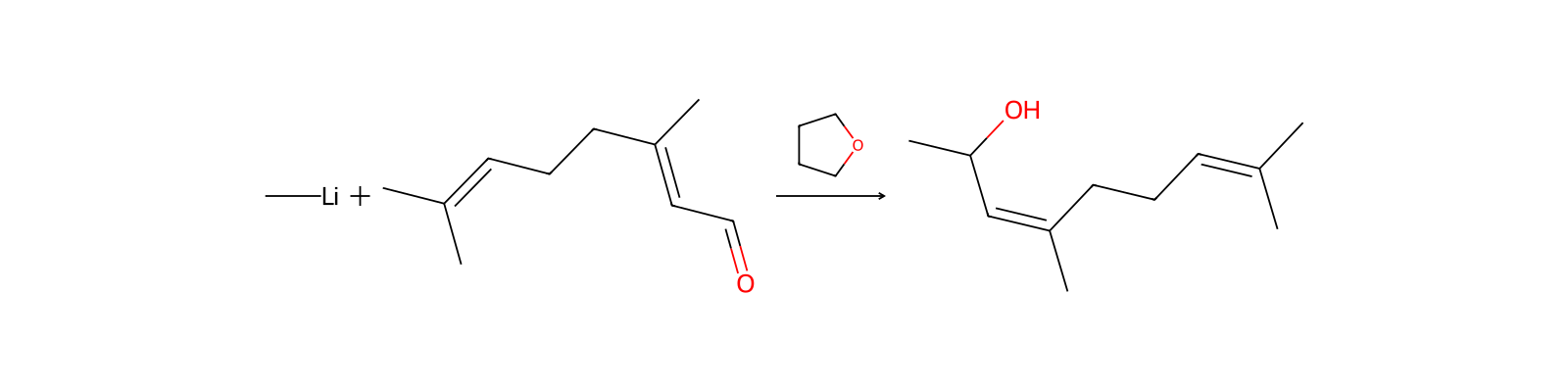
HRID 61335As reactant

5392-40-5CC(C)=CCCC(C)=CC=OWTEVQBCEXWBHNA-UHFFFAOYSA-NCitral is an enal that consists of octa-2,6-dienal bearing methyl substituents at positions 3 and 7. A mixture of the two geometric isomers geranial and neral, it is the major constituent (75-85%) of oil of lemon grass, the volatile oil of Cymbopogon citratus, or of C. flexuosus. It also occurs in oils of verbena, lemon, and orange. It has a role as an insecticide, a metabolite, a flavouring agent, a fragrance and an EC 1.2.3.1 (aldehyde oxidase) inhibitor. It contains a geranial and a neral.
5392-40-5DTXSID6024836CHEMBL2297541CHEBI:23316Safety information is for reference only and does not replace the supplier’s Safety Data Sheet (SDS), applicable regulations, or professional assessment.
OccurrenceReported found in apricot, clary sage, ginger, grape, grapefruit, lemon, lime, mandarin, orange, raspberry, tamarind, tangerine, tea and tomato.
UsesCitral is a liquid flavoring agent, light yellow in color with a citrus odor. it occurs in lemon and lemongrass oils. it is usually obtained from citral-containing oils by chemical means but may also be pre- pared synthetically. it is soluble in fixed oils, mineral oil, and pro- pylene glycol. it is moderately stable and should be stored in glass, tin, or resin-lined containers. it is used in flavors for lemon with applications in candy, baked goods, and ice cream at 20–40 ppm. it is also termed 2,6-dimethyl-octadian-2-6-al-8.
UsesCitral is an anti-microbial agent found in plants with antibacterial activity against some food pathogens. It is also a fragrance compound with a distinct lemon scent.
Usescitral is a naturally occurring aroma compound used to provide a lemon-type fragrance. Citral is a constituent of lemon oil, lemongrass oil, lime oil, ginger oil, verbena oil, and other plant-derived C essential oils.
General DescriptionA clear yellow colored liquid with a lemon-like odor. Less dense than water and insoluble in water. Toxic by ingestion. Used to make other chemicals.
PreparationSince citral is used in bulk as a starting material for the synthesis of vitamin A, it is produced industrially on a large scale. Smaller quantities are also isolated from essential oils. 1) Isolation from essential oils: Citral is isolated by distillation from lemongrass oil and from L. cubeba oil. It is the main component of these oils. 2) Synthesis from geraniol: Currently, the most important synthetic procedures are vapor-phase dehydrogenation and oxidation of geraniol or geraniol–nerol mixtures. Catalytic dehydrogenation under reduced pressure using copper catalysts is preferred. 3) Synthesis from dehydrolinalool: Dehydrolinalool is produced on a large scale from 6-methyl-5-hepten-2-one and acetylene and can be isomerized to citral in high yield by a number of catalysts. Preferred catalysts include organic orthovanadates, organic trisilyl oxyvanadates, and vanadium catalysts with silanols added to the reaction system. 4) Synthesis from isobutene and formaldehyde: 3-Methyl-3-buten-l-ol, obtained from isobutene and formaldehyde, isomerizes to form 3-methyl- 2-buten-lol. However, it is also converted into 3-methyl-2-butenal by dehydrogenation and subsequent isomerization. Under azeotropic conditions in the presence of nitric acid, 3-methyl-2-buten-l-ol and 3-methyl-2-butenal form an acetal (shown as follows), which eliminates one molecule of 3-methyl-2-buten-l-ol at higher temperatures. The intermediate enol ether undergoes Claisen rearrangement followed by Cope rearrangement to give citral in excellent yield: Today, this route is performed on a very large industrial scale in a continuous reactive distillation process.

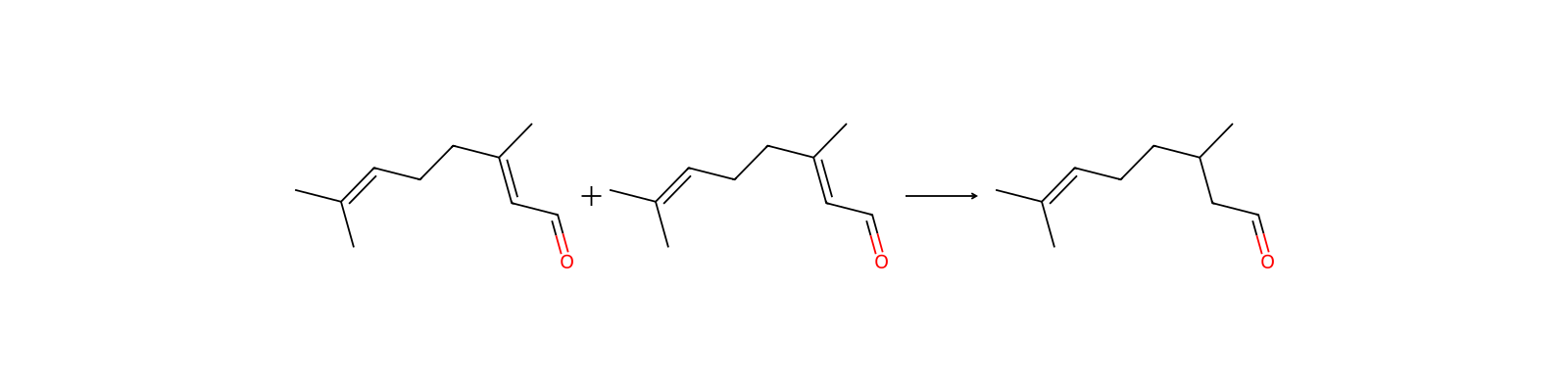


DefinitionCommercial material is a mixture of α and β isomers.