
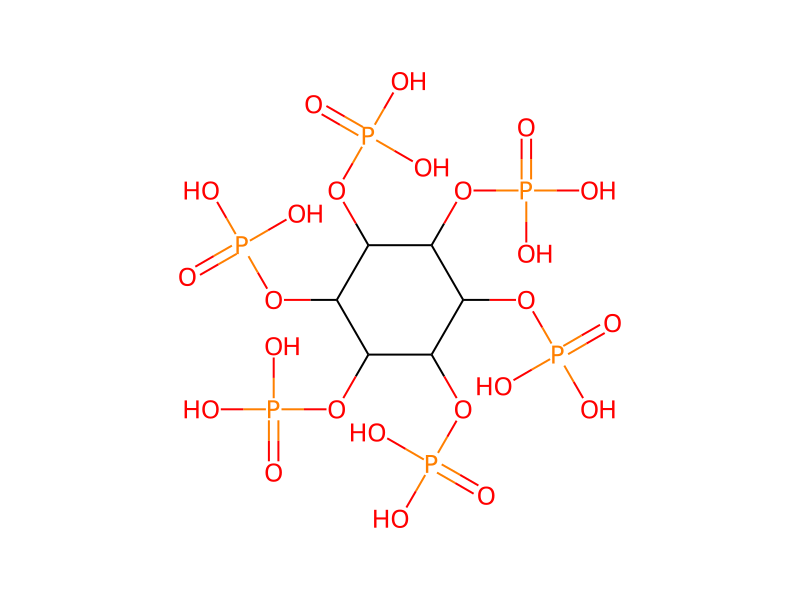
Basic information
- Standard SMILES
O=P(O)(O)OC1C(OP(=O)(O)O)C(OP(=O)(O)O)C(OP(=O)(O)O)C(OP(=O)(O)O)C1OP(=O)(O)O- InChIKey
IMQLKJBTEOYOSI-UHFFFAOYSA-N- Molecular formula
- C6H18O24P6
- Average molar mass
- 660.04 g/mol
- Monoisotopic mass
- 659.86137342
Names & identifiers
- Preferred name
- Phytate
- IUPAC
- (2,3,4,5,6-pentaphosphonooxycyclohexyl) dihydrogen phosphate
- English name
- Phytic acid
- Molecular formula
- C6H18O24P6
- Molecular weight
- 660.04
Names & synonyms
Phytate(2,3,4,5,6-pentaphosphonooxycyclohexyl) dihydrogen phosphateInositol 1,2,3,4,5,6-hexakisphosphateRefChem:929237Phytic acid83-86-3Fytic acidAlkalovertInositol hexaphosphatemyo-inositol hexakisphosphatemyo-Inositol hexaphosphateAcide fytique
Show more names
phyticphyticacidsolutionfyticacidPHYTIC ACID POWDERHexasodium phytateINOSITOL HEXAPHOSPHORIC ACIDWHL
Acido fiticoAlkovertExfodermPhytineAcidum fyticummyo-Inosistol hexakisphosphateinositol hexakisphosphateDermofeel pa-3
Database identifiers
- CAS
83-86-3- PubChem CID
- 890
- DTXSID
DTXSID00861653- ChEMBL
CHEMBL2005481- ChEBI
CHEBI:17401- UNII
- 7IGF0S7R8I
- Nikkaji
- J1.438.350F、J1.747.284D、J2.250.016C、J3.054.332G、J9.332G
Properties
Computed structural properties
- XLogP
- -10.3
- Topological polar surface area
- 401 Ų
- Hydrogen bond donors
- 12
- Hydrogen bond acceptors
- 24
- Rotatable bonds
- 12
- Heavy atoms
- 36
- Formal charge
- 0
- Complexity
- 818
Experimental & physicochemical properties
Collision Cross Section
215.8 Ų [M+H]+ [CCS Type: DT; Method: single field calibrated with ESI Low Concentration Tuning Mix (Agilent)];195.4 Ų [M-H]- [CCS Type: DT; Method: single field calibrated with ESI Low Concentration Tuning Mix (Agilent)];201.3 Ų [M+Na-2H]- [CCS Type: DT; Method: single field calibrated with ESI Low Concentration Tuning Mix (Agilent)]
193.29 Ų [M-H]- [CCS Type: DT; Method: single field calibrated with Agilent tune mix (Agilent)]
215.5 Ų [M+H]+;195.5 Ų [M-H]-;201 Ų [M-2H+Na]-
Physicochemical properties
- Melting point
- 25 ℃ · <25℃
- Boiling point
- 105 °C · 105 °C
- Density
- 1.432 g/mL · 1.432 g/mL at 25 °C
- vapor pressure
- 0.039 Pa · 0.039Pa at 60℃
- refractive index
- 20 · n20/D 1.4
- storage temp.
- 2 · 2-8°C
- solubility
- Acetone (Slightly), Methanol (Slightly), Water (Soluble)
- form
- Colourless to Light Brown Solution
- pka
- 1.13 · 1.13±0.10(Predicted)
- Specific Gravity
- 1.282 · 1.282
- color
- Colorless to light yellow
- Odor
- odorless
- Water Solubility
- MISCIBLE
- Merck
- 14 · 14,7387
- BRN
- 2201952 · 2201952
- Stability
- Stable. Incompatible with strong oxidizing agents.
- Cosmetics Ingredients Functions
- CHELATING
- InChIKey
- IMQLKJBTEOYOSI-GPIVLXJGSA-N
- SMILES
- OP(O)(=O)O[C@@H]1[C@H](OP(O)(O)=O)[C@H](OP(O)(O)=O)[C@@H](OP(O)(O)=O)[C@H](OP(O)(O)=O)[C@H]1OP(O)(O)=O
- CAS DataBase Reference
- 83 · 83-86-3(CAS DataBase Reference)
- EWG's Food Scores
- 1 · 1
- NCI Dictionary of Cancer Terms
- inositol hexaphosphate; phytic acid
- FDA UNII
- 7 IGF0S7R8I · 7IGF0S7R8I
- EPA Substance Registry System
- myo-Inositol, hexakis(dihydrogen phosphate) (83-86-3)
- UNSPSC Code
- 41116107 · 41116107
- NACRES
- 24 · NA.24
- Symbol(GHS)
- 5 · GHS05,GHS07
- Signal word
- Danger
- Hazard statements
- 290 · H290-H302-H314
- Precautionary statements
- 234 · P234-P270-P280-P301+P312-P303+P361+P353-P305+P351+P338
- PPE
- Eyeshields, Gloves, type ABEK (EN14387) respirator filter
- Hazard Codes
- Xi,C
- Risk Statements
- 36 · 36/37/38-35
- Safety Statements
- 26 · 26-36-37/39-45-36/37/39
- RIDADR
- 1760 · 1760
- WGK Germany
- -
- RTECS
- 7525000 · NM7525000
- TSCA
- TSCA listed
- HazardClass
- 8 · 8
- PackingGroup
- III
- HS Code
- 29199000 · 29199000
- Storage Class
- 8 A · 8A - Combustible corrosive hazardous materials
- Hazard Classifications
- 4 OralEye · Acute Tox. 4 OralEye Dam. 1Met. Corr. 1Skin Corr. 1
- Toxicity
- 50 intravenous · LD50 intravenous in mouse: 500mg/kg
- REACH Registrations
- Active
- Limited Quantities
- 1 L · 1.0 L (0.3 gallons) (liquid) or 1 Kg (2.2 lbs) (solid)
- Excepted Quantities
- Max Inner Pack (30g or 30ml) and Max Outer Pack (500g or 500ml)
Safety & regulation
Safety data
- PPE
- Eyeshields, Gloves, type ABEK (EN14387) respirator filter
- wgk
- -
- tsca
- TSCA listed
- rtecs
- NM7525000
- ridadr
- 1760
- hs_code
- 29199000
- Toxicity
- LD50 intravenous in mouse: 500mg/kg
- risk_code
- 36/37/38-35
- Signal word
- Danger
- Symbol(GHS)
- GHS05,GHS07
- hazard_code
- Xi,C
- safety_code
- 26-36-37/39-45-36/37/39
- hazard_class
- 8
- Storage Class
- 8A - Combustible corrosive hazardous materials
- packing_group
- III
- Hazard statements
- H290-H302-H314
- Limited Quantities
- 1.0 L (0.3 gallons) (liquid) or 1 Kg (2.2 lbs) (solid)
- Excepted Quantities
- Max Inner Pack (30g or 30ml) and Max Outer Pack (500g or 500ml)
- REACH Registrations
- Active
- Hazard Classifications
- Acute Tox. 4 OralEye Dam. 1Met. Corr. 1Skin Corr. 1
- Precautionary statements
- P234-P270-P280-P301+P312-P303+P361+P353-P305+P351+P338
Chemistry & industry
Uses & manufacturing
Use ClassificationCosmetics -> Chelating
Applications
UsesThe principal storage form of phosphorus in many plant tissues, especially bran and seeds. It has antioxidant effect as well as neuroprotective effect by chelating iron. Inositol hexakisphosphate kina se type 2 (InsP6K2), which converts phytic acid to inositol pyrophosphate diphosphoinositol pentakisphosphate, is believed to induce pathogenesis of Huntington disease (HD).
UsesA compound which inhibits cell differentiation and cell proliferation.
Usesphytic acid is used to help maintain product stability. Its therapeutic activities are said to include skin-lightening, anti-inflammatory and anti-oxidant properties. It is naturally occurring in grains, seeds, and beans.
General DescriptionPhytic acid is a mineral chelator that can bind to minerals to form mineral-phytate complex.It can also complex with metal ions bound to the surface of magnesium alloy to form a conversion coating, which can improve the resistance of magnesium alloy towards corrosion.
Upstream & downstream products
Upstream raw materials
Suppliers50 total
国药集团化学试剂有限公司86-21-63210123 · [email protected]
北京华美互利生物化工010-56205725 · [email protected]
梯希爱(上海)化成工业发展有限公司021-67121386 · [email protected]
上海阿拉丁生化科技股份有限公司400-6206333 13167063860 · [email protected]
上海众羽实业有限公司13761300671 · [email protected]
武汉鹏垒生物科技有限公司15871464247 · [email protected]
陕西帕尼尔生物科技有限公司029-84385017-8007 17602929471
上海如吉生物科技发展有限公司+86-21-65211385-8001 36031160 · [email protected]
Syntechem Co.,Ltd[email protected]
Ark Pharm, Inc.847-367-3680 · [email protected]
上海迈瑞尔生化科技有限公司4006356688 18621169109 · [email protected]
安耐吉化学&3A(安徽泽升科技股份有限公司)400-0056266 · [email protected]
上海瀚鸿科技股份有限公司021-54306202 13764082696 · [email protected]
成都普菲德生物技术有限公司028-82610909 13388174823 · [email protected]
上海景颜化工科技有限公司13817811078 · [email protected]
深圳虹彩祥根生物科技有限公司+86-0755-89668383 · [email protected]
上海隆盛化工有限公司58099637 13585536065 · [email protected]
合肥天健化工有限公司551-65418679 15856988503;15837135945 · [email protected]
Beckmann-Kenko GmbH+49 4241 9308 88 · [email protected]
山东西亚化学有限公司13355009207 13355009207 · [email protected]
四川库利南科技有限公司400-1166-196 18981987031 · [email protected]
天津希恩思生化科技有限公司400 638 7771 · [email protected]
斯百全化学(上海)有限公司021-021-021-67601398-809-809-809 15221380277 · [email protected]
上海源叶生物科技有限公司13636370518 · [email protected]
艾科试剂4008-755-333 18080918076 · [email protected]
成都锦然生物科技有限公司028-83311324 1278112614 · [email protected]
上海思域化工科技有限公司86-21-34053660 · [email protected]
西安康培基生物科技有限公司86-029-85456576 · [email protected]
赛默飞世尔科技(中国)有限公司800-810-5118 · [email protected]
北京伊诺凯科技有限公司400-810-7969 010-59572699 · [email protected]
上海遐瑞医药科技有限公司+86 21 61551611
TCI AMERICA800-4238616 · [email protected]
TOKYO CHEMICAL INDUSTRY CO., LTD.03-36680489 · [email protected]
TCI Europe320-37350700 · [email protected]
南京杜莱生物技术有限公司025-84699383-8003;025-846993838003-8003 18013301590 · [email protected]
上海倍卓生物科技有限公司021-61119791,13386096464 · [email protected]
湖北省圣宝莱生物科技有限公司027-59105235 13007105135 · [email protected]
上海将来实业股份有限公司400-0066400 13621662912 · [email protected]
上海将来实业股份有限公司021-61552785 · [email protected]
HBCChem, Inc.+1-510-219-6317 · [email protected]
日照力德士化工有限公司010-51268198 · [email protected]
郑州鸿晟医药科技有限公司0371-0371-13526885213 15637198702 · [email protected]
美岚实业(上海)有限公司021-58958189 · [email protected]
上海爱蝶实业有限公司021-58957966 18930537195 · [email protected]
四川省维克奇生物科技有限公司028-81700200 18116577057 · [email protected]
成都零六生物科技有限公司400-1166-196 13458535857 · [email protected]
湖北瑞今化学有限公司027 83642615 13995607107 · [email protected]
上海卓因生物科技有限公司021-61317773 · [email protected]
上海麦克林生化科技股份有限公司15221275939 15221275939 · [email protected]
杭州杰恒化工有限公司0571-87396432 · [email protected]
Additional notes
DefinitionChEBI: A myo-inositol hexakisphosphate in which each hydroxy group of myo-inositol is monophosphorylated.
Related reactions
8 records


Linked notes
Loading…