
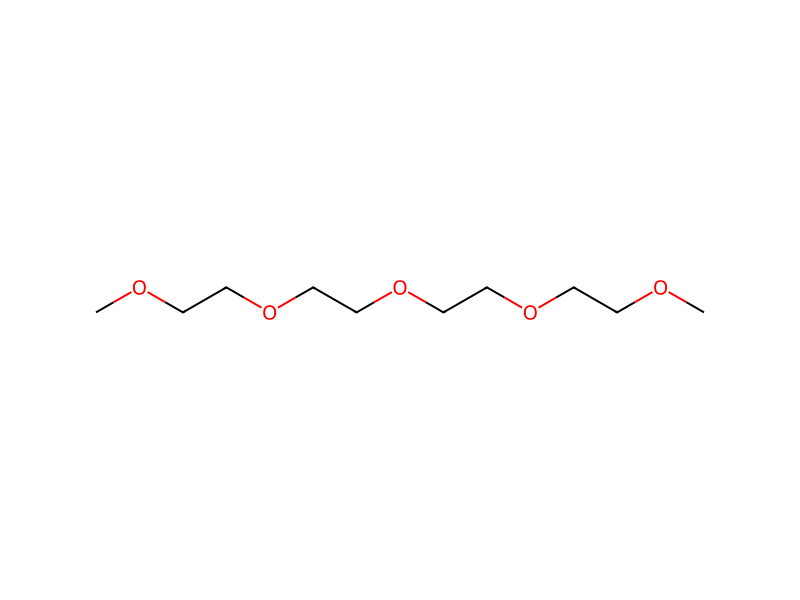
Basic information
- Standard SMILES
COCCOCCOCCOCCOC- InChIKey
ZUHZGEOKBKGPSW-UHFFFAOYSA-N- Molecular formula
- C10H22O5
- Average molar mass
- 222.28 g/mol
- Monoisotopic mass
- 222.1467238
Overview
Tetraglyme is a polyether.
Names & identifiers
- Preferred name
- Tetraglyme
- IUPAC
- 1-methoxy-2-[2-[2-(2-methoxyethoxy)ethoxy]ethoxy]ethane
- English name
- Dimethoxytetraglycol
- Molecular formula
- C10H22O5
- Molecular weight
- 222.27868
Names & synonyms
Tetraglyme143-24-8Tetraethylene glycol dimethyl ether2,5,8,11,14-PENTAOXAPENTADECANEDimethoxytetraethylene glycolGlyme 5Ansul ether 181ATDimethoxytetraglycolBis[2-(2-methoxyethoxy)ethyl] etherNissan uniox MM 200Methyltetraglyme200DTXSID7044396
Show more names
E181 (Ether)Bis(2-(2-methoxyethoxy)ethyl) ether78L136FLZ9NSC-65624DTXCID5024396CHEBI:46785RefChem:188598205-594-7
Database identifiers
- CAS
143-24-8- PubChem CID
- 8925
- DTXSID
DTXSID7044396- ChEMBL
CHEMBL3182543- ChEBI
CHEBI:46785- UNII
- 78L136FLZ9
- EC Number
- 205-594-7
- Nikkaji
- J5.817C
Properties
Computed structural properties
- XLogP
- -0.7
- Topological polar surface area
- 46.2 Ų
- Hydrogen bond donors
- 0
- Hydrogen bond acceptors
- 5
- Rotatable bonds
- 12
- Heavy atoms
- 15
- Formal charge
- 0
- Complexity
- 98
Experimental & physicochemical properties
DrugsPharmaceuticals -> Listed in ZINC15
SolventsSolvents -> Glycol Ethers (Glymes)
SpringerMaterials PropertiesBoiling point
SurfactantsSurfactant
Physical Description
Liquid; Liquid; Wet Solid
Liquid; [Merck Index] Clear colorless liquid; [Sigma-Aldrich MSDS]
Collision Cross Section147.3 Ų [M+Na]+ [CCS Type: DT; Buffer gas: N2; Ionization: ESI+; Dataset: TOXCAST; Source Identifier: DTXSID7044396]
Physicochemical properties
- Boiling point
- 275 · 275-276°C
- Density
- 1.009 · 1.009
- form
- A liquid
- Substances of Very High Concern (SVHC) Candidate List
- Bis(2-(2-methoxyethoxy)ethyl)ether (143-24-8)
- Toxicity
- 50 orl-rat: · LD50 orl-rat: 5140 mg/kg JIHTAB 23,259,41
Safety & regulation
GHS classification
GHS Classification
Danger
H360FD: May damage fertility; May damage the unborn child [Danger Reproductive toxicity]
P203, P280, P318, P405, and P501 (click each P-code to see the statement)
This chemical does not meet GHS hazard criteria for 14.4% (71 of 494) of reports.
Danger
H360 (54.3%): May damage fertility or the unborn child [Danger Reproductive toxicity]
Hazard information
Regulatory Information
Chemical: 2,5,8,11,14-Pentaoxapentadecane
Hazard Traits - Reproductive Toxicity
2,5,8,11,14-Pentaoxapentadecane is listed on the EPA's Chemical Data Reporting (CDR) system. Manufacturers and importers of 2,5,8,11,14-Pentaoxapentadecane are required to report information about their production and use of this chemical to the EPA under the Toxic Substances Control Act (TSCA). (40 eCFR Part 711)
SP - indicates a substance that is identified in a proposed Significant New Use Rule.
Status: Active Update: 05-07-2022 https://echa.europa.eu/registration-dossier/-/registered-dossier/14547
Substance: Bis(2-(2-methoxyethoxy)ethyl)ether
Other Safety InformationEvaluation - 2,5,8,11,14-Pentaoxapentadecane (tetraglyme)
Hazards Summary
A mild eye irritant; Causes somnolence and GI, kidney, and bladder changes in oral lethal-dose studies of rats; [RTECS] May form explosive peroxides on prolonged storage or contact with air; An eye irritant; [Sigma-Aldrich MSDS] See Monoglyme.
Peroxide Forming Chemical
Tetraethylene glycol dimethyl ether
D: Other compounds that may form peroxides
Kelly
Hazard Classes and Categories
Repr. 1A (54.3%)
Reproductive toxicity - category 1B
Reproductive toxicity - Category 1B
Repr. 1B
Toxicology
Adverse EffectsNeurotoxin - Acute solvent syndrome
Safety data
- Toxicity
- LD50 orl-rat: 5140 mg/kg JIHTAB 23,259,41
Chemistry & industry
Uses & manufacturing
UsesUsed as a solvent; [Merck Index]
U.S. Production2023: 75,000 - <100,000 lb
Consumer UsesSolvent
Industry UsesFlux agent
General Manufacturing Information
Petroleum Lubricating Oil and Grease Manufacturing
2,5,8,11,14-Pentaoxapentadecane: ACTIVE
Suppliers50 total
国药集团化学试剂有限公司86-21-63210123 · [email protected]
梯希爱(上海)化成工业发展有限公司021-67121386 · [email protected]
上海阿拉丁生化科技股份有限公司400-6206333 13167063860 · [email protected]
爱斯特(成都)生物制药股份有限公司+86-28-85122536 85324413 · [email protected]
韶远科技(上海)有限公司021-50795510 4000665055 · [email protected]
科瑞迪化学400-821-5857 021-64326257 · [email protected]
Ark Pharm, Inc.847-367-3680 · [email protected]
上海迈瑞尔生化科技有限公司4006356688 18621169109 · [email protected]
阿法埃莎(中国)化学有限公司400-6106006 · [email protected]
安耐吉化学&3A(安徽泽升科技股份有限公司)400-0056266 · [email protected]
北京绿百草科技发展有限公司010-61136123 · [email protected]
上海瀚鸿科技股份有限公司021-54306202 13764082696 · [email protected]
凯试(上海)科技有限公司021-50135380 · [email protected]
山东西亚化学有限公司13355009207 13355009207 · [email protected]
玛雅试剂+86 (573) 82222445 (0)18006601000 452520369 · [email protected]
四川库利南科技有限公司400-1166-196 18981987031 · [email protected]
天津希恩思生化科技有限公司400 638 7771 · [email protected]
斯百全化学(上海)有限公司021-021-021-67601398-809-809-809 15221380277 · [email protected]
艾科试剂4008-755-333 18080918076 · [email protected]
上海思域化工科技有限公司86-21-34053660 · [email protected]
赛默飞世尔科技(中国)有限公司800-810-5118 · [email protected]
北京伊诺凯科技有限公司400-810-7969 010-59572699 · [email protected]
江苏艾康生物医药研发有限公司025-66113011 13913916777 · [email protected]
TCI AMERICA800-4238616 · [email protected]
TOKYO CHEMICAL INDUSTRY CO., LTD.03-36680489 · [email protected]
TCI Europe320-37350700 · [email protected]
上海贤鼎生物科技有限公司4009209199 · [email protected]
上海倍卓生物科技有限公司021-61119791,13386096464 · [email protected]
北京环宇世纪化学科技有限公司hysj_bj.com
上海将来实业股份有限公司021-61552785 · [email protected]
美岚实业(上海)有限公司021-58958189 · [email protected]
成都零六生物科技有限公司400-1166-196 13458535857 · [email protected]
上海麦克林生化科技股份有限公司15221275939 15221275939 · [email protected]
杭州杰恒化工有限公司0571-87396432 · [email protected]
上海有朋化工有限公司021-69005955 13701776567 · [email protected]
北京海力扬化学科技有限公司13718199399 · [email protected]
北京欣赛维化学科技有限公司010-56218822 13717722232 · [email protected]
四川海诺威科技有限公司13708085536 13708085536 · [email protected]
上海凯赛化工有限公司021-33516722 13701817765 · [email protected]
上海彤源化工有限公司021-021-69182866 13701855675 · [email protected]
Shenzhen Vtolo Chemicals Co., Ltd.13534282526 · [email protected]
上海蓝润化学有限公司021-69515658 ; 69515628 13701998368 · [email protected]
上海容立化学科技有限公司021-69992220 13701886816 · [email protected]
上海康拓化工有限公司021-69185552 13701777608 · [email protected]
湖北巨胜科技有限公司027-59599241 18871490274 · [email protected]
池州凯隆进出口贸易有限公司[email protected]
Sigma-Aldrich西格玛奥德里奇(上海)贸易有限公司021-61415566 800-8193336 · [email protected]
潍坊市前进精细化工有限公司18753684562 · [email protected]
TargetMol中国(陶术生物)021-021-33632979 15002134094 · [email protected]
成都瑞欧克科技有限公司028-64353063 · [email protected]
Additional notes
DefinitionChEBI: Tetraglyme is a polyether.
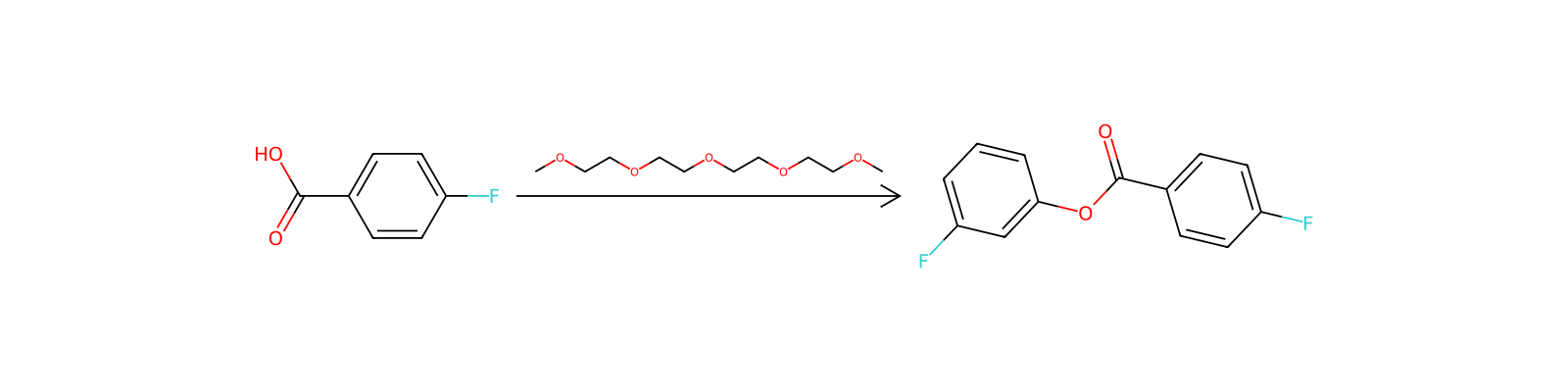
Related reactions
33 records






Linked notes
Loading…