
Methyl 3-amino-2-thiophenecarboxylate
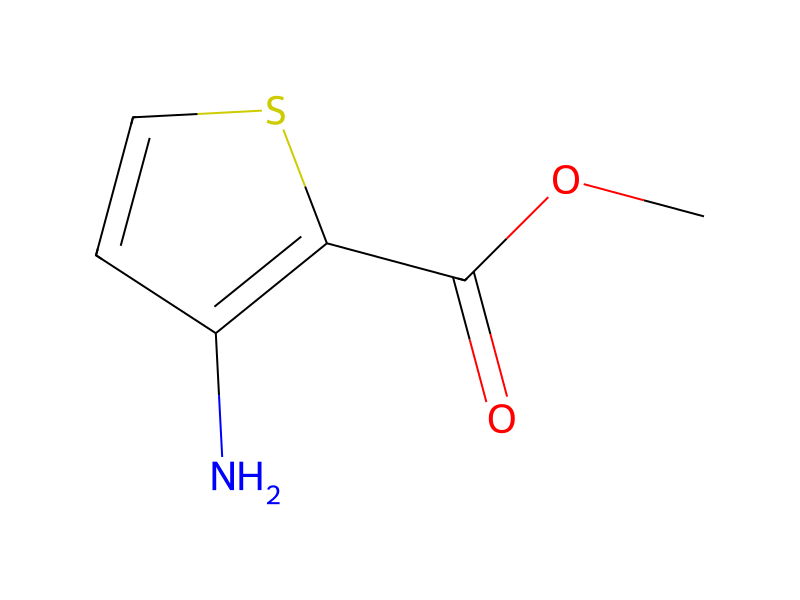
Basic information
- CAS
22288-78-4- Standard SMILES
COC(=O)c1sccc1N- InChIKey
TWEQNZZOOFKOER-UHFFFAOYSA-N- Molecular formula
- C6H7NO2S
- Average molar mass
- 157.19 g/mol
- Monoisotopic mass
- 157.01974964
Names & identifiers
- Preferred name
- Methyl 3-amino-2-thiophenecarboxylate
- IUPAC
- methyl 3-aminothiophene-2-carboxylate
- English name
- Methyl 3-amino-2-thiophenecarboxylate
- Molecular formula
- C6H7NO2S
- Molecular weight
- 157.19
Names & synonyms
22288-78-4Methyl 3-aminothiophene-2-carboxylateMethyl 3-amino-2-thiophenecarboxylate2-Thiophenecarboxylic acid, 3-amino-, methyl ester3-Amino-thiophene-2-carboxylic acid methyl esterEINECS 244-895-8E7S8G23AHXDTXSID7073436RefChem:815157DTXCID3036658244-895-83-Aminothiophene-2-carboxylic acid methyl ester
Show more names
3-aminothiophene-2-carboxylateM3AT2CAKOS 92421ina-5545-2Methyl3-amAKOS B020093Methyl 3-amino-2-3-Amino-2-thenoateRARECHEM AM UC 0123
MFCD000097653-Amino-2-thiophenecarboxylic Acid Methyl Estermethyl 3-amino-2-thiophene carboxylate3-Amino-2-carbomethoxythiophene64615-13-0ZINC105231methyl3-aminothiophene-2-carboxylateUNII-E7S8G23AHX
Database identifiers
- CAS
22288-78-4- PubChem CID
- 89652
- DTXSID
DTXSID7073436- UNII
- E7S8G23AHX
- EC Number
- 244-895-8
- Nikkaji
- J207.957G
Properties
Computed structural properties
- XLogP
- 1.7
- Topological polar surface area
- 80.6 Ų
- Hydrogen bond donors
- 1
- Hydrogen bond acceptors
- 4
- Rotatable bonds
- 2
- Heavy atoms
- 10
- Formal charge
- 0
- Complexity
- 140
Physicochemical properties
- Melting point
- 62 · 62-64 °C (lit.)
- Boiling point
- 100 · 100-102 °C/0.1 mmHg (lit.)
- Density
- 1.274 · 1.274 (estimate)
- refractive index
- 1.55 · 1.5500 (estimate)
- Flash point
- 100 · 100-102°C/0.1mm
- storage temp.
- Keep in dark place,Inert atmosphere,Room temperature
- solubility
- Soluble in alcohol, toluene, xylene and other solvents
- form
- Fine Crystalline Powder
- pka
- 1.86 · 1.86±0.10(Predicted)
- color
- Beige to beige-brown
- Water Solubility
- Slightly soluble in water.
- BRN
- 1365614 · 1365614
- InChI
- InChI=1S/C6H7NO2S/c1-9-6(8)5-4(7)2-3-10-5/h2-3H,7H2,1H3
- InChIKey
- TWEQNZZOOFKOER-UHFFFAOYSA-N
- SMILES
- C1(C(OC)=O)SC=CC=1N
Safety & regulation
Safety information is for reference only and does not replace the supplier’s Safety Data Sheet (SDS), applicable regulations, or professional assessment.
GHS classification
GHS Classification
Warning
H315 (96.2%): Causes skin irritation [Warning Skin corrosion/irritation]
P261, P264, P264+P265, P271, P280, P302+P352, P304+P340, P305+P351+P338, P319, P321, P332+P317, P337+P317, P362+P364, P403+P233, P405, and P501 (click each P-code to see the statement)
Aggregated GHS information provided per 53 reports by companies from 12 notifications to the ECHA C&L Inventory. Each notification may be associated with multiple companies.
Hazard information
Regulatory InformationPMN - indicates a commenced PMN (Pre-Manufacture Notices) substance.
Hazard Classes and CategoriesSkin Irrit. 2 (96.2%)
Safety data
- PPE
- dust mask type N95 (US), Eyeshields, Gloves
- wgk
- 3
- tsca
- TSCA listed
- rtecs
- XM8347500
- hs_code
- 29349990
- risk_code
- 36/37/38
- Signal word
- Warning
- Symbol(GHS)
- GHS07
- hazard_code
- Xi
- safety_code
- 26-37/39-36/37/39-22
- hazard_class
- IRRITANT
- Storage Class
- 11 - Combustible Solids
- target organs
- Respiratory system
Chemistry & industry
Uses & manufacturing
General Manufacturing Information2-Thiophenecarboxylic acid, 3-amino-, methyl ester: INACTIVE
Applications
UsesMethyl 3-amino-2-thiophenecarboxylate was used in:the synthesis of 4-nitro and 4-aminothienyl ureastotal synthesis of quinazolinocarboline alkaloidspreparation of thienopyrimidinone analogs
UsesMethyl 3-amino-2-thiophenecarboxylate is the starting material for synthesising Belvarafenib. Belvarafenib is a small-molecule RAF dimer (type II) inhibitor with potential antitumour activity.
General DescriptionMethyl 3-amino-2-thiophenecarboxylate reacts with hydrazonoyl chlorides in the presence of triethylamine to yield corresponding N-arylamidrazones.
Upstream & downstream products
Upstream raw materials
Related reactions
276 records


Compound notes
Loading…