
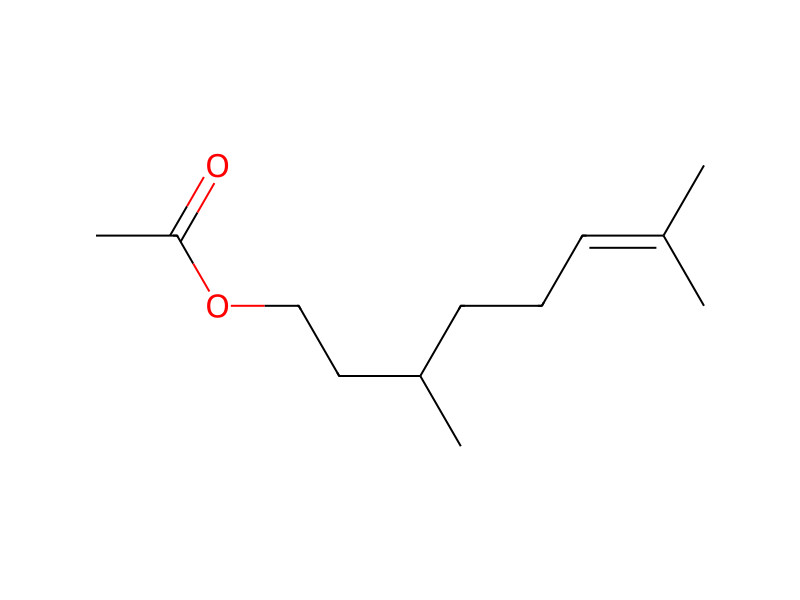
Basic information
- Standard SMILES
CC(=O)OCCC(C)CCC=C(C)C- InChIKey
JOZKFWLRHCDGJA-UHFFFAOYSA-N- Molecular formula
- C12H22O2
- Average molar mass
- 198.3 g/mol
- Monoisotopic mass
- 198.16197994
Names & identifiers
- Preferred name
- Citronellyl Acetate
- IUPAC
- 3,7-dimethyloct-6-enyl acetate
- English name
- Citronellyl acetate
- Molecular formula
- C12H22O2
- Molecular weight
- 198.3
Names & synonyms
Citronellyl acetate150-84-53,7-dimethyloct-6-enyl acetate3,7-Dimethyl-6-octen-1-yl acetateAcetic acid, citronellyl ester6-Octen-1-ol, 3,7-dimethyl-, 1-acetate2-Octen-8-ol, 2,6-dimethyl-, acetateFEMA No. 2311FEMA No. 2981IZ420RT3OYDTXSID5051739NSC-4893
Show more names
3,7-Dimethyl-6-octenyl acetateCitronelly acetateAcetic acid ester leMongrassCephereine3,7-DIMETHYL-6-OCTEN-1-OL ACETATEFEMA 2311CephreineCitronellylacetat
RefChem:32710DTXCID5030294205-775-0266-837-03,7-Dimethyloct-6-en-1-yl acetateCitronellol acetate1-Acetoxy-3,7-dimethyloct-6-ene6-Octen-1-ol, 3,7-dimethyl-, acetate
Database identifiers
- CAS
150-84-5、67601-05-2、67650-82-2- PubChem CID
- 9017
- DTXSID
DTXSID5051739- ChEMBL
CHEMBL1453648- ChEBI
CHEBI:70478- UNII
- IZ420RT3OY
- EC Number
- 205-775-0、266-837-0
- Nikkaji
- J2.964E
Properties
Computed structural properties
- XLogP
- 3.8
- Topological polar surface area
- 26.3 Ų
- Hydrogen bond donors
- 0
- Hydrogen bond acceptors
- 2
- Rotatable bonds
- 7
- Heavy atoms
- 14
- Formal charge
- 0
- Complexity
- 190
Experimental & physicochemical properties
LogP4.220
Density0.883-0.893
Solubility
soluble in alcohol, most fixed oils; insoluble in glycerol, propylene glycol, water
1 ml in 9 ml 70% alcohol (in ethanol)
Boiling Point
229.00 °C. @ 760.00 mm Hg
229 °C
Refractive Index1.440-1.450
Physical Description
Liquid
colourless liquid/fruity odour
Kovats Retention Index
1331;1331;1334;1332;1354;1336;1333;1314;1326;1331;1340;1333;1332;1335;1338;1332;1332;1332;1332;1338
1351.9;1353;1356;1351;1353;1354;1354;1355;1353;1348;1357;1347;1354;1353;1351;1349;1347;1335;1353;1358
1657;1662;1658;1666;1655;1658;1623;1648;1662;1648;1675;1663;1658;1649;1654;1692;1654;1673;1668;1668
Physicochemical properties
- Melting point
- 17.88 °C · 17.88°C (estimate)
- Boiling point
- 240 °C · 240 °C(lit.)
- Density
- 0.891 g/mL · 0.891 g/mL at 25 °C(lit.)
- vapor pressure
- 1.97 Pa · 1.97Pa at 20℃
- refractive index
- 20 · n20/D 1.445(lit.)
- FEMA
- 2311 · 2311 | CITRONELLYL ACETATE
- FLAVIS Number
- 9.012 · 09.012 | Citronellyl acetate
- Flash point
- 218 °F · 218 °F
- storage temp.
- Sealed in dry,Room Temperature
- solubility
- 100 mg/mL · DMSO : 100 mg/mL (504.29 mM; Need ultrasonic)
- form
- Liquid
- color
- Colorless liquid
- Odor
- fruity odor
- Odor Type
- floral
- biological source
- synthetic
- Water Solubility
- PRACTICALLY INSOLUBLE
- JECFA Number
- 57 · 57
- Major Application
- flavors and fragrances
- Cosmetics Ingredients Functions
- FRAGRANCE
- InChI
- 1S/C12H22O2/c1-10(2)6-5-7-11(3)8-9-14-12(4)13/h6,11H,5,7-9H2,1-4H3
- InChIKey
- JOZKFWLRHCDGJA-UHFFFAOYSA-N
- SMILES
- CC(CCOC(C)=O)CC\C=C(\C)C
- LogP
- 4.9 at · 4.9 at 25℃
- CAS DataBase Reference
- 150 · 150-84-5(CAS DataBase Reference)
- Substances Added to Food (formerly EAFUS)
- CITRONELLYL ACETATE
- FDA 21 CFR
- 172.515 · 172.515
- EWG's Food Scores
- 1 · 1
- FDA UNII
- 420 RT3OY · IZ420RT3OY
- NIST Chemistry Reference
- Citronellyl acetate(150-84-5)
- EPA Substance Registry System
- Citronellol acetate (150-84-5)
- UNSPSC Code
- 12164502 · 12164502
- NACRES
- 21 · NA.21
- Symbol(GHS)
- 7 · GHS07
- Signal word
- Danger
- Hazard statements
- 315 · H315-H319-H335
- Precautionary statements
- 261 · P261-P280a-P304+P340-P305+P351+P338-P405-P501a
- PPE
- Eyeshields, Gloves, multi-purpose combination respirator cartridge (US)
- Risk Statements
- 36 · 36/37/38
- Safety Statements
- 24 · 24/25-37-26
- WGK Germany
- 2 · 2
- RTECS
- 3422500 · RH3422500
- TSCA
- TSCA listed
- HS Code
- 29153900 · 29153900
- Storage Class
- 10 · 10 - Combustible liquids
- Toxicity
- 50 orl-rat: · LD50 orl-rat: 6800 mg/kg FCTXAV 11,1011,73
- REACH Registrations
- Active
Safety & regulation
GHS classification
GHS Classification
Warning
H315 (> 99.9%): Causes skin irritation [Warning Skin corrosion/irritation];H319 (14.5%): Causes serious eye irritation [Warning Serious eye damage/eye irritation];H411 (97.6%): Toxic to aquatic life with long lasting effects [Hazardous to the aquatic environment, long-term hazard]
P264, P264+P265, P273, P280, P302+P352, P305+P351+P338, P321, P332+P317, P337+P317, P362+P364, P391, and P501 (click each P-code to see the statement)
Aggregated GHS information provided per 2000 reports by companies from 17 notifications to the ECHA C&L Inventory. Each notification may be associated with multiple companies.;Information may vary between notifications depending on impurities, additives, and other factors. The percentage value in parenthesis indicates the notified classification ratio from companies that provide hazard codes. Only hazard codes with percentage values above 10% are shown. For more detailed information, please visit ECHA C&L website.
Hazard information
Regulatory Information
Chemical: 6-Octen-1-ol, 3,7-dimethyl-, acetate
Regulation (EC) No 1831/2003 (amended)
6-Octen-1-ol, 3,7-dimethyl-, 1-acetate is listed on the EPA's Chemical Data Reporting (CDR) system. Manufacturers and importers of 6-Octen-1-ol, 3,7-dimethyl-, 1-acetate are required to report information about their production and use of this chemical to the EPA under the Toxic Substances Control Act (TSCA). (40 eCFR Part 711)
Status: Active Update: 10-01-2020 https://echa.europa.eu/registration-dossier/-/registered-dossier/5472
Citronellyl acetate: Does not have an individual approval but may be used under an appropriate group standard
Other Safety InformationIMAP assessments - 6-Octen-1-ol, 3,7-dimethyl-, acetate: Human health tier I assessment
Hazard Classes and CategoriesSkin Irrit. 2 (> 99.9%);Eye Irrit. 2 (14.5%);Aquatic Chronic 2 (97.6%)
Regulatory information
Regulatory Information
Chemical: 6-Octen-1-ol, 3,7-dimethyl-, acetate
Regulation (EC) No 1831/2003 (amended)
6-Octen-1-ol, 3,7-dimethyl-, 1-acetate is listed on the EPA's Chemical Data Reporting (CDR) system. Manufacturers and importers of 6-Octen-1-ol, 3,7-dimethyl-, 1-acetate are required to report information about their production and use of this chemical to the EPA under the Toxic Substances Control Act (TSCA). (40 eCFR Part 711)
Status: Active Update: 10-01-2020 https://echa.europa.eu/registration-dossier/-/registered-dossier/5472
Citronellyl acetate: Does not have an individual approval but may be used under an appropriate group standard
Safety data
- PPE
- Eyeshields, Gloves, multi-purpose combination respirator cartridge (US)
- wgk
- 2
- tsca
- TSCA listed
- rtecs
- RH3422500
- hs_code
- 29153900
- Toxicity
- LD50 orl-rat: 6800 mg/kg FCTXAV 11,1011,73
- risk_code
- 36/37/38
- Signal word
- Danger
- Symbol(GHS)
- GHS07
- safety_code
- 24/25-37-26
- Storage Class
- 10 - Combustible liquids
- Hazard statements
- H315-H319-H335
- REACH Registrations
- Active
- Precautionary statements
- P261-P280a-P304+P340-P305+P351+P338-P405-P501a
Chemistry & industry
Pharmacology
Cellular LocationsExtracellular;Membrane
Uses & manufacturing
U.S. Production2023: 8,500,000 - <10,000,000 lb;2022: 8,500,000 - <10,000,000 lb;2021: 8,500,000 - <10,000,000 lb;2020: 8,500,000 - <10,000,000 lb
Consumer UsesFragrance
Industry UsesOther;Fragrance
IFRA Fragrance Standards
Citronellyl acetate
Citronellyl acetate; 3,7-Dimethyl-6-octen-1-ol acetate; 3,7-Dimethyl-6-octen-1-yl acetate; 3,7-Dimethyloct-6-en-1-yl acetate; 6-Octen-1-ol, 3,7-dimethyl-, acetate; Acetic acid, citronellyl ester; laevo-Citronellyl acetate; 3,7-Dimethyloct-6-enyl acetate; 6-Octen-1-ol, 3,7-dimethyl-, 1-acetate (3S)-; 6-Octen-1-ol, 3,7-dimethyl-, acetate (S)-; (S)-3,7-Dimethyloct-6-en-1-yl acetate; (-)-3,7-dimethyloct-6-enyl acetate; alpha-Citronellyl acetate; 3,7-Dimethyl-(6-or 7-)octen-1-yl acetate; 3,7-Dimethyl-(6-or 7-)octen-1-yl ethanoate; 3,7-Dimethyloct-7-en-1-yl acetate; 7-Octen-1-ol, 3,7-dimethyl-, acetate; 3,7-Dimethyl-7-octen-1-yl acetate; 3,7-Dimethyl-7-octen-1-yl ethanoate; (S)-3,7-Dimethyloct-7-enyl acetate; Rhodinyl acetate; Rhodinyl ethanoate; l-Citronellyl acetate (commercial name)
IFRA_STD_248.pdf
51
IFRA 51st Amendment - Guidance for the use of IFRA Standards
Restriction: This material should be used only in the limited quantity as stated in the Standard
Household ProductsInformation on 41 consumer products that contain Citronellyl Acetate in the following categories is provided:;• Auto Products;• Commercial / Institutional;• Inside the Home;• Personal Care
Use Classification
Fragrance Ingredients
Fragrance Ingredients
Flavouring Agent -> FLAVOURING_AGENT -> JECFA Functional Classes
Flavoring Agents -> JECFA Flavorings Index
Cosmetics -> Masking
General Manufacturing Information
Soap, Cleaning Compound, and Toilet Preparation Manufacturing;All Other Chemical Product and Preparation Manufacturing
6-Octen-1-ol, 3,7-dimethyl-, 1-acetate: ACTIVE
Restriction Limits in the Finished Product (%)
0.49 [Products applied to the lips]
0.15 [Products applied to the axillae]
2.0 [Products applied to the face/body using fingertips]
2.7 [Products related to fine fragrances]
0.70 [Products applied to the body using the hands (palms), primarily leave-on (Body lotion)]
0.70 [Products applied to the face using the hands (palms), primarily leave-on (Face moisturizer)]
Applications
OccurrenceReported in the oil of citronella, Chamaecyparis lawsoniana Parl, orange juice, lemon juice, lemon and grapefruit peel oil, swangi (Citrus hystrix D.C.), ginger, tarragon, myrtle leaf, nutmeg, Cympogon citralis oil and beer.
UsesCitronellyl acetate is used as a reactant, and oxidized by ruthenium tetroxide catalyst in presence of acetonitrile.
UsesPerfumery, flavoring.
Preparation methods
PreparationBy esterification of citronellol with acetic acid or acetic anhydride.
Upstream & downstream products
Upstream raw materials
Suppliers3 total
上海珈得尔化学技术有限公司021-4007787-550 400-7787-550 · [email protected]
career henan chemical co+86-0371-86658258 · [email protected]
DAYANG CHEM (HANGZHOU) CO.,LTD+86-88938639 +86-17705817739 · [email protected]
Additional notes
DefinitionChEBI: A monoterpenoid that is the acetate ester of citronellol. It has been isolated from Citrus hystrix.
Related reactions
7 records


Linked notes
Loading…