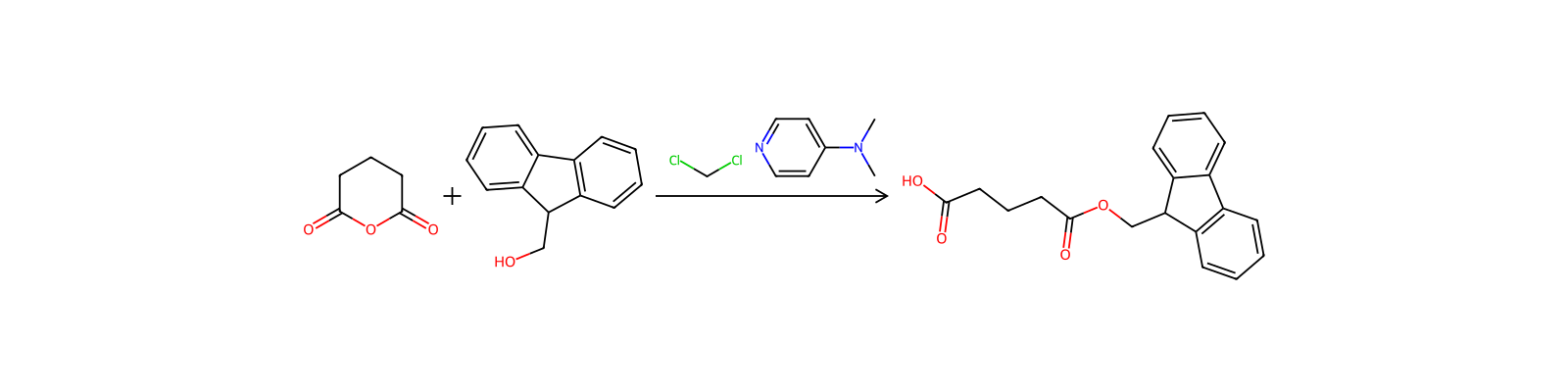

Basic information
- CAS
24324-17-2- Standard SMILES
OCC1c2ccccc2-c2ccccc21- InChIKey
XXSCONYSQQLHTH-UHFFFAOYSA-N- Molecular formula
- C14H12O
- Average molar mass
- 196.24 g/mol
- Monoisotopic mass
- 196.088815
Names & identifiers
- Preferred name
- 9H-Fluorene-9-methanol
- IUPAC
- 9H-fluoren-9-ylmethanol
- English name
- 9-Fluorenemethanol
- Molecular formula
- C14H12O
- Molecular weight
- 196.24
Names & synonyms
24324-17-29H-Fluorene-9-methanolFluorene-9-methanol(Fluoren-9-yl)methanolEINECS 246-167-5DTXSID7066980RefChem:549969DTXCID1037064246-167-59-Fluorenemethanol9-Fluorenylmethanol9H-Fluoren-9-ylmethanol
Show more names
FMOC-OHFMOLFM-OHFoMc-OHFluorenemethanolFLUORENYL METHANOLHOFMFMOC-hydroxy
(9h-fluoren-9-yl)methanol9-(Hydroxymethyl)fluorene9-HydroxymethylfluoreneMFCD000011399-Fluorenyl Methanolfluoren-9-ylmethan-1-ol9-fluorenmethanol9-FluorenYl-Methanol
Database identifiers
- CAS
24324-17-2- PubChem CID
- 90466
- DTXSID
DTXSID7066980- UNII
- AWJ7E4RKJ8
- EC Number
- 246-167-5
- Nikkaji
- J208.517H
Properties
Computed structural properties
- XLogP
- 2.7
- Topological polar surface area
- 20.2 Ų
- Hydrogen bond donors
- 1
- Hydrogen bond acceptors
- 1
- Rotatable bonds
- 1
- Heavy atoms
- 15
- Formal charge
- 0
- Complexity
- 203
Experimental & physicochemical properties
LogP2.89
Endocrine DisruptorsPotential endocrine disrupting compound
Physicochemical properties
- Melting point
- 105 · 105-107 °C (lit.)
- Boiling point
- 293.14 °C · 293.14°C (rough estimate)
- Density
- 1.0304 · 1.0304 (rough estimate)
- refractive index
- 1.5385 · 1.5385 (estimate)
- storage temp.
- Sealed in dry,Room Temperature
- solubility
- Soluble in methanol.
- form
- Crystalline Powder
- pka
- 13.68 · 13.68±0.10(Predicted)
- color
- White to pale yellow
- BRN
- 2330017 · 2330017
- InChI
- InChI=1S/C14H12O/c15-9-14-12-7-3-1-5-10(12)11-6-2-4-8-13(11)14/h1-8,14-15H,9H2
Safety & regulation
GHS classification
GHS Classification
Warning
H302 (100%): Harmful if swallowed [Warning Acute toxicity, oral]
P261, P264, P264+P265, P270, P271, P280, P301+P317, P302+P352, P304+P340, P305+P351+P338, P319, P321, P330, P332+P317, P337+P317, P362+P364, P403+P233, P405, and P501 (click each P-code to see the statement)
The GHS information provided by 1 company from 1 notification to the ECHA C&L Inventory.
Hazard information
Hazard Classes and CategoriesAcute Tox. 4 (100%)
Safety data
- PPE
- Eyeshields, Gloves, type N95 (US)
- wgk
- 3
- tsca
- TSCA listed
- hs_code
- 29062900
- risk_code
- 36/37/38
- Signal word
- Warning
- Symbol(GHS)
- GHS07
- hazard_code
- Xi
- hazard_note
- Irritant
- safety_code
- 22-24/25-36/37/39-27-26
- Storage Class
- 11 - Combustible Solids
- Hazard statements
- H302-H320-H402
- Precautionary statements
- P501-P273-P270-P264-P337+P313-P305+P351+P338-P301+P312+P330
Chemistry & industry
Uses & manufacturing
General Manufacturing Information9H-Fluorene-9-methanol: INACTIVE
Applications
Uses9-Fluorenylmethanol(FMOC-OH) acts as a N-protecting reagent, which is used in the synthesis of peptide. It is also used in the preparation of deoxynucleoside 9-fluorenemethyl phosphorodithioates. Further, it is used to prepare 9-(fluoromethyl)fluorene. In addition to this, it is involved in the electropolymerization with boron trifluoride diethyl etherate to yield low-potential electrodeposition of semiconducting poly(9-fluorenemethanol) film.
Uses9-Fluorenemethanol(FMOC-OH), N-protecting reagent, was used in the peptide syntheses. 9-Fluorenemethanol was also used in the synthesis of deoxynucleoside 9-fluorenemethyl phosphorodithioates.
General DescriptionVibrational spectroscopy of jet-cooled 9-fluorenemethanol and its clusters 9-fluorenemethanol-H2O, 9-fluorenemethanol-CH3OH, 9-fluorenemethanol-C2H5OH and 9-fluorenemethanol-C3H7OH has been studied by IR-UV double-resonance method.
Preparation methods
PreparationIn the presence of a catalyst, a hydrogen atom at the 9-position of fluorene is removed as a proton, and the resulting fluorene anion reacts with ethyl formate to produce 9-fluorenaldehyde. Using a reducing agent, 9-fluorenaldehyde is reduced to the crude product 9-Fluorenemethanol.
Upstream & downstream products
Upstream raw materials
Downstream products
Related reactions
25 records


Compound notes
Loading…