
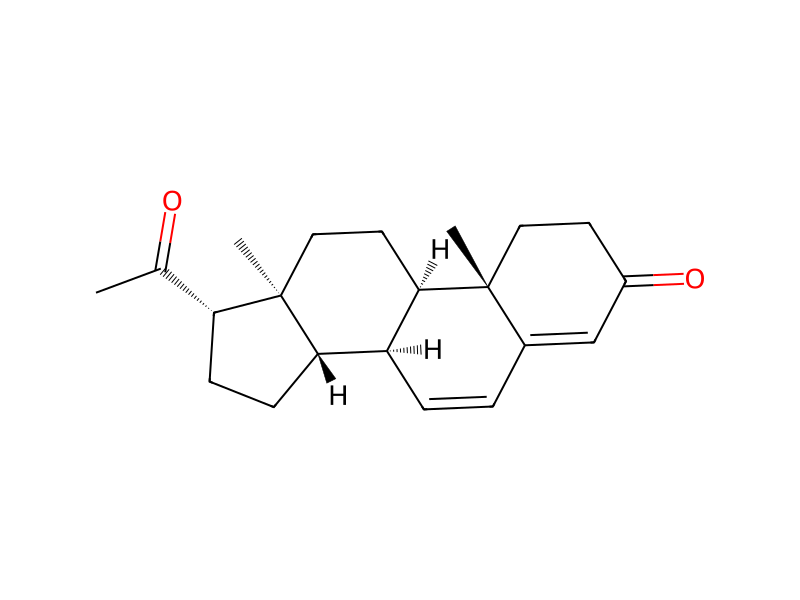
Basic information
- Standard SMILES
CC(=O)[C@H]1CC[C@H]2[C@@H]3C=CC4=CC(=O)CC[C@@]4(C)[C@@H]3CC[C@]12C- InChIKey
JGMOKGBVKVMRFX-HQZYFCCVSA-N- Molecular formula
- C21H28O2
- Average molar mass
- 312.4 g/mol
- Monoisotopic mass
- 312.20893013
Names & identifiers
- Preferred name
- Dydrogesterone
- IUPAC
- (8S,9R,10S,13S,14S,17S)-17-acetyl-10,13-dimethyl-1,2,8,9,11,12,14,15,16,17-decahydrocyclopenta[a]phenanthren-3-one
- English name
- Dydrogesterone
- Molecular formula
- C21H28O2
- Molecular weight
- 312.45
Names & synonyms
dydrogesterone152-62-5IsopregnenoneHydrogesteroneDuphastonGynorestHydrogestroneGestatronRetroneDiphastonDufastonDuvaron
Show more names
Dydrogesteron(9beta,10alpha)-pregna-4,6-diene-3,20-dioneDH 33DuvaroRetron
TerolutProdel10alpha-IsopregnenoneRetro-6-dehydroprogesteroneDidrogesteroneDydrogesteronumdelta(6)-Retroprogesteronedidrogesterona
Database identifiers
- CAS
152-62-5- PubChem CID
- 9051
- DTXSID
DTXSID1022974- ChEMBL
CHEMBL1200853- ChEBI
CHEBI:31527- UNII
- 90I02KLE8K
- EC Number
- 205-806-8
- Nikkaji
- J3.272G
Properties
Computed structural properties
- XLogP
- 3.8
- Topological polar surface area
- 34.1 Ų
- Hydrogen bond donors
- 0
- Hydrogen bond acceptors
- 2
- Rotatable bonds
- 1
- Heavy atoms
- 23
- Formal charge
- 0
- Complexity
- 628
Experimental & physicochemical properties
LogP
3.4
3.4
OdorOdorless
Color/Form
Crystals from acetone + hexane
White to off-white...crystalline powder.
Solubility
Soluble in acetone, chloroform (1 in 2), ethanol (1 in 40) and diethyl ether (1 in 200); slightly soluble in fixed oils; sparingly soluble in methanol.
4.86e-03 g/L
Melting Point
168-169
170 °C
169.5 °C
Optical RotationSpecific optical rotation: -484.5 deg at 25 °C/D (chloroform)
Physical DescriptionSolid
Physicochemical properties
- Melting point
- 168 · 168-173°C
- alpha
- 25 · D25 -484.5° (chloroform)
- Boiling point
- 392.36 °C · 392.36°C (rough estimate)
- Density
- 1.0697 · 1.0697 (rough estimate)
- refractive index
- 1.49 · 1.4900 (estimate)
- storage temp.
- 2 · 2-8°C
- solubility
- Practically insoluble in water, soluble in acetone, sparingly soluble in ethanol (96 per cent).
- form
- Solid
- color
- White to Light Yellow
- Major Application
- pharmaceuticalpharmaceutical small molecule
- InChI
- InChI=1/C21H28O2/c1-13(22)17-6-7-18-16-5-4-14-12-15(23)8-10-20(14,2)19(16)9-11-21(17,18)3/h4-5,12,16-19H,6-11H2,1-3H3/t16-,17+,18-,19+,20+,21+/s3
- InChIKey
- JGMOKGBVKVMRFX-HQZYFCCVSA-N
- SMILES
- C[C@@]12CCC(=O)C=C1C=C[C@@]1([H])[C@]3([H])CC[C@H](C(=O)C)[C@@]3(C)CC[C@@]21[H] |&1:1,10,12,16,20,24,r|
- CAS DataBase Reference
- 152 · 152-62-5(CAS DataBase Reference)
- FDA UNII
- 90 I02KLE8K · 90I02KLE8K
- NCI Drug Dictionary
- Duphaston
- ATC code
- 3 DB01 · G03DB01
- UNSPSC Code
- 41116107 · 41116107
- Symbol(GHS)
- 8 · GHS08,GHS09
- Signal word
- Danger
- Hazard statements
- 372 · H372-H410
- Precautionary statements
- 260 · P260-P264-P270-P314-P501-P273-P391-P501
- RIDADR
- 3077 · UN 3077 9 / PGIII
- WGK Germany
- 3 · WGK 3
- Storage Class
- 11 · 11 - Combustible Solids
- Hazardous Substances Data
- 152 · 152-62-5(Hazardous Substances Data)
- Toxicity
- 50 oral · LD50 oral in rat: > 4600mg/kg
Safety & regulation
GHS classification
GHS Classification
Danger
H372 (97.8%): Causes damage to organs through prolonged or repeated exposure [Danger Specific target organ toxicity, repeated exposure];H410 (91.3%): Very toxic to aquatic life with long lasting effects [Warning Hazardous to the aquatic environment, long-term hazard]
P260, P264, P270, P273, P319, P391, and P501 (click each P-code to see the statement)
Aggregated GHS information provided per 46 reports by companies from 4 notifications to the ECHA C&L Inventory. Each notification may be associated with multiple companies.;Information may vary between notifications depending on impurities, additives, and other factors. The percentage value in parenthesis indicates the notified classification ratio from companies that provide hazard codes. Only hazard codes with percentage values above 10% are shown. For more detailed information, please visit ECHA C&L website.
Hazard information
FDA RequirementsThe Approved Drug Products with Therapeutic Equivalence Evaluations identifies discontinued drug products. Dydrogesterone is included on this list.
Hazard Classes and CategoriesSTOT RE 1 (97.8%);Aquatic Chronic 1 (91.3%)
Safety & protection
Storage ConditionsDo not store above 30 °C.
Disposal Methods
SRP: At the time of review, regulatory criteria for small quantity disposal are subject to significant revision, however, household quantities of waste pharmaceuticals may be managed as follows: Mix with wet cat litter or coffee grounds, double bag in plastic, discard in trash.
SRP: Expired or waste pharmaceuticals shall carefully take into consideration applicable DEA, EPA, and FDA regulations. It is not appropriate to dispose by flushing the pharmaceutical down the toilet or discarding to trash. If possible return the pharmaceutical to the manufacturer for proper disposal being careful to properly label and securely package the material. Alternatively, the waste pharmaceutical shall be labeled, securely packaged and transported by a state licensed medical waste contractor to dispose by burial in a licensed hazardous or toxic waste landfill or incinerator.
Toxicology
Human Toxicity Excerpts
/HUMAN EXPOSURE STUDIES/ The aim of this study was to evaluate the impact of a three-month continuous administration of oral E2, alone, or combined with 2 different dosages of dydrogesterone, on the glucose tolerance and insulin sensitivity in postmenopausal women. In a prospective placebo-controlled study, 43 normal weight and normoinsulinemic women were randomized to receive either 2 mg of oral 17beta E2 daily (group A), or 2 mg E2 daily plus 5 mg daily oral dydrogesterone, from day 14 to 28, in a sequentially combined regimen (group B), or 2 mg of E2 and 10 mg dydrogesterone in the same sequentially combined regimen (group C) or placebo for 12 weeks. An OGTT and a euglycemic hyperinsulinemic clamp were performed before and after treatment. Serum glucose and insulin concentrations were measured both in fasting conditions and after OGTT. C-peptide pancreatic secretion was tested only in fasting conditions. Total body glucose utilization (M), for insulin sensitivity evaluation, was determined in each subject. Postmenopausal women treated with unopposed 17beta E2 (group A) showed a slight but statistically significant decrease of insulin sensitivity (p<0.05). A more marked deterioration of the same parameter was observed in the 2 groups treated with E2 plus dydrogesterone (group B and group C: p<0.01). Post hoc testing for the percent change from baseline indicated that group A significantly differed from group C (p<0.05) and all treated groups significantly differed from the placebo group (p<0.01). Finally, after treatment in group C, a significant reduction of insulin and an increase of glucose responses to OGTT (p<0.01) were observed. These results indicate that, in a short-term period, the use of 17beta E2 and overall 17beta E2 plus dydrogesterone, even with the reduction of insulin plasma levels, might cause a decrease in insulin sensitivity in normal weight and normoinsulinemic post-menopausal women.
/SIGNS AND SYMPTOMS/ Both estradiol and dydrogesterone are substances with low toxicity. Theoretically, symptoms such as nausea, vomiting, sleepiness and dizziness could occur in cases of overdosing. It is unlikely that any specific or symptomatic treatment will be necessary.
/CASE REPORTS/ In December, 1986, a 29 year old woman developed nephrosis due to systemic lupus erythematosus after taking oral contraceptives (OC) for 6.5 years. Hospitalized for 3 months, she received steroid treatment, which lowered albumin in urine. At the time of hospitalization, the following symptoms were noted. Edema on all her limbs, 4.5 g/dl of urine albumin per day, white blood cell count of 2600/mm, 640 time positive anti-nuclear antibodies, pseudo-positive response to syphilis via bentonite flocculation on particle (BFP). OC she had taken since 1980 were 0.5 mg of norgestrel day and 0/05 mg of ethinyl estradiol day. She had been routinely checked on her kidney function biannually and everything had been normal till then. For 2 months starting in December, 1987, at the patient's request, progesterone along (dydrogesterone 10 mg/day) was administered for contraception. No urine albumin was detected. It appears that autoimmune-type thyroid gland abnormality preceded systemic lupus erythematosus (SLE) which was triggered by the oral contraceptive use. Estrogen metabolism of SLE patients is characterized by estrogen active 16 alpha hydroxyestrone.
/CASE REPORTS/ Dydrogesterone, similar to women's natural progesterone, has been used in a wide range of gynecological conditions. /The authors/ describe a case of hepatitis and warm antibody hemolytic anemia due to dydrogesterone.
For more Human Toxicity Excerpts (Complete) data for DYDROGESTERONE (23 total), please visit the HSDB record page.
Drug Induced Liver Injury
Drug-Induced Liver Injury Severity and Toxicity (DILIst)
Dydrogesterone
DILI Positive
DOI:10.1016/j.drudis.2019.09.022
Non-Human Toxicity Excerpts
/LABORATORY ANIMALS: Subchronic or Prechronic Exposure/ Dydrogesterone (0.1 mg, sc) injected into rats daily for 14 days incr FSH-releasing hormone in the hypothalamus and also increased LH-releasing hormone-like substance in the hypothalamus.
/GENOTOXICITY/ Four steroids that share the 17-hydroxy-3-oxopregna-4,6-diene structure - cyproterone acetate, chlormadinone acetate, megestrol acetate, and potassium canrenoate - have been shown previously to behave with different potency as liver-specific genotoxic agents, the response being markedly higher in female than in male rats, but similar in humans of both genders. In this study, performed to better define the relationship between chemical structure and genotoxicity, dydrogesterone (DGT) with double bonds C4=C5 and C6=C7, dienogest (DNG) with double bonds C4=C5 and C9=C10, and 1,4,6-androstatriene-17beta-ol-3-one acetate (ADT) with double bonds C1=C2, C4=C5 and C6=C7, were compared with cyproterone acetate (CPA) for their ability to induce DNA fragmentation and DNA repair synthesis in primary cultures of hepatocytes from three rats of each sex. At subtoxic concentrations, ranging from 10 to 90 microM, all four steroids consistently induced a dose-dependent increase of DNA fragmentation, which in all cases was higher in females than in males; their DNA damaging potency decreased in the order CPA > DNG > ADT > DGT. Under the same experimental conditions, the responses provided by the DNA repair-synthesis assay were positive or inconclusive in hepatocytes from female rats and consistently negative in hepatocytes from male rats. In the induction of apoptotic cells examined in primary hepatocytes from female rats, CPA was more active than ADT and DGT, and DNG was inactive. Considered as a whole these findings suggest that a liver-specific genotoxic effect more marked in female than in male rats might be a common property of steroids with two or three double bonds.
/GENOTOXICITY/ Progesterone (PG) and three structurally similar synthetic progestins-norethisterone (NE), allylestrenol (AE), and dydrogesterone (DG)-have been compared for their ability to induce the formation of micronuclei and of enzyme-altered foci in the liver of female rats. In the micronucleus assay, carried out in rats given a single p.o. dose of 100 mg kg-1 3 days before partial hepatectomy and sacrificed for cell sampling 2 days later, the frequency of micronucleated hepatocytes was 3.5-fold higher than in controls with PG, 2.8-fold with DG, 2.2-fold with NE and 2.1-fold with AE, but the increase was statistically significant only for PG. In the liver foci assay, performed to evaluate the tumor initiating activity of p. o. dosing with 100 mg kg-1 once a week for 6 successive weeks, the values of the number and area of gamma-glutamyltranspeptidase-positive foci were, as compared to controls, 15.9- and 100-fold higher with NE, and 13.9- and 52-fold higher with AE, but only the increase of area produced by NE was statistically significant; PG and DG did not display in this test any activities. Considered together with previous findings, these results suggest that NE might be biotransformed in the liver into reactive species and thus behave as a weak genotoxic agent.
Populations at Special Risk
Generally recognised risk factors for venous thrombo embolus (VTE) include a personal or family history, severe obesity (BMI>30 kg/sq m) and systemic lupus erythematosus (SLE). There is no consensus about the possible role of varicose veins in VTE.
Patients with rare hereditary problems of galactose intolerance, the Lapp lactase deficiency or glucose-galactose malabsorption should not take this medicine.
Probable Routes of Human ExposureNIOSH (NOES Survey 1981-1983) has statistically estimated that 191 workers (82 of these were female) were potentially exposed to dydrogesterone in the US(1).
Antidote and Emergency Treatment
/SRP:/ Immediate first aid: Ensure that adequate decontamination has been carried out. If patient is not breathing, start artificial respiration, preferably with a demand valve resuscitator, bag-valve-mask device, or pocket mask, as trained. Perform CPR if necessary. Immediately flush contaminated eyes with gently flowing water. Do not induce vomiting. If vomiting occurs, lean patient forward or place on the left side (head-down position, if possible) to maintain an open airway and prevent aspiration. Keep patient quiet and maintain normal body temperature. Obtain medical attention. /Poisons A and B/
/SRP:/ Basic treatment: Establish a patent airway (oropharyngeal or nasopharyngeal airway, if needed). Suction if necessary. Watch for signs of respiratory insufficiency and assist ventilations if needed. Administer oxygen by nonrebreather mask at 10 to 15 L/min. Monitor for pulmonary edema and treat if necessary ... . Monitor for shock and treat if necessary ... . Anticipate seizures and treat if necessary ... . For eye contamination, flush eyes immediately with water. Irrigate each eye continuously with 0.9% saline (NS) during transport ... . Do not use emetics. For ingestion, rinse mouth and administer 5 mL/kg up to 200 mL of water for dilution if the patient can swallow, has a strong gag reflex, and does not drool ... . Cover skin burns with dry sterile dressings after decontamination ... . /Poisons A and B/
/SRP:/ Advanced treatment: Consider orotracheal or nasotracheal intubation for airway control in the patient who is unconscious, has severe pulmonary edema, or is in severe respiratory distress. Positive-pressure ventilation techniques with a bag valve mask device may be beneficial. Consider drug therapy for pulmonary edema ... . Consider administering a beta agonist such as albuterol for severe bronchospasm ... . Monitor cardiac rhythm and treat arrhythmias as necessary ... . Start IV administration of D5W /SRP: "To keep open", minimal flow rate/. Use 0.9% saline (NS) or lactated Ringer's if signs of hypovolemia are present. For hypotension with signs of hypovolemia, administer fluid cautiously. Watch for signs of fluid overload ... . Treat seizures with diazepam or lorazepam ... . Use proparacaine hydrochloride to assist eye irrigation ... . /Poisons A and B/
Regulatory information
FDA RequirementsThe Approved Drug Products with Therapeutic Equivalence Evaluations identifies discontinued drug products. Dydrogesterone is included on this list.
Safety data
- wgk
- WGK 3
- ridadr
- UN 3077 9 / PGIII
- Toxicity
- LD50 oral in rat: > 4600mg/kg
- Signal word
- Danger
- Symbol(GHS)
- GHS08,GHS09
- Storage Class
- 11 - Combustible Solids
- Hazard statements
- H372-H410
- Precautionary statements
- P260-P264-P270-P314-P501-P273-P391-P501
- Hazardous Substances Data
- 152-62-5(Hazardous Substances Data)
Chemistry & industry
Pharmacology
ATC Code
G03DB01
G - Genito urinary system and sex hormones;G03 - Sex hormones and modulators of the genital system;G03D - Progestogens;G03DB - Pregnadien derivatives;G03DB01 - Dydrogesterone
QG - Genito urinary system and sex hormones;QG03 - Sex hormones and modulators of the genital system;QG03D - Progestogens;QG03DB - Pregnadien derivatives;QG03DB01 - Dydrogesterone
Pharmacodynamics
Dydrogesterone is an orally active progestogen which acts directly on the uterus, producing a complete secretory endometrium in an estrogen-primed uterus. At therapeutic levels, dydrogesterone has no contraceptive effect as it does not inhibit or interfere with ovulation or the corpus luteum. Furthermore, dydrogesterone is non-androgenic, non-estrogenic, non-corticoid, non-anabolic and is not excreted as pregnanediol. Dydrogesterone helps to regulate the healthy growth and normal shedding of the uterus lining. Therefore, it may be useful in the treatment of menstrual disorders such as absent, irregular or painful menstrual periods, infertility, premenstrual syndrome and endometriosis.
Mechanism of Action
Dydrogesterone is a progestogen that works by regulating the healthy growth and normal shedding of the womb lining by acting on progesterone receptors in the uterus.
Dydrogesterone is an orally-active progestagen. The addition of a progestagen greatly reduces the estrogen-induced risk of endometrial hyperplasia and cancer in non-hysterectomised women, by reducing the growth of the endometrium.
Progestins cannot be equated as group with progesterone because some are inherently estrogenic, some slightly androgenic, and some purely progestational; correspondingly, their ovulation-inhibiting potentialities may be mediated in somewhat different ways. /Progestins/
The 17-hydroxy or acetoxy compounds, on the other hand, elicit responses more nearly resembling those of progesterone. They have little or no estrogenic or androgenic activity and may produce catabolic and slight diuretic effects. The 19-nor derivatives are more effective in postponing the normal menstrual period. /Progestins/
Accumulating evidence indicates that the neuropeptide substance P (SP) is predominantly involved in neurogenic inflammation and pain perception via its high-affinity neurokinin 1 receptor (NK-1R). Intriguingly, decreased pain sensitivity is found to be associated with high plasma progesterone levels. We hypothesize that progesterone may attenuate nociception and associated inflammatory response via NK-1R-dependent pathways. To address our hypothesis, we incubated splenic lymphocytes from CBA/J female mice with different concentrations of the progesterone derivative dydrogesterone. Subsequently, the expressions of NK-1R and T helper (Th1)-type cytokines were analyzed by flow cytometry. Next, we subcutaneously injected CBA/J mice with 1.25 mg of dydrogesterone in 200-microl sesame oil; control mice were sham-injected. Tail flick test to detect the nociceptive threshold was performed in 30-min intervals upon injection. Lymphocytes were isolated from blood and uterus and analyzed for NK-1R surface expression. Immunohistochemical analyses were performed to investigate the uterine tissue distribution of NK-1R. Dydrogesterone induced a decrease in the percentage of NK-1R+ lymphocytes in vitro and in vivo. Additionally, an increase in Th2-type and a decrease in Th1-type cytokines could be detected in vitro after incubation with dydrogesterone. An increased tail flick latency following dydrogesterone injection supported the concept that decreased expression of the NK-1R on lymphocytes is associated with an increased pain threshold. Taken together, these results clearly reveal a pathway by which dydrogesterone or progesterone respectively modulates the cross talk of the nervous, endocrine and immune systems in inflammation and pain.
For more Mechanism of Action (Complete) data for DYDROGESTERONE (6 total), please visit the HSDB record page.
Biological Half-Life
Dydrogesterone: 5-7 hours, 20-dihydrodydrogesterone (DHD) metabolite: 14-17 hours
Mean terminal half lives of dydrogesterone and DHD vary between 5 to 7 and 14 to 17 hours, respectively.
Metabolism/Metabolites
Metabolism is complete to a 20-dihydrodydrogesterone (DHD) metabolite.
In man, dydrogesterone is completely metabolised. The main metabolite of dydrogesterone is 20alpha-dihydrodydrogesterone (DHD) and is present in the urine predominantly as the glucuronic acid conjugate. A common feature of all metabolites characterized is the retention of the 4,6 diene-3-one configuration of the parent compound and the absence of 17alpha-hydroxylation. This explains the absence of estrogenic and androgenic activity.
Dydrogesterone is not excreted in urine as pregnanediol, like progesterone. Analysis of endogenous progesterone production based on pregnanediol excretion therefore remains possible.
MeSH Pharmacological Classification
Compounds that interact with PROGESTERONE RECEPTORS in target tissues to bring about the effects similar to those of PROGESTERONE. Primary actions of progestins, including natural and synthetic steroids, are on the UTERUS and the MAMMARY GLAND in preparation for and in maintenance of PREGNANCY.
Absorption, Distribution and Excretion
Rapidly absorbed in the gastrointestinal tract with a bioavailability of 28%.
After oral administration of labelled dydrogesterone, on average 63% of the dose is excreted into the urine. Within 72 hours, excretion is complete.
After oral administration of dydrogesterone, plasma concentrations of DHD are substantially higher as compared to the parent drug. The AUC and Cmax ratios of DHD to dydrogesterone are in the order of 40 and 25, respectively. Dydrogesterone is rapidly absorbed. The Tmax values of dydrogesterone and DHD vary between 0.5 and 2.5 hours.
The dihydrodydrogesterone Caverage is 13 ng/mL, the Cmin is 4.1 ng/mL and the Cmax is 63 ng/mL. The dydrogesterone Caverage is 0.38 ng/mL the Cmin is <0.1 ng/mL and the Cmax is 2.5 ng/mL.
Progestins are reportedly distributed into milk. The possible effects of progestins in milk on nursing infants have not been determined. /Progestins General Statement/
Cellular LocationsCytoplasm;Extracellular;Membrane
Uses & manufacturing
Uses
MEDICATION
Use (kg; approx.) in Germany (2009): >100;Consumption (g per capita; approx.) in Germany (2009): 0.00122;Calculated removal (%): 23.6
Methods of Manufacturing
It is believed to be prepared commercially from lumisterol (9beta,10alpha-ergosta-5,7,22-trien-3beta-ol derived from ultra-violet-irradiated ergosterol) via a multistep synthesis involving oxidation, isomerization, lithium reduction, ozonolysis of the side-chain and a final zinc reduction
Formulations/Preparations
Estradiol/dydrogesterone (Femoston) combination tablets: Round, biconvex, grey film-coated tablets
...MARKETED AS 5- & 10-MG TABLETS.
General Manufacturing Information...Derivative of retroprogesterone... /PRC: purely progestational/
Applications
DescriptionDydrogesterone is a synthetic progestogen that has no estrogenic, androgenic, glucocorticoid, or anabolic effects, although it is an agonist of progesterone receptors (EC50 = 12.3 nM) and an antagonist of androgen, mineralocorticoid, and glucocorticoid receptors (IC50s = 28.6, 82.7, and 363 nM, respectively). Dydrogesterone protects against sound stress-induced abortion in mice when administered at a dose of 1.25 mg per animal prior to the stressor on day five of pregnancy. Formulations containing dydrogesterone have been used in hormone replacement therapy, in the treatment of menstrual disorders, and to prevent miscarriage.
UsesDydrogesterone is a synthetic progestin largely used in hormone therapy, on the central nervous system by studying two markers of the neuroendocrine function: the neurosteroid allopregnanolone and the opioid .beta.-endorphin. Progestogen.
Upstream & downstream products
Upstream raw materials
Suppliers50 total
国药集团化学试剂有限公司86-21-63210123 · [email protected]
北京华美互利生物化工010-56205725 · [email protected]
台州开创生物医药有限公司+86-0576-88827176 +86-18906581668 · [email protected]
湖北永阔科技有限公司027-59223108 15972152991 · [email protected]
上海阿拉丁生化科技股份有限公司400-6206333 13167063860 · [email protected]
湖北万得化工有限公司15377098680 15377098680 · [email protected]
广州隽沐生物科技股份有限公司020-36607679; 13502246435 · [email protected]
湖北金梭生物科技有限公司00123456789 · [email protected]
Dayang Chem (Hangzhou) Co.,Ltd.+86-0571-88938639 17705817739 · [email protected]
广州隽唐科技有限公司020-36607679 13502246435 · [email protected]
南京世洲生物科技有限公司025-025-85560043 17301488900 · [email protected]
Hebei Yanxi Chemical Co., Ltd.+86-17531190177 · [email protected]
LGM Pharma1-(800)-881-8210 · [email protected]
江西瑞威尔生物科技有限公司400-880-2824 18107960669 · [email protected]
深圳市简一生物科技有限公司0755-84826604 · [email protected]
Cangzhou Wanyou New Material Technology Co.,Ltd18631714998 · [email protected]
上海柯维化学技术有限公司021-64609169 18901607656 · [email protected]
深圳市恩赞生物医药有限公司0755-25325458 13602565027 · [email protected]
西安泽邦生物科技有限公司[email protected]
MedBio脉铂医药021-69568360 18916172912 · [email protected]
上海钰康生物科技有限公司+86-18930848214 +86-021-56762820 · [email protected]
上海泰坦科技股份有限公司400-6009262 15618770481 · [email protected]
MedChemexpress LLC021-58955995 · [email protected]
Zhejiang J&C Biological Technology Co.,Limited+1-2135480471 · [email protected]
合肥天健化工有限公司551-65418679 15856988503;15837135945 · [email protected]
Nanjing Shizhou Biotechnology Co., Ltd+86-15850508050 · [email protected]
湖南汇百侍生物科技有限公司0731-85526065 13308475853 · [email protected]
上海复和化学科技有限公司0086-21-67651709 · [email protected]
成都思天德生物科技有限公司028-83243028 19136088901 · [email protected]
深圳振强药物研发有限公司0755-66853366 13670046396 · [email protected]
南京生利德生物科技有限公司025-57798810 18652991625 · [email protected]
上海陶素生化科技有限公司021-33632979 · [email protected]
南京世洲生物科技有限公司13675144456 · [email protected]
湖北威德利化学试剂有限公司186-02735115 18602735115 · [email protected]
北京奥秘佳得医药科技有限公司+86-13522808617 · [email protected]
南京世洲生物科技有限公司025-0258556344 17301488900 · [email protected]
凯试(上海)科技有限公司021-50135380 · [email protected]
Sigma-Aldrich西格玛奥德里奇(上海)贸易有限公司021-61415566 800-8193336 · [email protected]
上海楼岚生物科技有限公司021-52996696,15000506266 15000506266
ALB Technology Limited702-983-3769 · [email protected]
石家庄通洋进出口有限公司[email protected]
上海皓元医药股份有限公司021-58950125 · [email protected]
TargetMol中国(陶术生物)021-021-33632979 15002134094 · [email protected]
上海陶术生物科技股份有限公司+1-781-999-5354; +1-00000000000 · [email protected]
上海波以尔化工有限公司021-50182298 021-50180596 · [email protected]
资川生化科技(苏州)有限公司0512-66317708 13372112871 · [email protected]
杭州鼎燕化工有限公司0571-87157530-8003 18267553885 · [email protected]
济南岑奔医药科技有限公司14793566
安耐吉化学&3A(安徽泽升科技股份有限公司)400-0056266 · [email protected]
Alfa Chemistry+1-5166625404 · [email protected]
Additional notes
DefinitionChEBI: Dydrogesterone is a 3-oxo-Delta(4) steroid and a 20-oxo steroid. It has a role as a progestin.
Related reactions
1 records
Linked notes
Loading…