Completing data — refresh the page later to see the latest
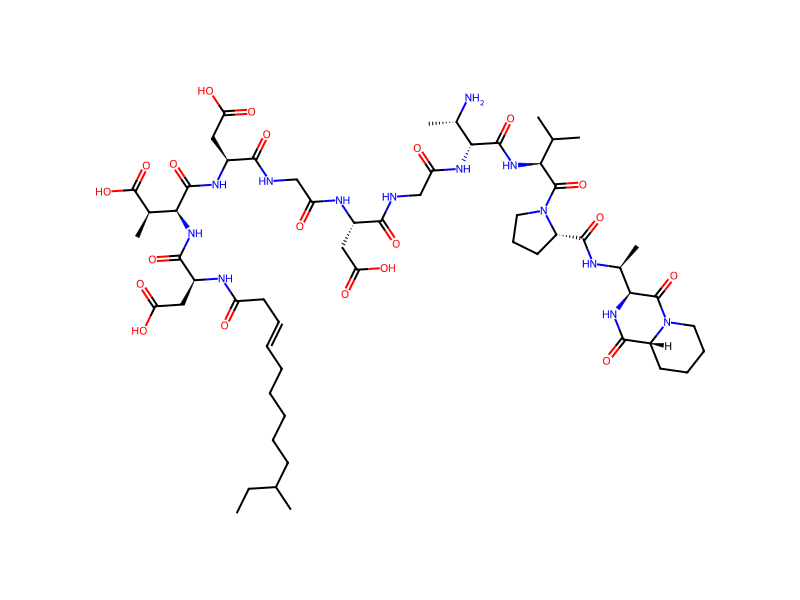
Basic information
- CAS
1402-82-0- Standard SMILES
CCC(C)CCCCC/C=C/CC(=O)N[C@@H](CC(=O)O)C(=O)N[C@H](C(=O)N[C@@H](CC(=O)O)C(=O)NCC(=O)N[C@@H](CC(=O)O)C(=O)NCC(=O)N[C@@H](C(=O)N[C@H](C(=O)N1CCC[C@H]1C(=O)N[C@@H](C)[C@@H]1NC(=O)[C@H]2CCCCN2C1=O)C(C)C)[C@H](C)N)[C@@H](C)C(=O)O- InChIKey
XBNDESPXQUOOBQ-LSMLZNGOSA-N- Molecular formula
- C58H91N13O20
- Average molar mass
- 1,290.437 g/mol
- Monoisotopic mass
- 1,289.65033231
Names & identifiers
- Preferred name
- Amphomycin
- IUPAC
- N-[(3E)-10-Methyldodec-3-enoyl]-L-alpha-aspartyl-3-methyl-L-alpha-aspartyl-L-alpha-aspartylglycyl-L-alpha-aspartyl-N-[(2R,3S)-3-amino-1-({(2S)-1-[(2S)-2-({(1S)-1-[(3S,9aR)-1,4-dioxooctahydro-2H-pyrido[1,2-a]pyrazin-3-yl]ethyl}carbamoyl)pyrrolidin-1-yl]-3-methyl-1-oxobutan-2-yl}amino)-1-oxobutan-2-yl]glycinamide
- English name
- Amphomycin
- Molecular formula
- C58H91N13O20
- Molecular weight
- 1290.43
Names & synonyms
amfamycinNsc267431Amphomycin
Database identifiers
- CAS
1402-82-0- PubChem CID
- 91663250
- DTXSID
DTXSID101017657- ChEMBL
CHEMBL2103921- UNII
- 4P63B997RT
- EC Number
- 215-760-0
Properties
Physicochemical properties
- alpha
- 25 · D25 +7.5° (c = 1 at pH 6)
- Boiling point
- 854.06 °C · 854.06°C (rough estimate)
- Density
- 1.0985 · 1.0985 (rough estimate)
- refractive index
- 1.67 · 1.6700 (estimate)
- storage temp.
- -20 °C · Store at -20°C
- solubility
- Soluble in DMSO
- form
- solid
- color
- Crystals
- EWG's Food Scores
- 1 · 1
- FDA UNII
- 4 P63B997RT · 4P63B997RT
- Toxicity
- 50 orl-mus: · LD50 orl-mus: 500 mg/kg 85GDA2 4(1),317,80
Safety & regulation
Safety information is for reference only and does not replace the supplier’s Safety Data Sheet (SDS), applicable regulations, or professional assessment.
Safety data
- Toxicity
- LD50 orl-mus: 500 mg/kg 85GDA2 4(1),317,80
Chemistry & industry
Applications
UsesAmphomycin is a lipopeptide antibiotic produced by Streptomycetes and Actinoplanes, initially reported by researchers at Bristol-Myers in 1953 from Streptomyces canus. Amphomycin was marketed as a complex of closely related analogues in the 1950s and 1960s. Structure elucidation was not completed until 2000. Amphomycin is active against Gram positive bacteria, inhibiting peptidoglycan synthesis and blocking cell wall development. Amphomycin is closely related to a number of “lost” antibiotics, aspartocin, crystallomycin, glumamycin, friulimicin, laspartocin, tsushimycin and zaomycin. Interest in amphomycin was re-awakened with the discovery of friulimicin activity against antibiotic resistant strains.
Upstream & downstream products
Upstream raw materials
Suppliers14 total
Career Henan Chemica Co+86-0371-86658258 +86-13203830695 · [email protected]
Shaanxi Cuikang Pharmaceutical Technology Co., Ltd+86-13119157289 · [email protected]
孟成科技(上海)有限公司400-820-6829 · [email protected]
MedBio脉铂医药021-69568360 18916172912 · [email protected]
上海维亦特生物科技有限公司15317051735 · [email protected]
BOC Sciences16314854226; +8616314854226 · [email protected]
浙江珲达生物科技有限公司0571-89903022 18679456698 · [email protected]
Related reactions
0 records
No reaction records under the current filter.
Compound notes
Loading…