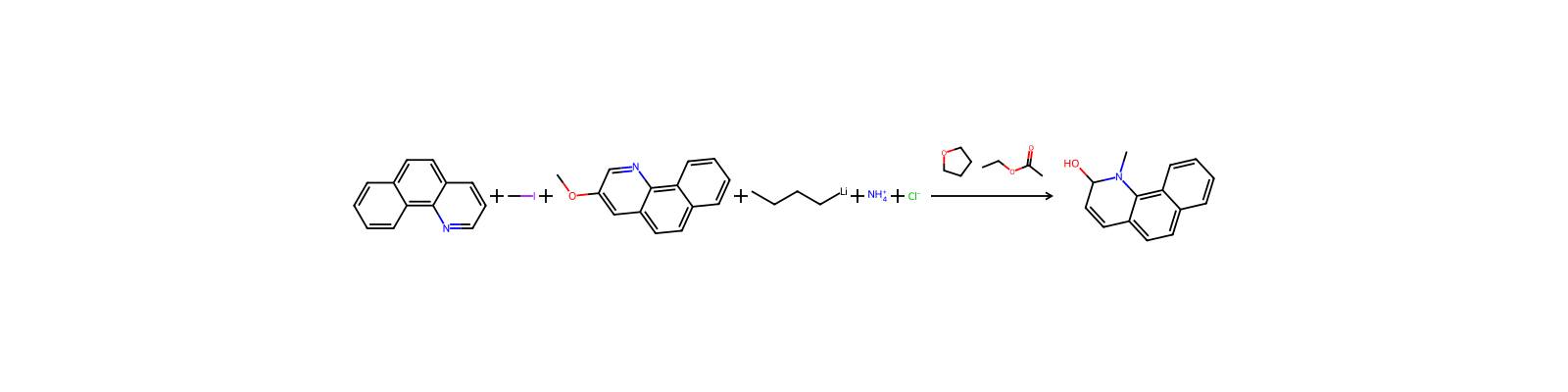
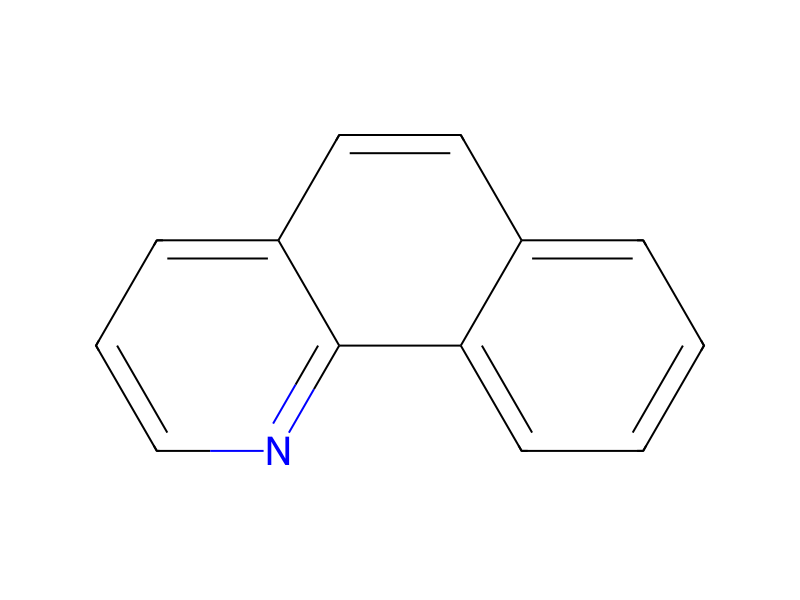
Basic information
- Standard SMILES
c1ccc2c(c1)ccc1cccnc12- InChIKey
WZJYKHNJTSNBHV-UHFFFAOYSA-N- Molecular formula
- C13H9N
- Average molar mass
- 179.22 g/mol
- Monoisotopic mass
- 179.07349929
Names & identifiers
- Preferred name
- Benzo(h)quinoline
- IUPAC
- benzo[h]quinoline
- English name
- 7,8-BENZOQUINOLINE
- Molecular formula
- C13H9N
- Molecular weight
- 179.22
Names & synonyms
Benzo[h]quinoline230-27-34-AzaphenanthreneBENZO(H)QUINOLINEalpha-Naphthoquinolinealpha-BenzoquinolineNSC-16033DTXSID1075199RefChem:518341DTXCID3036787205-937-07,8-Benzoquinoline
Show more names
A-NAPHTHOQUINOLINE7,8-BenzoquinoL7,S-Benzochinolinα-naphthaquinoline
1-Naphthoquinoline.alpha.-Benzoquinoline7,8-Benoz(h)quinoline7,8-BenzoquinalineCCRIS 801MFCD00004984.alpha.-Naphthoquinoline8KWJ7WT6Y7
Database identifiers
- CAS
230-27-3- PubChem CID
- 9191
- DTXSID
DTXSID1075199- ChEMBL
CHEMBL2227835- UNII
- 8KWJ7WT6Y7
- EC Number
- 205-937-0
- Nikkaji
- J5.436D
Properties
Computed structural properties
- XLogP
- 3.4
- Topological polar surface area
- 12.9 Ų
- Hydrogen bond donors
- 0
- Hydrogen bond acceptors
- 1
- Rotatable bonds
- 0
- Heavy atoms
- 14
- Formal charge
- 0
- Complexity
- 201
Experimental & physicochemical properties
Chemical ClassesNitrogen Compounds -> Quinolines
SpringerMaterials PropertiesAngular frequency
LogP3.25
Vapor Pressure0.000218 [mmHg]
Physical DescriptionDark yellow crystalline solid; [Sigma-Aldrich MSDS]
Ionization Efficiency
Positive
4.1
2.7
Agilent XCT
Electrospray ionization
formic acid (5.3nM)
Physicochemical properties
- Melting point
- 48 · 48-50 °C(lit.)
- Boiling point
- 338 °C719 · 338 °C719 mm Hg(lit.)
- Density
- 1.234 · 1.2340
- refractive index
- 1.727 · 1.7270 (estimate)
- Flash point
- 230 °F · >230 °F
- storage temp.
- Sealed in dry,Room Temperature
- solubility
- almost transparency in Methanol
- form
- Crystalline Powder
- pka
- 1 · pK1: 4.15(+1) (20°C)
- color
- Off-white to brown
- BRN
- 120249 · 120249
- InChI
- InChI=1S/C13H9N/c1-2-6-12-10(4-1)7-8-11-5-3-9-14-13(11)12/h1-9H
- InChIKey
- WZJYKHNJTSNBHV-UHFFFAOYSA-N
- SMILES
- N1C2C(=CC=C3C=CC=CC3=2)C=CC=1
- CAS DataBase Reference
- 230 · 230-27-3(CAS DataBase Reference)
- FDA UNII
- 8 KWJ7WT6Y7 · 8KWJ7WT6Y7
- NIST Chemistry Reference
- Benzo[h]quinoline(230-27-3)
- EPA Substance Registry System
- Benzo[h]quinoline (230-27-3)
- UNSPSC Code
- 12352100 · 12352100
- NACRES
- 22 · NA.22
- Symbol(GHS)
- 7 · GHS07
- Signal word
- Warning
- Hazard statements
- 315 · H315-H319-H335
- Precautionary statements
- 261 · P261-P301+P312-P302+P352-P304+P340-P305+P351+P338
- PPE
- 95 · Eyeshields, Gloves, type N95 (US)
- Hazard Codes
- Xi
- Risk Statements
- 36 · 36/37/38
- Safety Statements
- 22 · 22-24/25-36-26
- WGK Germany
- 3 · 3
- RTECS
- 1432000 · DK1432000
- HS Code
- 29339900 · 29339900
- Storage Class
- 11 · 11 - Combustible Solids
Safety & regulation
GHS classification
GHS Classification
Warning
H302 (100%): Harmful if swallowed [Warning Acute toxicity, oral]
P261, P264, P264+P265, P270, P271, P280, P301+P317, P302+P352, P304+P340, P305+P351+P338, P319, P321, P330, P332+P317, P337+P317, P362+P364, P403+P233, P405, and P501 (click each P-code to see the statement)
The GHS information provided by 1 company from 1 notification to the ECHA C&L Inventory.
Hazard information
Hazards SummaryMay cause irritation; [Sigma-Aldrich MSDS]
Hazard Classes and CategoriesAcute Tox. 4 (100%)
Safety data
- PPE
- Eyeshields, Gloves, type N95 (US)
- wgk
- 3
- rtecs
- DK1432000
- hs_code
- 29339900
- risk_code
- 36/37/38
- Signal word
- Warning
- Symbol(GHS)
- GHS07
- hazard_code
- Xi
- safety_code
- 22-24/25-36-26
- Storage Class
- 11 - Combustible Solids
- Hazard statements
- H315-H319-H335
- Precautionary statements
- P261-P301+P312-P302+P352-P304+P340-P305+P351+P338
Chemistry & industry
Applications
UsesBenzo[h]quinoline was used to study the mutagenic activities of benzo[f]quinoline, benzo[h]quinolone and a number of their derivatives in strain TA 100 of Salmonella typhimurium. It was used in determination of nitrogen-containing polynuclear aromatic hydrocarbons in the gaseous products of the thermal degradation of polymers by HPLC- fluorescence detection. It was used as starting reagent for the synthesis of osmium and ruthenium complexes containing an N-heterocyclic carbene ligand.
Upstream & downstream products
Upstream raw materials
Suppliers50 total
国药集团化学试剂有限公司86-21-63210123 · [email protected]
梯希爱(上海)化成工业发展有限公司021-67121386 · [email protected]
湖北永阔科技有限公司027-59223108 15972152991 · [email protected]
上海阿拉丁生化科技股份有限公司400-6206333 13167063860 · [email protected]
上海康朗生物科技有限公司021-61998208 18217752821 · [email protected]
上海莉凯化工技术有限公司16628776521 · [email protected]
上海麦克林生化科技股份有限公司021-50706066 15221275939 · [email protected]
武汉欣扬瑞和化学科技有限公司153-07155313 15307155313 · [email protected]
宁波季诺化学品有限公司0574-87314919 057487319282 · [email protected]
河北展药生物科技有限公司15369953316 +8615369953316 · [email protected]
爱斯特(成都)生物制药股份有限公司+86-28-85122536 85324413 · [email protected]
上海如吉生物科技发展有限公司+86-21-65211385-8001 36031160 · [email protected]
Dayang Chem (Hangzhou) Co.,Ltd.+86-0571-88938639 17705817739 · [email protected]
浙江珲达生物科技有限公司0571-89903022 18679456698 · [email protected]
上海弘顺生物科技有限公司15901914505 · [email protected]
毕佳索(上海毕得医药科技股份有限公司)400-6005915 · [email protected]
郑州德元凯化工有限公司17837139533 · [email protected]
韶远科技(上海)有限公司021-50795510 4000665055 · [email protected]
上海迈瑞尔生化科技有限公司4006356688 18621169109 · [email protected]
北京华威锐科化工有限公司0757-86329057 18934348241 · [email protected]
北京索莱宝科技有限公司010-50973130 17801761073 · [email protected]
武汉易泰科技有限公司上海分公司18930552037 · [email protected]
南京药石科技股份有限公司025-86918202 4000255188 · [email protected]
阿法埃莎(中国)化学有限公司400-6106006 · [email protected]
安耐吉化学&3A(安徽泽升科技股份有限公司)400-0056266 · [email protected]
上海瀚鸿科技股份有限公司021-54306202 13764082696 · [email protected]
广东方信生物科技有限公司0751-2838688 13376594225 · [email protected]
南京哈柏医药科技有限公司13376080562 13376090521 · [email protected]
上海隆盛化工有限公司58099637 13585536065 · [email protected]
郑州研德生物科技有限公司0371-63682289 15538176268 · [email protected]
南京唯博特医药科技有限公司18066048793; 18014498793 · [email protected]
苏州启航生物科技有限公司18662190603;18151111370 · [email protected]
四川库利南科技有限公司400-1166-196 18981987031 · [email protected]
天津希恩思生化科技有限公司400 638 7771 · [email protected]
TargetMol 中国(陶术生物)400-821-0310 15002144251 · [email protected]
广东元丰化学试剂有限公司0751-2829979 13376591640 · [email protected]
艾科试剂4008-755-333 18080918076 · [email protected]
赛默飞世尔科技(中国)有限公司800-810-5118 · [email protected]
江苏艾康生物医药研发有限公司025-66113011 13913916777 · [email protected]
上海健超生物科技有限公司150-2103-5486 18017383231 · [email protected]
TCI AMERICA800-4238616 · [email protected]
TOKYO CHEMICAL INDUSTRY CO., LTD.03-36680489 · [email protected]
TCI Europe320-37350700 · [email protected]
越林试剂021-62960152 · [email protected]
苏州亚科科技股份有限公司0512-87182055 13451648594 · [email protected]
常州市马龙化工有限公司18651958646
上海湄水化工科技有限公司021-60549325 18616193163
上海将来实业股份有限公司021-61552785 · [email protected]
安徽科迪达化工有限公司0554-2106669 · [email protected]
上海毕得医药科技股份有限公司400-164-7117 18317119277 · [email protected]
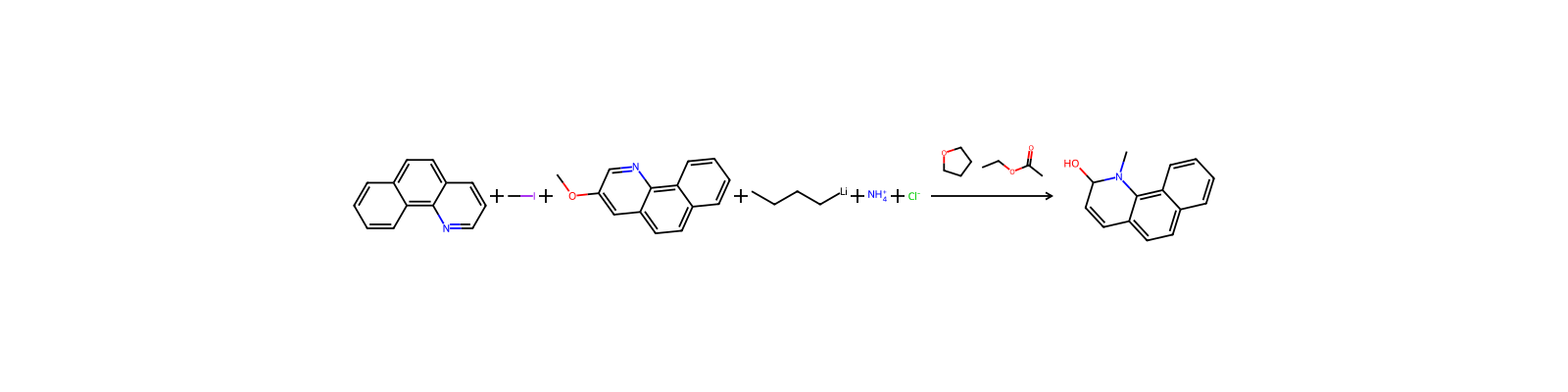
Related reactions
47 records




Linked notes
Loading…