HomeMCPWorkbenchSkills
HomeWorkbenchNotificationsMe
llms.txt · MCP GuidePrivacy Policy · Terms of Service · Supportv1.8.0
  1. Home
  2. /Compound

Thiazole

HCID 9256
New noteNew reactionRequest quotes
Print preview

Completing data — refresh the page later to see the latest

Basic informationOverviewNames & identifiersPropertiesSafety & regulationChemistry & industryRelated reactionsCompound notes
Substructure searchFind similar structures

Basic information

CAS
288-47-1
Standard SMILES
c1cscn1
InChIKey
FZWLAAWBMGSTSO-UHFFFAOYSA-N
Molecular formula
C3H3NS
Average molar mass
85.13 g/mol
Monoisotopic mass
84.9986201

Overview

Thiazole appears as colorless or pale yellow liquid with a foul odor. (NTP, 1992)

Names & identifiers

Preferred name
Thiazole
IUPAC
1,3-thiazole
English name
Thiazole
Molecular formula
C3H3NS
Molecular weight
85.13

Names & synonyms

THIAZOLE288-47-11,3-ThiazoleThiazolesFEMA No. 3615320RCW8PEFDTXSID2059776CHEBI:43732RefChem:897653DTXCID4037875CHEBI:48901206-021-3
Show more names
FEMA 3615Thiazole >Thiazole,98%THIAZOLE 99+%FEMA NUMBER 3615Thiazole in methanolThiazole (6CI, 8CI, 9CI, ACI)
MFCD00005315THIAN-4-ONEOXIMEthiazoltzCCRIS 3205EINECS 206-021-3UNII-320RCW8PEFBRN 0103852

Database identifiers

CAS
288-47-1
PubChem CID
9256
DTXSID
DTXSID2059776
ChEMBL
CHEMBL15605
ChEBI
CHEBI:43732
UNII
320RCW8PEF
EC Number
206-021-3
Nikkaji
J26D

Properties

Computed structural propertiesFilling in

XLogP
0.4
Topological polar surface area
41.1 Ų
Hydrogen bond donors
0
Hydrogen bond acceptors
2
Rotatable bonds
0
Heavy atoms
5
Formal charge
0
Complexity
30.1

Experimental & physicochemical properties

Chemical ClassesNitrogen Compounds -> Thiazoles
SpringerMaterials Properties15N nuclear magnetic resonance spectrum
LogP · 2 items

0.44

0.44

Food AdditivesFLAVORING AGENT OR ADJUVANT -> FDA Substance added to food
Density · 2 items

1.1998 (NTP, 1992) - Denser than water; will sink

1.198-1.202

Solubility · 3 items

Slightly soluble (NTP, 1992)

Slightly soluble in water; Soluble in ether

Miscible at room temperature (in ethanol)

Boiling Point · 3 items

242.2 °F at 760 mmHg (NTP, 1992)

115.00 to 118.00 °C. @ 760.00 mm Hg

115-118 °C

Refractive Index1.531-1.541
Physical Description

Safety & regulation

Safety information is for reference only and does not replace the supplier’s Safety Data Sheet (SDS), applicable regulations, or professional assessment.

GHS classification

GHS Classification · 4 items

Danger

H225 (86.3%): Highly Flammable liquid and vapor [Danger Flammable liquids]

P210, P233, P240, P241, P242, P243, P261, P264, P264+P265, P270, P271, P280, P301+P317, P302+P352, P303+P361+P353, P304+P340, P305+P354+P338, P317, P319, P321, P330, P332+P317, P362+P364, P370+P378, P403+P233, P403+P235, P405, and P501 (click each P-code to see the statement)

Aggregated GHS information provided per 307 reports by companies from 9 notifications to the ECHA C&L Inventory. Each notification may be associated with multiple companies.

Hazard information

Regulatory Information · 3 items

Chemical: Thiazole

Commission Regulation (EC) No 1565/2000 (Repealed by Com. Implementing Reg. (EU) No 872/2012)

Thiazole: Does not have an individual approval but may be used under an appropriate group standard

DOT LabelCombustible Liquid
Fire HazardsExcerpt from ERG Guide 128 [Flammable Liquids (Water-Immiscible)]:
Health HazardsExcerpt from ERG Guide 128 [Flammable Liquids (Water-Immiscible)]:
Hazards SummaryAn eye irritant; Harmful by ingestion; [Alfa Aesar MSDS] See 4-Methylthiazole.
Reactive GroupAmines, Phosphines, and Pyridines
Reactivity Profile · 1 item

THIAZOLE, An organosulfide amine derivative. Organosulfides are incompatible with acids, diazo and azo compounds, halocarbons, isocyanates, aldehydes, alkali metals, nitrides, hydrides, and other strong reducing agents. Reactions with these materials generate heat and in many cases hydrogen gas. Many of these compounds may liberate hydrogen sulfide upon decomposition or reaction with an acid.

Chemistry & industry

Pharmacology

Cellular LocationsCytoplasm

Uses & manufacturing

UsesUsed as a flavoring agent; [FDA] Used to make fungicides, dyes, and rubber accelerators; [NTP]
Use Classification · 2 items

Flavouring Agent -> FLAVOURING_AGENT -> JECFA Functional Classes

Flavoring Agents -> JECFA Flavorings Index

General Manufacturing InformationThiazole: ACTIVE
Applications · 5 items

OccurrenceReported found in roasted chicken, chicken fat, boiled and cooked beef, grilled and roasted beef, pork liver, beer, cognac and other types of grape brandy, rum, coffee, roasted barley, roasted filbert, roasted peanut, soybean, popcorn, oat products, rice bran, buckwheat, malt, wort, dried bonito, crab, crayfish, Chinese quince and other natural sources.

UsesThiazoles were used to create novel recognition motifs for interaction with divalent and trivalent metal ions in siderophores or antibiotics.

UsesThiazole is used as a flavoring agent and in the preparation of dyes and rubber accelerators. It serves as a component of the vitamin thiamine (B1). It acts as a protected formyl group used in natural product synthesis. It reacts with alkyl lithium and Grignards reagent to prepare organometallic complexes. It is involved in the electrophilic aromatic substitution and nucleophilic aromatic substitution at C-5 and C-2 positions respectively. Further, it undergoes alkylation reaction to get thiazolium cation, which is used as a catalyst in the Stetter reaction and the Benzoin condensation. In addition to this, it is involved in the preparation of alagebrium.

UsesOrganic synthesis of fungicides, dyes, and rubber accelerators.

Colorless or pale yellow liquid with a foul odor.

Related reactions

420 records

New reaction record
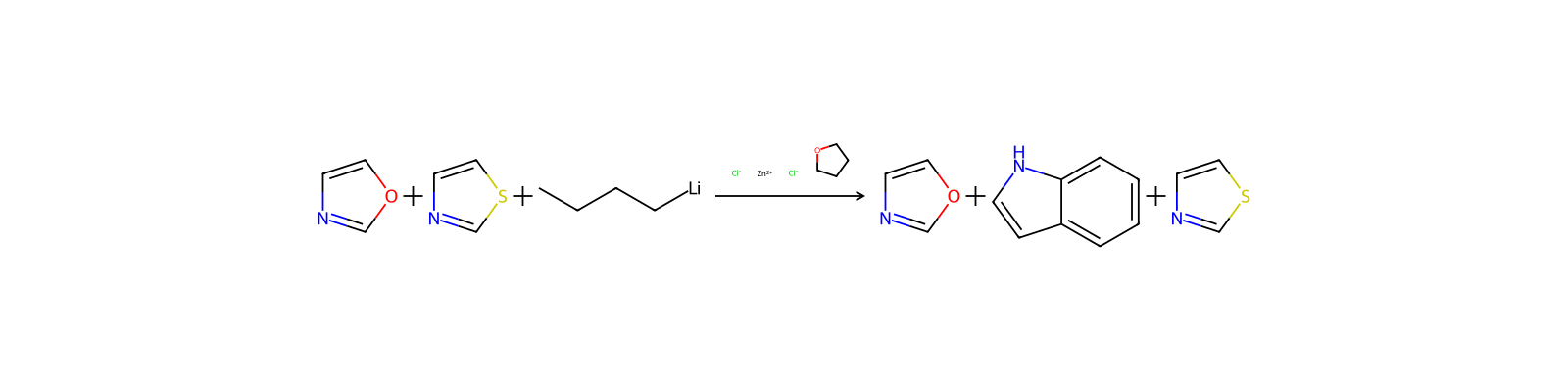
HRID 1368 reaction equation
HRID 1368As reactantuspto-grants-1998_03
HRID 8299 reaction equation
HRID 8299As reactantuspto-grants-2006_08
HRID 14097 reaction equation
HRID 14097As reactantuspto-grants-2010_06
HRID 14288 reaction equation
HRID 14288As reactantuspto-grants-2010_06
HRID 14343 reaction equation
HRID 14343As reactantuspto-grants-2010_06
HRID 24568 reaction equation
HRID 24568As reactantuspto-grants-2005_02
HRID 38390 reaction equation
HRID 38390As reactantuspto-grants-2013_09
HRID 38418 reaction equation
HRID 38418As reactantuspto-grants-2013_09
Page 1 of 53

Compound notes

Loading…

On this pageBasic informationOverviewNames & identifiersPropertiesSafety & regulationChemistry & industryRelated reactionsCompound notes
More actions
New noteNew reactionRequest quotes
· 4 items

Thiazole appears as colorless or pale yellow liquid with a foul odor. (NTP, 1992)

Colorless or light yellow liquid with a foul characteristic odor; [Merck Index] Colorless liquid with an unpleasant odor; [Alfa Aesar MSDS]

Liquid

Colourless to pale yellow liquid; green, sweet, nutty, tomatoe note

Physicochemical properties

Melting point
-33 °C · -33°C
Boiling point
117 · 117-118 °C (lit.)
Density
1.2 g/mL · 1.2 g/mL at 25 °C (lit.)
refractive index
20 · n20/D 1.538(lit.)
FEMA
3615 · 3615 | THIAZOLE
Flash point
72 °F · 72 °F
storage temp.
2 · Keep in dark place,Inert atmosphere,2-8°C
pka
2.44 · 2.44(at 20℃)
form
Liquid
color
Clear colorless to yellow
Specific Gravity
1.2 · 1.200
Odor
0.1 % · at 0.10 % in propylene glycol. pyridine nutty meaty
Odor Type
fishy
biological source
synthetic
Water Solubility
slightly soluble
Sensitive
Air & Light Sensitive
Merck
14 · 14,9307
JECFA Number
1032 · 1032
BRN
103852 · 103852
Stability
Stable. Incompatible with strong oxidizing agents.
InChI
1S/C3H3NS/c1-2-5-3-4-1/h1-3H
InChIKey
FZWLAAWBMGSTSO-UHFFFAOYSA-N
SMILES
c1cscn1
LogP
0.44 · 0.44
CAS DataBase Reference
288 · 288-47-1(CAS DataBase Reference)
Substances Added to Food (formerly EAFUS)
THIAZOLE
EWG's Food Scores
1 · 1
FDA UNII
320 RCW8PEF · 320RCW8PEF
NIST Chemistry Reference
Thiazole(288-47-1)
EPA Substance Registry System
Thiazole (288-47-1)
UNSPSC Code
12352100 · 12352100
NACRES
22 · NA.22
Symbol(GHS)
2 · GHS02,GHS07
Signal word
Danger
Hazard statements
225 · H225-H302
Precautionary statements
210 · P210-P233-P240-P241-P242-P301+P312
PPE
Eyeshields, Faceshields, Gloves, type ABEK (EN14387) respirator filter
Hazard Codes
Xn,F
Risk Statements
10 · 10-22-37/38-41
Safety Statements
16 · 16-26-39
RIDADR
1993 · UN 1993 3/PG 3
WGK Germany
3 · 3
RTECS
1290000 · XJ1290000
F
8 · 8-10-23
TSCA
TSCA listed
HazardClass
3 · 3
PackingGroup
II
HS Code
29341000 · 29341000
Storage Class
3 · 3 - Flammable liquids
Hazard Classifications
4 OralFlam · Acute Tox. 4 OralFlam. Liq. 2
Air and Water ReactionsSlightly water soluble.
Hazard Classes and CategoriesFlam. Liq. 2 (86.3%)

Safety & protection

Fire FightingExcerpt from ERG Guide 128 [Flammable Liquids (Water-Immiscible)]:
First Aid · 1 item

EYES: First check the victim for contact lenses and remove if present. Flush victim's eyes with water or normal saline solution for 20 to 30 minutes while simultaneously calling a hospital or poison control center. Do not put any ointments, oils, or medication in the victim's eyes without specific instructions from a physician. IMMEDIATELY transport the victim after flushing eyes to a hospital even if no symptoms (such as redness or irritation) develop.

Nonfire Spill ResponseExcerpt from ERG Guide 128 [Flammable Liquids (Water-Immiscible)]:
Isolation and EvacuationExcerpt from ERG Guide 128 [Flammable Liquids (Water-Immiscible)]:
Personal Protective Equipment (PPE) · 1 item

RECOMMENDED RESPIRATOR: Where the neat test chemical is weighed and diluted, wear a NIOSH-approved half face respirator equipped with an organic vapor/acid gas cartridge (specific for organic vapors, HCl, acid gas and SO2) with a dust/mist filter. (NTP, 1992)

Safety data

F
8-10-23
PPE
Eyeshields, Faceshields, Gloves, type ABEK (EN14387) respirator filter
wgk
3
tsca
TSCA listed
rtecs
XJ1290000
ridadr
UN 1993 3/PG 3
hs_code
29341000
risk_code
10-22-37/38-41
Signal word
Danger
Symbol(GHS)
GHS02,GHS07
hazard_code
Xn,F
safety_code
16-26-39
hazard_class
3
Storage Class
3 - Flammable liquids
packing_group
II
Hazard statements
H225-H302
Hazard Classifications
Acute Tox. 4 OralFlam. Liq. 2
Precautionary statements
P210-P233-P240-P241-P242-P301+P312
General Description

Upstream & downstream products

Upstream raw materials

2-ThiophenethiolTetrahydrothiophen-3-one2-methylthiophene-3-thiol2-Acetyl pyrroleGlutathione

Downstream products

AztreonamBASIC BLUE 41 (C.I. 11105)ThiabendazoleCeftizoximeCefotaxime sodium2,6-Dichlorobenzothiazole6-Mercaptopurine monohydrate4-phenyl-1,3-thiazole2-Thiazolesulfonyl chloride2-(Methylthio)thiazole

Additional notes

DefinitionA colorless volatile liquid, a beterocyclic compound with a five-membered ring containing three carbon atoms, one nitrogen atom, and one sulfur atom. It resembles PYRIDINE in its reactions.

Definitionthiazole: A heterocyclic compound containing a five-membered ringwith sulphur and nitrogen heteroatoms, C3SNH3. A range of thiazoledyes are manufactured containingthis ring system.