HuagongsheHuagongshe Chemistry Print Report · For research reference only
Manganese acetate tetrahydrate
MANGANESE ACETATE · MANGANESE(II) ACETATE · MANGANESE ACETATE TETRAHYDRATE · MANGANOUS ACETATE TETRAHYDRATE · Co-Mn · ManganeseAcetateAr · acetate tetrahydrate · Manganese acetate, GR 99%+
Identifiers & Physical Properties
| CAS No. | 6156-78-1 |
|---|---|
| Molecular formula | C4H6MnO4 . 4H2O |
| Average molar mass | 245.09 g/mol |
| Monoisotopic mass | 245.00691251 g/mol |
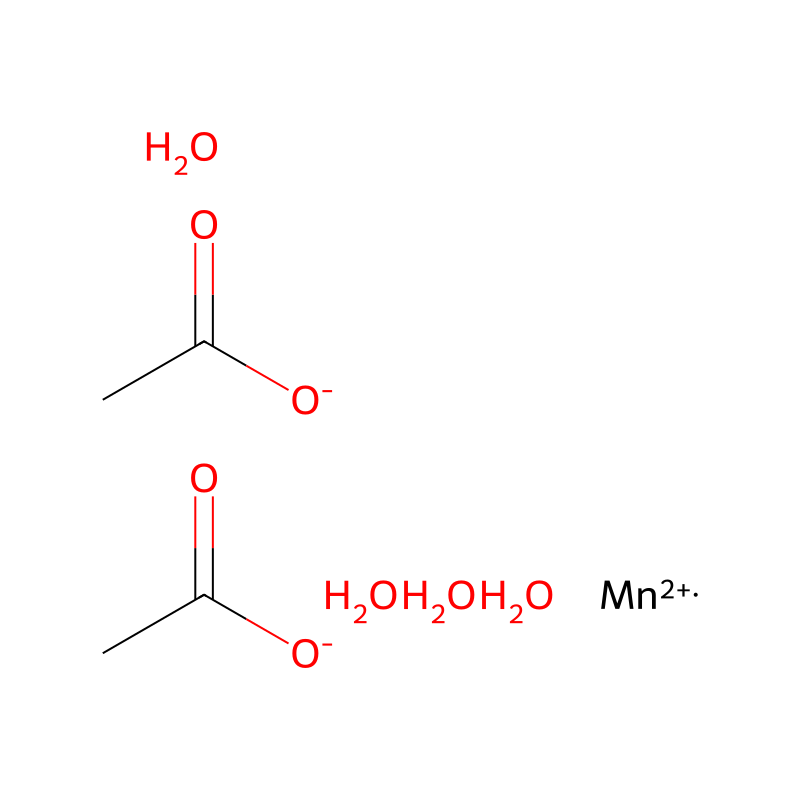
| SMILES | CC(=O)[O-].CC(=O)[O-].O.O.O.O.[Mn+2] |
| InChIKey | CESXSDZNZGSWSP-UHFFFAOYSA-L |
| PubChem CID | 93021 |
| EC No. | 612-176-1 |
| DTXSID | DTXSID00210566 |
Chemical & Physical Properties
| Topological polar surface area | 84.3 |
|---|---|
| Hydrogen bond donors | 4 |
| Hydrogen bond acceptors | 8 |
| Rotatable bonds | 0 |
| Heavy atoms | 13 |
| Formal charge | 0 |
| Complexity | 25.5 |
| Chemical classes | Metals -> Organic Acids, Metal Salts |
| Density | 1.59 @ 20°C1.589 g/mL at 25 °C(lit.) |
| Melting point | 80 °C>300 °C(lit.) |
| Physical Description | Light red transparent solid[Merck Index] Light pink hygroscopic crystals[Acros Organics MSDS] |
| Bulk density | 700kg/m3 |
| Vapor pressure | <1 hPa (25 °C) |
| Storage conditions | Store below +30°C. |
| Solubility | 233g/lSoluble in water, methanol, ethanol, and acetic acid. |
| Physical state | Crystals |
| Specific gravity | 1.589 |
| Color | Pink |
| pH | 7.0 (50g/l, H2O, 20℃) |
| Hydrolytic Sensitivity | 4: no reaction with water under neutral conditions |
| Merck | 14,5724 |
| BRN | 3730728 |
| Exposure limits | OSHA: Ceiling 5 mg/m3NIOSH: IDLH 500 mg/m3TWA 1 mg/m3STEL 3 mg/m3 |
| InChI | 1S/2C2H4O2.Mn.4H2O/c2*1-2(3)4/h2*1H3,(H,3,4)4*1H2/q+2/p-2 |
| InChIKey | SLMRUTJYVMZEPJ-UHFFFAOYSA-M |
| SMILES | [H]O[H].[H]O[H].[H]O[H].[H]O[H].CC(=O)O[Mn]OC(C)=O |
| CAS DataBase Reference | 6156-78-1(CAS DataBase Reference) |
| FDA 21 CFR | 175.105582.80 |
| FDA UNII | 9TO51D176N |
| UNSPSC Code | 12352103 |
| NACRES | NA.23 |
| GHS pictogram | GHS07 |
| Signal word | Warning |
| GHS hazard statements | H303-H315-H319-H335 |
| GHS precautionary statements | P261-P305+P351+P338-P280a-P304+P340-P405-P501a |
| Target organs | Brain |
| Hazard symbols | Xi |
| Risk statements (R) | 36/37/38 |
| Safety statements (S) | 26-36 |
| Water hazard class (WGK) | 2 |
| RTECS number | AI5775000 |
| TSCA inventory status | Yes |
| Customs code | 29152990 |
| Storage class | 11 - Combustible Solids |
| Hazard class | Aquatic Chronic 3STOT RE 2 Inhalation |
| Toxicity | LD50 orally in Rabbit: 3730 mg/kg |
Safety & Regulations
| GHS classification | This chemical does not meet GHS hazard criteria for 35.1% (26 of 74) of reports.WarningH315 (63.5%): Causes skin irritation [Warning Skin corrosion/irritation]P261, P264, P264+P265, P271, P280, P302+P352, P304+P340, P305+P351+P338, P319, P321, P332+P317, P337+P317, P362+P364, P403+P233, P405, and P501 (click each P-code to see the statement)Aggregated GHS information provided per 74 reports by companies from 9 notifications to the ECHA C&L Inventory. Each notification may be associated with multiple companies.Danger |
|---|---|
| Regulatory information | Chemical: Acetic acid, manganese(2+) salt, tetrahydrateAcetic acid, manganese(2+) salt, tetrahydrate: Does not have an individual approval but may be used under an appropriate group standard |
| Other safety information | IMAP assessments - Soluble manganese compounds: Human health tier II assessment |
| Hazards summary | An irritantPossible reproductive and fetal toxicant[Acros Organics MSDS] See Manganese(II) acetate. See Manganese and linked occupational diseases. |
| Hazard Classes and Categories | Skin Irrit. 2 (63.5%)Acute toxicity (ingestion) - category 4 |
| Exposure control and personal protection | 0.2 [mg/m3], as Mn (inhalable fraction), 0.02 mg/m3, as Mn (respirable fraction)[German Research Foundation (DFG)] |
| Minimum Risk Level | Chronic Inhalation: 0.0003 mg/m3 (L134) |
| Threshold Limit Values (TLV) | 0.02 [mg/m3], as Mn (respirable fraction), 0.1 mg/m3, as Mn (inhalable fraction) |
| Protective Action Criteria (PAC) | 13 [mg/m3]22 [mg/m3]740 [mg/m3] |
| Health effects | Manganese mainly affects the nervous system and may cause behavioral changes and other nervous system effects, which include movements that may become slow and clumsy. This combination of symptoms when sufficiently severe is referred to as “manganism”. (L228) |
| Adverse effects | Neurotoxin - Parkinsonism |
| Exposure routes | Oral (L228)inhalation (L228) |
| Toxicity summary | Manganese is a cellular toxicant that can impair transport systems, enzyme activities, and receptor functions. It primarily targets the central nervous system, particularily the globus pallidus of the basal ganglia. It is believed that the manganese ion, Mn(II), enhances the autoxidation or turnover of various intracellular catecholamines, leading to increased production of free radicals, reactive oxygen species, and other cytotoxic metabolites, along with a depletion of cellular antioxidant defense mechanisms, leading to oxidative damage and selective destruction of dopaminergic neurons. In addition to dopamine, manganese is thought to perturbations other neurotransmitters, such as GABA and glutamate. In order to produce oxidative damage, manganese must first overwhelm the antioxidant enzyme manganese superoxide dismutase. The neurotoxicity of Mn(II) has also been linked to its ability to substitute for Ca(II) under physiological conditions. It can enter mitochondria via the calcium uniporter and inhibit mitochondrial oxidative phosphorylation. It may also inhibit the efflux of Ca(II), which can result in a loss of mitochondrial membrane integrity. Mn(II) has been shown to inhibit mitochondrial aconitase activity to a significant level, altering amino acid metabolism and cellular iron homeostasis. (L228) |
| Signs and Symptoms | Manganese mainly affects the nervous system and may cause behavioral changes and other nervous system effects, which include movements that may become slow and clumsy. This combination of symptoms when sufficiently severe is referred to as “manganism”. (L228) |
| Carcinogen Classification | No indication of carcinogenicity to humans (not listed by IARC). |
| Water hazard class (WGK) | 2 |
| TSCA inventory status | Yes |
| RTECS number | AI5775000 |
| Customs code | 29152990 |
| Toxicity | LD50 orally in Rabbit: 3730 mg/kg |
| Risk statements (R) | 36/37/38 |
| Signal word | Warning |
| GHS pictogram | GHS07 |
| Hazard symbols | Xi |
| Safety statements (S) | 26-36 |
| Storage class | 11 - Combustible Solids |
| Target organs | Brain |
| GHS hazard statements | H303-H315-H319-H335 |
| Hazard class | Aquatic Chronic 3STOT RE 2 Inhalation |
| GHS precautionary statements | P261-P305+P351+P338-P280a-P304+P340-P405-P501a |
Applications & Uses
Uses
Manganese(II) acetate tetrahydrate may be used in the sol gel synthesis of doped TiO2 containing different amounts of Mn2+.
General Description
Manganese(II) acetate tetrahydrate is a hydrated salt of manganese. Kinetic studies suggest that its dehydration takes place in two-step reaction involving the loss of two water molecules. Its crystal structure has been investigated by X-ray studies. Its crystals exhibit monoclinic crystal system and space group P21/c.