HomeMCPWorkbenchSkills
HomeWorkbenchNotificationsMe
llms.txt · MCP GuidePrivacy Policy · Terms of Service · Supportv1.8.3
  1. Home
  2. /Compound

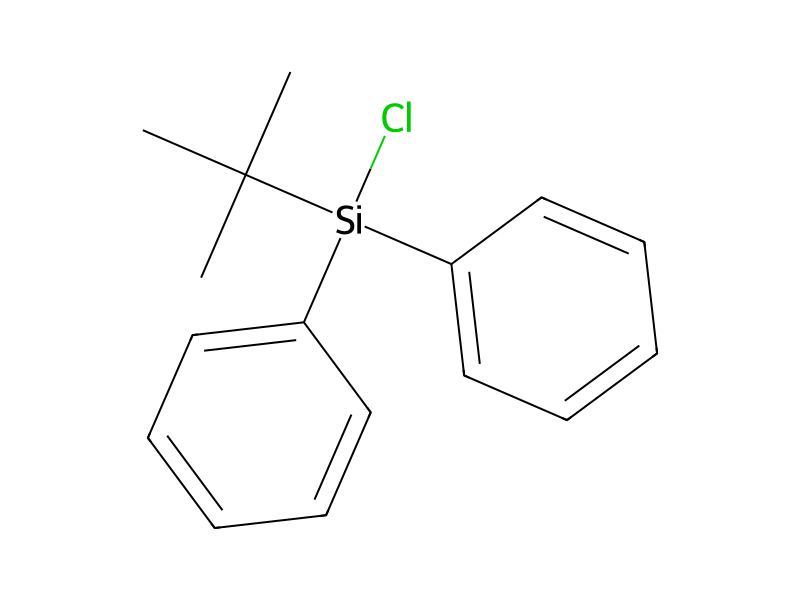
tert-Butyldiphenylchlorosilane

HCID 94078
New reaction
Print
Basic informationNames & identifiersPropertiesSafety & regulationChemistry & industryRelated reactionsCompound notes
Substructure searchFind similar structures

Basic information

CAS
58479-61-1
Standard SMILES
CC(C)(C)[Si](Cl)(c1ccccc1)c1ccccc1
InChIKey
MHYGQXWCZAYSLJ-UHFFFAOYSA-N
Molecular formula
C16H19ClSi
Average molar mass
274.86 g/mol
Monoisotopic mass
274.0944548

Names & identifiers

Preferred name
tert-Butyldiphenylchlorosilane
IUPAC
tert-butyl-chloro-diphenylsilane
English name
tert-Butylchlorodiphenylsilane
Molecular formula
C16H19ClSi
Molecular weight
274.86

Names & synonyms

tert-Butylchlorodiphenylsilane58479-61-1tert-ButyldiphenylchlorosilaneSilane, chloro(1,1-dimethylethyl)diphenyl-TERT-BUTYLDIPHENYLSILYL CHLORIDETBDPS-ClT-BUPH2SICL3BEU48UI4EBenzene, 1,1'-(chloro(1,1-dimethylethyl)silylene)bis-EINECS 261-282-0NSC-617386DTXSID5069259
Show more names
TBDPSTBDPSCITBDPCLTBDPbutylchlorodiphenylsilaneT-BUTYLCHLORODIPHENYLSILANEtert-Butylchlorodiphenylsilane ,97%
TERT-BUTYLDIPHENYLCHLOROSILANE [MI]1,1'-(CHLORO(1,1-DIMETHYLETHYL)SILYLENE)BISBENZENEBENZENE, 1,1'-[CHLORO(1,1-DIMETHYLETHYL)SILYLENE]BIS-RefChem:896568DTXCID8042395261-282-0TBDPSCltert-Butyl(chloro)diphenylsilane

Database identifiers

CAS
58479-61-1
PubChem CID
94078
DTXSID
DTXSID5069259
UNII
3BEU48UI4E
EC Number
261-282-0
Nikkaji
J149.823A

Properties

Computed structural properties

Topological polar surface area
0 Ų
Hydrogen bond donors
0
Hydrogen bond acceptors
0
Rotatable bonds
3
Heavy atoms
18
Formal charge
0
Complexity
239

Physicochemical properties

Boiling point
90 °C0.01 · 90 °C0.01 mm Hg(lit.)
Density
1.057 g/mL · 1.057 g/mL at 25 °C(lit.)
refractive index
20 · n20/D 1.568(lit.)
Flash point
230 °F · >230 °F
storage temp.
2 · Inert atmosphere,2-8°C
solubility
miscible in most organic solvents.
form
Liquid
Specific Gravity
1.074 · 1.074
color
Clear colorless to yellow or slightly brown
Water Solubility
reacts
Sensitive
Moisture Sensitive
Hydrolytic Sensitivity
7 · 7: reacts slowly with moisture/water
BRN
644023 · 644023
InChI
1S/C16H19ClSi/c1-16(2,3)18(17,14-10-6-4-7-11-14)15-12-8-5-9-13-15/h4-13H,1-3H3
InChIKey
MHYGQXWCZAYSLJ-UHFFFAOYSA-N
SMILES
CC(C)(C)[Si](Cl)(c1ccccc1)c2ccccc2

Safety & regulation

Safety information is for reference only and does not replace the supplier’s Safety Data Sheet (SDS), applicable regulations, or professional assessment.

GHS classification

GHS Classification · 4 items

Danger

H314 (100%): Causes severe skin burns and eye damage [Danger Skin corrosion/irritation]

P260, P264, P280, P301+P330+P331, P302+P361+P354, P304+P340, P305+P354+P338, P316, P321, P363, P405, and P501 (click each P-code to see the statement)

Aggregated GHS information provided per 53 reports by companies from 7 notifications to the ECHA C&L Inventory.

Hazard information

Regulatory Information · 2 items

Chemical: Silane, chloro(1,1-dimethylethyl)diphenyl-

Silane, chloro(1,1-dimethylethyl)diphenyl-: Does not have an individual approval but may be used under an appropriate group standard

Hazard Classes and CategoriesSkin Corr. 1 (100%)

Safety data

F
10
wgk
3
tsca
TSCA listed
ridadr
UN 2987 8/PG 2
hs_code
29310095
risk_code
14-34-37-29-20/21/22-40
Signal word
Danger
Symbol(GHS)
GHS05,GHS07
hazard_code
C,Xi
hazard_note
Irritant/Corrosive
safety_code
26-36/37/39-45-8
hazard_class
8
Storage Class

Chemistry & industry

Uses & manufacturing

General Manufacturing InformationBenzene, 1,1'-[chloro(1,1-dimethylethyl)silylene]bis-: ACTIVE
Applications · 3 items

Usestert-Butyldiphenylchlorosilane acts as a silylating reagent used to protect alcohols and in the preparation of silyl ethers. It plays a major role as a raw material and a precursor in organic synthesis and pharmaceuticals. It is also used for the synthesis of interphenylene phenyloxazoles which can be used for the treatment of circulatory disorders, angina and stroke.

Usestert-Butylchlorodiphenylsilane can be used to prepare 1-benzyloxy-3-(tert-butyldiphenylsilyloxy)propan-2-ol, a key intermediate for the synthesis of mono-O-protected pyrimidine acyclic nucleosides.

UsesSeveral newmethods have been developed for using the reagent to protect primary and secondary alcohols as their TBDPS ethers. In the presence of ammonium nitrate or ammonium perchlorate, reaction between TBDPS-Cl and a primary alcohol, such as benzyl alcohol, in DMF provided excellent yields of the corresponding silyl ethers in just 15 min (eq 1).19 When silver nitrate was used as promoter, the reactions gave inferior yields under otherwise identical conditions.When TBDPS-Cl is used to react with hemiacetals, it converts hemiacetals into ring-opened silyl ether carbonyl compounds, instead of mixed acetals.Presumably, the sizable TBDPS group presents too much steric hindrance for the formation of the corresponding mixed silyl acetals.

Preparation methods · 1 item

Preparationa dry 1 L, three-necked round bottomed flask is equipped with a magnetic stirring bar, a 500mL equalizing dropping funnel fitted with a rubber septum, a reflux condenser, and nitrogen inlet tube. The flask is flushed with nitrogen, then charged with 127 g (0.5 mol) of diphenyldichlorosilane in 300mL of redistilled pentane. A solution of tbutyllithium in pentane (500 mL, 0.55 mol), is transferred under nitrogen pressure to the dropping funnel using a stainless steel, double-tip transfer needle. This solution is slowly added to the contents of the flask and when the addition is complete, the mixture is refluxed 30 h under nitrogen with stirring. The suspension is allowed to cool to rt, the precipitated lithium chloride is rapidly filtered through a pad of Celite, and the latter is washed with 200mL of pentane. The solvent is removed by evaporation, and the colorless residue is distilled through a short (10 cm), Vigreux column, to give 125–132 g of the colorless title compound.

Related reactions

948 records
New reaction record
HRID 890 reaction equation
HRID 890As reactant
HRID 891 reaction equation
HRID 891As reactant
HRID 6256 reaction equation
HRID 6256As reactant
HRID 11459 reaction equation
HRID 11459As reactant
HRID 13431 reaction equation
HRID 13431As reactant
HRID 16215 reaction equation
HRID 16215As reactant
HRID 16226 reaction equation
HRID 16226As reactant
HRID 16329 reaction equation
HRID 16329As reactant
PreviousPage 1 of 119

Compound notes

On this pageBasic informationNames & identifiersPropertiesSafety & regulationChemistry & industryRelated reactionsCompound notes
CAS DataBase Reference
58479 · 58479-61-1(CAS DataBase Reference)
FDA UNII
3 BEU48UI4E · 3BEU48UI4E
NIST Chemistry Reference
Silane, chloro(1,1-dimethylethyl)diphenyl-(58479-61-1)
EPA Substance Registry System
Silane, chloro(1,1-dimethylethyl)diphenyl- (58479-61-1)
UNSPSC Code
12352002 · 12352002
NACRES
22 · NA.22
Symbol(GHS)
5 · GHS05,GHS07
Signal word
Danger
Hazard statements
314 · H314-H335
Precautionary statements
261 · P261-P271-P280-P301+P330+P331-P303+P361+P353-P305+P351+P338
target organs
Respiratory system
Hazard Codes
C,Xi
Risk Statements
14 · 14-34-37-29-20/21/22-40
Safety Statements
26 · 26-36/37/39-45-8
RIDADR
2987 · UN 2987 8/PG 2
WGK Germany
3 · 3
F
10 · 10
Hazard Note
Irritant/Corrosive
TSCA
TSCA listed
HazardClass
8 · 8
PackingGroup
II
HS Code
29310095 · 29310095
Storage Class
8 A · 8A - Combustible corrosive hazardous materials
Hazard Classifications
1 Skin · Eye Dam. 1Skin Corr. 1BSTOT SE 3
Limited Quantities
1 L · 1.0 L (0.3 gallons) (liquid) or 1 Kg (2.2 lbs) (solid)
Excepted Quantities
Not Permitted as Excepted Quantity
8A - Combustible corrosive hazardous materials
packing_group
II
target organs
Respiratory system
Hazard statements
H314-H335
Limited Quantities
1.0 L (0.3 gallons) (liquid) or 1 Kg (2.2 lbs) (solid)
Excepted Quantities
Not Permitted as Excepted Quantity
Hazard Classifications
Eye Dam. 1Skin Corr. 1BSTOT SE 3
Precautionary statements
P261-P271-P280-P301+P330+P331-P303+P361+P353-P305+P351+P338

Upstream & downstream products

Upstream raw materials

2-Chloro-2-methylpropaneDichlorodiphenylsilaneHexaneTetrahydrofuranMagnesium

Downstream products

Fluvastatin sodium salt3-Amino-2,2-dimethyl-4-oxo-azetidine-1-sulfonic acid2-(t-Butyldiphenylsilanyloxy)Ethanol(S)-4-Boc-morpholine-3-carboxylic acid4-PentylcyclohexanoneBenzene, 1,1'-[(2-bromoethoxy)(1,1-dimethylethyl)silylene]bis-(S)-2-(tert-Butoxycarbonylamino)-3-(tert-butyldiphenylsilyloxy)propanoic acid(But-3-en-1-yloxy)(tert-butyl)diphenylsilaneBenzene, 1,1'-[(1,1-dimethylethyl)(2-propen-1-yloxy)silylene]bis-2-(2-((tert-butyldiphenylsilyl)oxy)ethoxy)ethanol(WXPC0004)6-O-(tert-Butyldiphenylsilyl)-D-glucalMethyl-(6R)-((t-butyl) diphenylsilyloxy)-(2E,4E,8Z)-tetradecatrienoate2,6-Di([1-(tert-butyl)-1,1-diphenylsilyl]oxy)-9,10-dihydroanthracene-9,10-dionetert-Butyl(3-butynyloxy)diphenylsilane