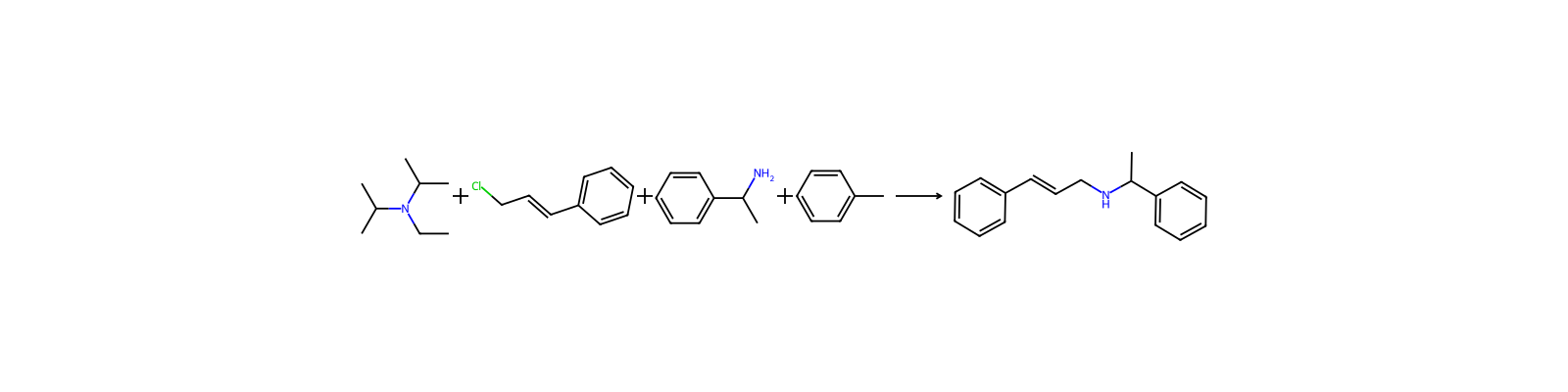
Home / Compound Benzene, (3-chloro-1-propenyl)- Basic information Names & identifiers Properties Safety & regulation Chemistry & industry Related reactions Compound notes Standard SMILES ClCC=Cc1ccccc1InChIKey IWTYTFSSTWXZFU-UHFFFAOYSA-N
Molecular formula C9H9Cl
Average molar mass 152.62 g/mol
Monoisotopic mass 152.039278
Preferred name Benzene, (3-chloro-1-propenyl)-
IUPAC 3-chloroprop-1-enylbenzene
English name Cinnamyl chloride
Molecular formula C9H9Cl
Molecular weight 152.62 Names & synonyms Benzene, (3-chloro-1-propenyl)- RefChem:562118 3-chloroprop-1-enylbenzene (Chloromethyl)styrene Chloromethylstyrene (3-Chloropropenyl)benzene 3-Phenyl-2-propenyl chloride (3-Chloroprop-1-enyl)benzene EINECS 220-246-4 3-Phenylallyl chloride AI3-01855 SCHEMBL15852
Show more names AKOS 371 Cinnamyl chloride AKOS BBS-00003853 Cinnamylchloride,95% β-Chloromethylstylene Cinnamyl chloride 95% β-Chloromethylstyrene b-Chloromethylstyrene r-Chloropropenylbenzene
(3-chloro-1-propenyl)benzene 1-chloro-3-phenyl-2-propene SCHEMBL2311225 SCHEMBL3713876 SCHEMBL8863221 DTXSID6062591 SCHEMBL28189156 (3-chloro-prop-1-enyl)-benzene
Load more (20 shown)
Database identifiers
PubChem CID 94242
DTXSID DTXSID6062591
EC Number 220-246-4 Computed structural properties
XLogP 3.2
Topological polar surface area 0 Ų
Hydrogen bond donors 0
Hydrogen bond acceptors 0
Rotatable bonds 2
Heavy atoms 10
Formal charge 0
Complexity 101 Show all 8 Show all 8 / 8 Experimental & physicochemical properties SpringerMaterials Properties Density
Physicochemical properties
Melting point 8 °C · 8 °C
Boiling point 136 °C/37 · 136 °C/37 mmHg
Density 1.1 · 1.10
vapor pressure 2 Pa · 2Pa at 20℃
refractive index 1.58 · 1.58
Flash point 79 °C · 79 °C
storage temp. 2 · 2-8°C
form clear liquid
color Colorless to Light yellow
Water Solubility 0.2 g/L · 0.2 g/L (20 ºC)
Sensitive Lachrymatory
BRN 741974 · 741974
InChI 1S/C9H9Cl/c10-8-4-7-9-5-2-1-3-6-9/h1-7H,8H2/b7-4+
Safety information is for reference only and does not replace the supplier’s Safety Data Sheet (SDS), applicable regulations, or professional assessment.
GHS classification GHS Classification · 4 items Danger
H302 (80.8%): Harmful if swallowed [Warning Acute toxicity, oral]
P233, P260, P261, P264, P270, P271, P272, P280, P284, P301+P317, P301+P330+P331, P302+P352, P302+P361+P354, P304+P340, P305+P354+P338, P316, P320, P321, P330, P333+P317, P342+P316, P362+P364, P363, P403, P403+P233, P405, and P501 (click each P-code to see the statement)
Aggregated GHS information provided per 52 reports by companies from 9 notifications to the ECHA C&L Inventory. Each notification may be associated with multiple companies.
Hazard information Regulatory Information · 3 items Chemical: Benzene, (3-chloro-1-propenyl)-
REACH registered substance: (3-chloroprop-1-enyl)benzene (EC: 220-246-4)
Benzene, (3-chloro-1-propenyl)-: Does not have an individual approval but may be used under an appropriate group standard
Hazard Classes and Categories Acute Tox. 4 (80.8%)
Safety data
PPE Faceshields, Gloves, Goggles, type ABEK (EN14387) respirator filter
wgk 3
tsca TSCA listed
rtecs CZ0919905
ridadr UN 1760 8/PG 2
hs_code 2903999090
Toxicity rat,LC50,inhalation,29mg/m3/4H (29mg/m3),BEHAVIORAL: SOMNOLENCE (GENERAL DEPRESSED ACTIVITY)LUNGS, THORAX, OR RESPIRATION: RESPIRATORY DEPRESSION,Toksikologicheskii Vestnik. Vol. (4), Pg. 30, 1997.
risk_code 22-26-34-43-36 Applications Uses Cinnamyl chloride is used in the enantioselective total synthesis of helioporins C and E, bioactive marine diterpenes.
General Description Cinnamyl chloride reacts regioselectively with aryl and alkenylgold(I) phosphanes in the presence of palladium catalyst in THF to afford the α-substitution product.
Upstream & downstream products Related reactions 107 records
All As reactant As product As reagent As catalyst As solvent
Show 4 more
InChIKey
IWTYTFSSTWXZFU-QPJJXVBHSA-N
CAS DataBase Reference 2687 · 2687-12-9(CAS DataBase Reference)
FDA UNII 2 I1ADL56TX · 2I1ADL56TX
NIST Chemistry Reference Benzene, (3-chloro-1-propenyl)-(2687-12-9)
EPA Substance Registry System Benzene, (3-chloro-1-propenyl)- (2687-12-9)
UNSPSC Code 12352100 · 12352100
Symbol(GHS) 7 · GHS07,GHS08
Hazard statements 315 · H315-H317-H341-H361d-H373
Precautionary statements 202 · P202-P260-P264-P280-P302+P352-P308+P313
PPE Faceshields, Gloves, Goggles, type ABEK (EN14387) respirator filter
Risk Statements 22 · 22-26-34-43-36
Safety Statements 26 · 26-28-36/37/39-45-28A-23-27
RIDADR 1760 · UN 1760 8/PG 2
Hazard Note Corrosive/Lachrymatory
HS Code 2903999090 · 2903999090
Storage Class 10 · 10 - Combustible liquids
Hazard Classifications 2 Repr · Muta. 2Repr. 2Skin Irrit. 2Skin Sens. 1BSTOT RE 2
Toxicity 50 · rat,LC50,inhalation,29mg/m3/4H (29mg/m3),BEHAVIORAL: SOMNOLENCE (GENERAL DEPRESSED ACTIVITY)LUNGS, THORAX, OR RESPIRATION: RESPIRATORY DEPRESSION,Toksikologicheskii Vestnik. Vol. (4), Pg. 30, 1997.
REACH Registrations Active
Limited Quantities 1 L · 1.0 L (0.3 gallons) (liquid) or 1 Kg (2.2 lbs) (solid)
Excepted Quantities Max Inner Pack (30g or 30ml) and Max Outer Pack (500g or 500ml) Show all 44 Show all 44 / 44
hazard_note Corrosive/Lachrymatory
safety_code 26-28-36/37/39-45-28A-23-27
Storage Class 10 - Combustible liquids
Hazard statements H315-H317-H341-H361d-H373
Limited Quantities 1.0 L (0.3 gallons) (liquid) or 1 Kg (2.2 lbs) (solid)
Excepted Quantities Max Inner Pack (30g or 30ml) and Max Outer Pack (500g or 500ml)
REACH Registrations Active
Hazard Classifications Muta. 2Repr. 2Skin Irrit. 2Skin Sens. 1BSTOT RE 2
Precautionary statements P202-P260-P264-P280-P302+P352-P308+P313 Show all 22 Show all 22 / 22