
HRID 223278As reactant
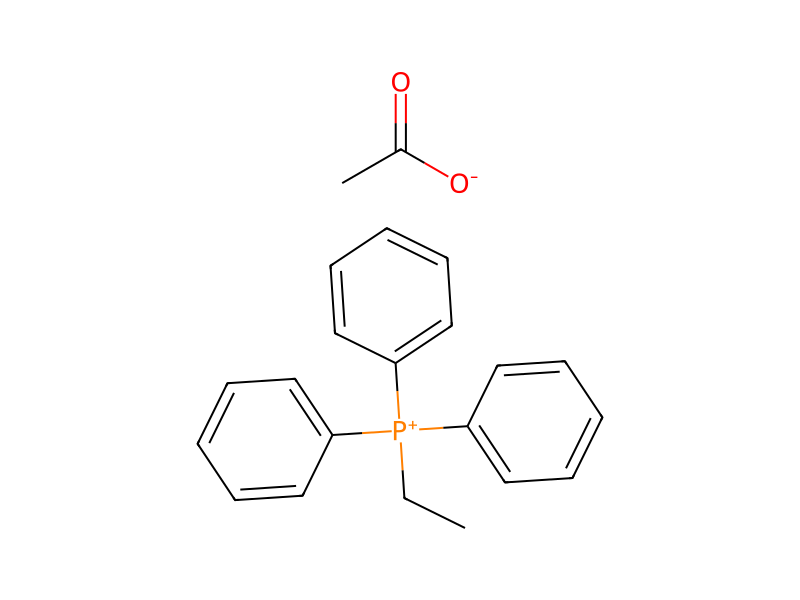
35835-94-0CC(=O)[O-].CC[P+](c1ccccc1)(c1ccccc1)c1ccccc1HZZUMXSLPJFMCB-UHFFFAOYSA-M35835-94-0DTXSID8067945Safety information is for reference only and does not replace the supplier’s Safety Data Sheet (SDS), applicable regulations, or professional assessment.
This chemical does not meet GHS hazard criteria for 4.9% (5 of 103) of reports.
Danger
H301 (95.1%): Toxic if swallowed [Danger Acute toxicity, oral]
P260, P261, P264, P264+P265, P270, P271, P273, P280, P301+P316, P301+P330+P331, P302+P352, P302+P361+P354, P304+P340, P305+P354+P338, P316, P317, P319, P321, P330, P332+P317, P362+P364, P363, P391, P403+P233, P405, and P501 (click each P-code to see the statement)
Aggregated GHS information provided per 103 reports by companies from 7 notifications to the ECHA C&L Inventory. Each notification may be associated with multiple companies.
Chemical: Phosphonium, ethyltriphenyl-, acetate
Phosphonium, ethyltriphenyl-, acetate (1:1) is listed on the EPA's Chemical Data Reporting (CDR) system. Manufacturers and importers of Phosphonium, ethyltriphenyl-, acetate (1:1) are required to report information about their production and use of this chemical to the EPA under the Toxic Substances Control Act (TSCA). (40 eCFR Part 711)
REACH registered substance: Ethyltriphenylphosphonium acetate (EC: 252-743-7)
Phosphonium, ethyltriphenyl-, acetate: Does not have an individual approval but may be used as a component in a product covered by a group standard. It is not approved for use as a chemical in its own right.
Plastics Material and Resin Manufacturing
Phosphonium, ethyltriphenyl-, acetate (1:1): ACTIVE
DescriptionEthyltriphenylphosphonium Acetate, also known as ETPAAC, ETPAACc and TEPA, is a colourless to slightly yellow liquid with the chemical formula C22H23O2P. This quaternary phosphonium salt is available in a 70% by-weight solution in methanol. Notably, one mole of acetic acid is bound to each mole of ETPAAC. Furthermore, the material is mainly used for advancing and curing phenolic-based epoxy resins and serving as a phase transfer catalyst. Compared to amines, imidazoles, and quaternary ammonium salts, Ethyltriphenylphosphonium Acetate has considerably better latency and thermal stability. Further, it offers a low odour, minimal colour formation and controlled reactivity.
UsesEthyltriphenylphosphonium acetate is mainly used to advance and cure phenolic-based epoxy resins and as a phase transfer catalyst. It exhibits considerably better latency and thermal stability when compared to amines, imidazoles and quaternary ammonium salts. Furthermore, it has minimal odour, colour formation, and controlled reactivity. It decreases or eliminates side reactions and creates longer, straighter chain epoxy molecules with sharp molecular weight distribution.