
HomeMCPWorkbenchSkills
HomeWorkbenchNotificationsMe
llms.txt · MCP GuidePrivacy Policy · Terms of Service · Supportv1.8.1
  1. Home
  2. /Compound

Nitroxyl

HCID 945
New reaction
Print

Completing data — refresh the page later to see the latest
Basic informationOverviewNames & identifiersPropertiesSafety & regulationChemistry & industryRelated reactionsCompound notes
Substructure searchFind similar structures

Basic information

CAS
10102-43-9
Standard SMILES
N=O
InChIKey
ODUCDPQEXGNKDN-UHFFFAOYSA-N
Molecular formula
HNO
Average molar mass
31.014 g/mol
Monoisotopic mass
31.00581365

Overview

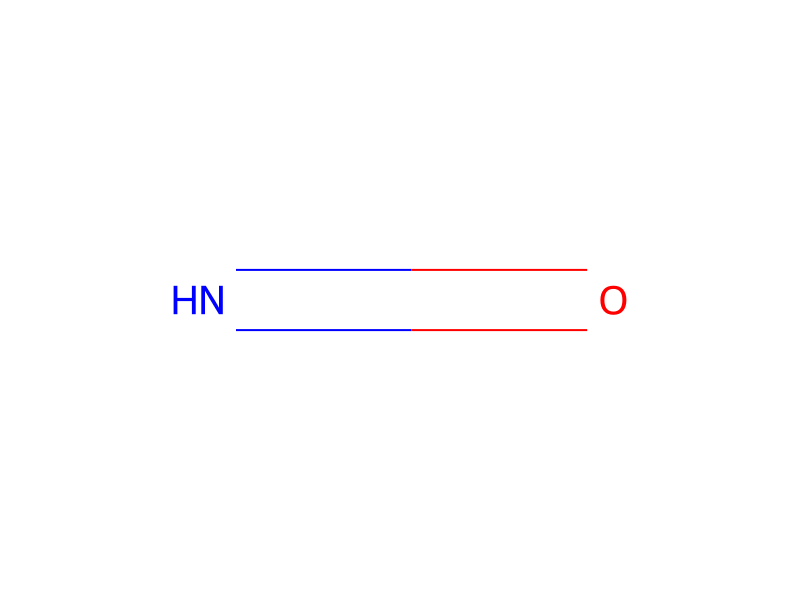
Nitroxyl is a nitrogen oxoacid consisting of an oxygen atom double-bonded to an NH group.

Names & identifiers

Preferred name
Nitroxyl
IUPAC
nitroxyl
English name
Nitric oxide
Molecular formula
NO*
Molecular weight
30.01

Names & synonyms

NitroxylNitrosyl hydrideazanoneoxidanimineNitroxide radical14332-28-6GFQ4MMS07WJ985.316BCHEBI:84879HNO compoundRefChem:166163HNO
Show more names
NOnitricNITROGEN MONOXIDENitrogen monooxideStickoxideNITRICMONOXIDEDIBROMOHEXAMIDINE ISETHIONATEoxo-amidogenitricoxide0stickmonoxyd
Nitronous oxideOXOAMINEStickmonoxyd [German]HYDROGEN NITROXIDEOxyde nitrique [French]UNII-GFQ4MMS07WBioxyde d'azote [French]RCRA waste no. P076

Database identifiers

CAS
10102-43-9、14332-28-6
PubChem CID
945
DTXSID
DTXSID901361717
ChEMBL
CHEMBL1234765
ChEBI
CHEBI:84879
UNII
GFQ4MMS07W
Nikkaji
J985.316B

Properties

Computed structural propertiesFilling in

XLogP
0.2
Topological polar surface area
40.9 Ų
Hydrogen bond donors
1
Hydrogen bond acceptors
2
Rotatable bonds
0
Heavy atoms
2
Formal charge
0
Complexity
2

Experimental & physicochemical properties

SpringerMaterials PropertiesSchoenflies notation

Physicochemical properties

Melting point
163.6 °C · −163.6 °C(lit.)
Boiling point
151.7 °C · −151.7 °C(lit.)
Density
-150.2 · d-150.2 (liq) 1.27; Relative d (gas) 1.036 (air = 1); Absolute d (gas) 1.227 (air = 1)
vapor density
1.05 · 1.05 (vs air)
refractive index
25 · nD25 1.0002697
solubility
20 °C · At 20 °C and at a pressure of 101 kPa, 1 volume dissolves in about 21 volumes of water.
form
colorless gas
color
colorless
Water Solubility
2 O · slightly soluble H2O [HAW93]
Specific Heat Capacity
1 J/ · Cp(gas): 1 J/(g·K), at 25℃
Merck
13 · 13,6611

Safety & regulation

Safety information is for reference only and does not replace the supplier’s Safety Data Sheet (SDS), applicable regulations, or professional assessment.

Safety data

OEB
A
OEL
TWA: 25 ppm (30 mg/m3)
PPE
Faceshields, Gloves, Goggles, multi-purpose combination respirator cartridge (US)
wgk
1
IDLA
100 ppm
tsca
TSCA listed
rtecs
QX0525000
ridadr
UN 1660 (NITRIC OXIDE, COMPRESSED)
Toxicity
LCLo inhalation in dog: 5000ppm/25M
risk_code
8-23-34-44
Signal word
Danger
Symbol(GHS)
GHS03,GHS04,GHS05,GHS06
hazard_code
O,T
safety_code
17-23-36/37/39-45
hazard_class
2.3
Storage Class
2A - Gases
Hazard statements
H270-H280-H314-H330
DOT Classification
2.3, Hazard Zone A (Gas poisonous by inhalation)
REACH Registrations
Active
Hazard Classifications
Acute Tox. 1 InhalationOx. Gas 1Press. Gas Compr. GasSkin Corr. 1B
Precautionary statements
P220-P244-P260-P264-P280-P271-P284-P370+P376-P301+P330+P331-P303+P361+P353-P363-P304+P340-P310-P305+P351+P338-P403-P405-P403+P233-P501
Hazardous Substances Data
10102-43-9(Hazardous Substances Data)

Chemistry & industry

Pharmacology

MeSH Pharmacological Classification · 2 items

Naturally occurring or synthetic substances that inhibit or retard oxidation reactions. They counteract the damaging effects of oxidation in animal tissues.

Drugs intended to prevent damage to the brain or spinal cord from ischemia, stroke, convulsions, or trauma. Some must be administered before the event, but others may be effective for some time after. They act by a variety of mechanisms, but often directly or indirectly minimize the damage produced by endogenous excitatory amino acids.

Applications · 7 items

UsesNitric oxide is an important intermediate in the production of nitric acid. Fluorine, chlorine, and bromine react with nitric oxide to form the corresponding nitrosyl halide. [t is also used in making mixtures for calibration standards for stationary and mobile exhaust emission measurements.

Descriptionnear room temperature (its liquid density at 20°C is 1.45 g/cm3). Nitrogen monoxide (NO) is commonly called nitric oxide,Nitric oxide is colorless and has a sharp sweet odor;Nitric oxide is nonfl ammable, toxic gases.Nitric oxide is a free radical that quickly reacts in air to produce nitrogen dioxide.It is also an important biological messenger and transmitter.

HistoryNitric oxide was prepared in 1772 by Joseph Priestley (1733–1804) and described in his volumes Experiments and Observations of Different Kinds of Air published between 1774 and 1786. Priestley called nitric oxide nitrous air, nitrogen dioxide nitrous acid vapor, and nitrous oxide phlogisticated nitrous air, but also referred to the latter as diminished nitrous air. He observed the change of clear nitric oxide to red nitrogen dioxide. Priestley prepared nitric oxide by reacting nitric acid with a metal such as copper: 3Cu(s) + 8HNO3(aq) → 2NO(g) + 3Cu(NO3)2(aq) + 4H2O(l).

UsesNitric oxide is used as an intermediate in themanufacture of nitric acid, in the preparationof metal nitrosyls, in bleaching of rayon,and in incandescent lamps. It is produced byheating air at high temperatures.

UsesNitric oxide is produced as an intermediateusing the Ostwald method to make nitric acid (see Nitric Acid). Nitrogen compoundsproduced from nitric acid are use to manufacture fertilizers, explosives, and other chemicals.

Related reactions

44 records
New reaction record
HRID 1146 reaction equation
HRID 1146As reactantuspto-grants-1998_03
HRID 120778 reaction equation
HRID 120778As reactantTraining data from https://doi.org/10.1039/C8SC04228D (2/10)
HRID 133662 reaction equation
HRID 133662As reactantuspto-grants-2008_06
HRID 146140 reaction equation
HRID 146140As reactantTraining data from https://doi.org/10.1039/C8SC04228D (9/10)
HRID 195011 reaction equation
HRID 195011As reactantTraining data from https://doi.org/10.1039/C8SC04228D (6/10)
HRID 305178 reaction equation
HRID 305178As reactantTraining data from https://doi.org/10.1039/C8SC04228D (8/10)
HRID 315586 reaction equation
HRID 315586As productTraining data from https://doi.org/10.1039/C8SC04228D (8/10)
HRID 466369 reaction equation
HRID 466369As reactantuspto-grants-1992_10
PreviousPage 1 of 6

Compound notes

On this pageBasic informationOverviewNames & identifiersPropertiesSafety & regulationChemistry & industryRelated reactionsCompound notes
Henry's Law Constant
1.9 · 1.9×10-5 mol/(m3Pa) at 25℃, Warneck and Williams (2012)
Exposure limits
25 ppm · ACGIH:TLV-TWA 25 ppm (31 mg/m3)OSHA:PEL-TWA 25 ppm (30 mg/m3)NIOSH:REL-TWA 25 ppm
Stability
Spontaneously reacts with oxygen in air to yield brown nitrogen dioxide. Reacts violently or explosively with ammonia and many organic materials.
InChI
1S/NO/c1-2
InChIKey
MWUXSHHQAYIFBG-UHFFFAOYSA-N
SMILES
[N]=O
CAS DataBase Reference
10102 · 10102-43-9(CAS DataBase Reference)
EWG's Food Scores
1 · 1
FDA UNII
31 C4KY9ESH · 31C4KY9ESH
ATC code
7 AX01 · R07AX01
EPA Substance Registry System
Nitric oxide (10102-43-9)
UNSPSC Code
12352303 · 12352303
Symbol(GHS)
3 · GHS03,GHS04,GHS05,GHS06
Signal word
Danger
Hazard statements
270 · H270-H280-H314-H330
Precautionary statements
220 · P220-P244-P260-P264-P280-P271-P284-P370+P376-P301+P330+P331-P303+P361+P353-P363-P304+P340-P310-P305+P351+P338-P403-P405-P403+P233-P501
PPE
Faceshields, Gloves, Goggles, multi-purpose combination respirator cartridge (US)
Hazard Codes
O,T
Risk Statements
8 · 8-23-34-44
Safety Statements
17 · 17-23-36/37/39-45
RIDADR
1660 · UN 1660 (NITRIC OXIDE, COMPRESSED)
OEB
A
OEL
25 ppm · TWA: 25 ppm (30 mg/m3)
WGK Germany
1 · 1
RTECS
525000 · QX0525000
TSCA
TSCA listed
DOT Classification
2.3 · 2.3, Hazard Zone A (Gas poisonous by inhalation)
HazardClass
2.3 · 2.3
Storage Class
2 A · 2A - Gases
Hazard Classifications
1 InhalationOx · Acute Tox. 1 InhalationOx. Gas 1Press. Gas Compr. GasSkin Corr. 1B
Hazardous Substances Data
10102 · 10102-43-9(Hazardous Substances Data)
Toxicity
5000 ppm/25M · LCLo inhalation in dog: 5000ppm/25M
IDLA
100 ppm · 100 ppm
REACH Registrations
Active

Uses▼▲ Industry Application Role/benefit Chemical manufacture Manufacture of nitric acid Intermediate Manufacture of hydroxylamine Intermediate Medcine Treatment of primary pulmonary hypertension Active ingredient/helps to promote capillary and pulmonary dilation Treatment of respiratory failure in premature babies Active ingredient/can relax smooth muscle to widen (dilate) blood vessels Treatment of impotence or erectile dysfunction Active ingredient/enhances nitric oxide’s relaxant effects on smooth muscle cells in the corpus cavernosa Chemical analysis Detecting surface radicals on polymers Radicals quenching agent Analysis for nitric acid or its salts Analytical agent Others Narcotics and preservatives Effective component Rayon production Decolorizer Propylene and dimethyl ether preservation Stabilizing agent Semiconductor manufacturing Oxidation and chemical vapor deposition gas

General DescriptionA colorless gas. Noncombustible but accelerates the burning of combustible material. Vapors heavier than air. Very toxic by inhalation and skin absorption. Heating the containers may cause them to rupture violently and rocket. Nitric oxide was discovered by Van Helmont in 1620. It occurs in the exhaust gases from automobiles along with other oxides of nitrogen, at trace concentrations. It also is found in minute quantities in the upper atmosphere, resulting from the oxidation of nitrogen in the presence of ionizing radiation or by electric discharge. Nitric oxide is the most stable oxide of nitrogen. It is used as an intermediate or as a starting reactant in the production of many nitrogen compounds, including nitrogen dioxide, nitric acid and nitrosyl chloride.

Upstream & downstream products

Upstream raw materials

Nitrous acidSodium nitriteNitrogen dioxide

Downstream products

Oxalic acidAluminonBARIUM NITRITEOxalic acid dihydrate1-Diazo-2-naphthol-4-sulfonic acid2,4-DinitrophenolSodium nitriteBismuth subcarbonatetert-Butyl nitriteNitric acidStannic oxide4-Diazo-3,4-dihydro-7-nitro-3-oxo-1-naphthalenesulfonic acidQuizalofop-p-ethylSodium nitratedinitrogen trioxide
Additional notes · 2 items

DefinitionChEBI: Nitric Oxide is a nitrogen oxide which is a free radical, each molecule of which consists of one nitrogen and one oxygen atom.

DefinitionA colorless gas that is insoluble in water but dissolves in a solution containing iron(II) ions owing to the formation of the complex ion (FeNO)2+: the nitrogen monoxide can be released by heating. Nitrogen monoxide is prepared by the action of nitric acid on copper turnings; the impure product can be purified by using a solution of iron(II) ions to absorb the product. Commercially, nitrogen monoxide is prepared by the catalytic oxidation of ammonia or by the direct union of nitrogen and oxygen in an electric arc. Nitrogen monoxide is the most heat-stable of the oxides of nitrogen, only decomposing above 1000°C. At ordinary temperatures it combines immediately with oxygen to give nitrogen dioxide:2NO(g) + O2(g) → 2NO2(g).