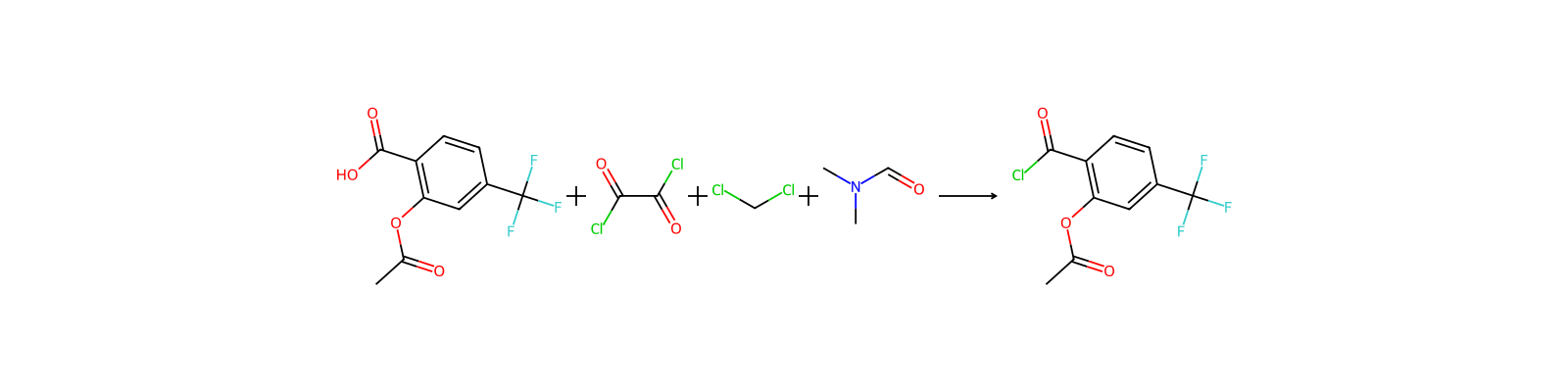
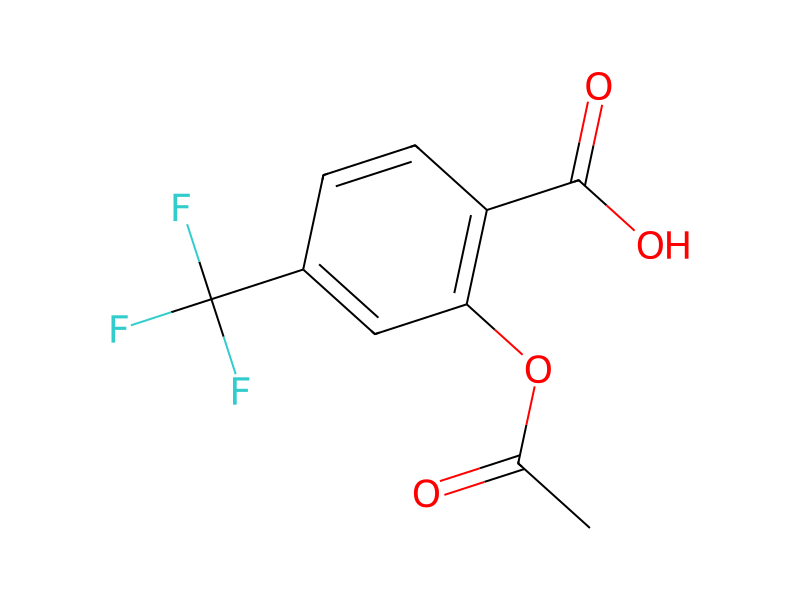
Basic information
- Standard SMILES
CC(=O)Oc1cc(C(F)(F)F)ccc1C(=O)O- InChIKey
RMWVZGDJPAKBDE-UHFFFAOYSA-N- Molecular formula
- C10H7F3O4
- Average molar mass
- 248.15 g/mol
- Monoisotopic mass
- 248.02964319
Names & identifiers
- Preferred name
- Triflusal
- IUPAC
- 2-acetyloxy-4-(trifluoromethyl)benzoic acid
- English name
- Triflusal
- Molecular formula
- C10H7F3O4
- Molecular weight
- 248.16
Names & synonyms
Triflusal322-79-22-Acetoxy-4-trifluoromethylbenzoic acid2-(Acetyloxy)-4-(trifluoromethyl)benzoic acidTriflusalumDTXSID80453051Z0YFI05OODTXCID6025305RefChem:191611B01AC18206-297-5Disgren
Show more names
ur1501DrisgenTriflusal-d3Triflusal CRSTriflusal (UR1501)TRIFLUOROTRIMESICACIDTriflusal, 10 mM in DMSO4-trifluoromethylsalicylicacidacetate
2-Acetoxy-4-(trifluoromethyl)benzoic Acid2-acetyloxy-4-(trifluoromethyl)benzoic acidTriflusal [INN]C10H7F3O4MFCD00866793Benzoic acid, 2-(acetyloxy)-4-(trifluoromethyl)-alpha,alpha,alpha-Trifluoro-2,4-cresotic acid acetateTriflusal (INN)
Database identifiers
- CAS
322-79-2- PubChem CID
- 9458
- DTXSID
DTXSID8045305- ChEMBL
CHEMBL1332032- ChEBI
CHEBI:94721- UNII
- 1Z0YFI05OO
- EC Number
- 206-297-5
- Nikkaji
- J5.672C
Properties
Computed structural properties
- XLogP
- 2.1
- Topological polar surface area
- 63.6 Ų
- Hydrogen bond donors
- 1
- Hydrogen bond acceptors
- 7
- Rotatable bonds
- 3
- Heavy atoms
- 17
- Formal charge
- 0
- Complexity
- 313
Physicochemical properties
- Melting point
- 120 · 120-122° (upon slow heating); 110-112° (upon quick heating)
- Boiling point
- 316 · 316.0±42.0 °C(Predicted)
- Density
- 1.433 · 1.433±0.06 g/cm3(Predicted)
- storage temp.
- 2 · Sealed in dry,2-8°C
- solubility
- 30 mg/mL · DMSO: >30mg/mL
- pka
- 2.97 · 2.97±0.10(Predicted)
- form
- powder
- color
- white to off-white
- λmax
- 297 nm · 297nm(H2O)(lit.)
- Merck
- 14 · 14,9688
- InChI
- 1S/C10H7F3O4/c1-5(14)17-8-4-6(10(11,12)13)2-3-7(8)9(15)16/h2-4H,1H3,(H,15,16)
- InChIKey
- RMWVZGDJPAKBDE-UHFFFAOYSA-N
- SMILES
- FC(F)(F)c1cc(c(cc1)C(=O)O)OC(=O)C
- CAS DataBase Reference
- 322 · 322-79-2(CAS DataBase Reference)
- FDA UNII
- 1 Z0YFI05OO · 1Z0YFI05OO
- ATC code
- 1 AC18 · B01AC18
- UNSPSC Code
- 41116107 · 41116107
- NACRES
- 25 · NA.25
- Symbol(GHS)
- 7 · GHS07
- Signal word
- Warning
- Hazard statements
- 302 · H302-H315-H317-H319-H335
- Precautionary statements
- 261 · P261-P264-P280-P304+P340+P312-P333+P313
- target organs
- Respiratory system
- Hazard Codes
- Xn
- Risk Statements
- 22 · 22-36/37/38-43
- Safety Statements
- 26 · 26-36/37
- WGK Germany
- 3 · 3
- RTECS
- 4250000 · GP4250000
- HS Code
- 2918.29 · 2918.29.7500
- Storage Class
- 11 · 11 - Combustible Solids
- Hazard Classifications
- 4 OralEye · Acute Tox. 4 OralEye Irrit. 2Skin Irrit. 2Skin Sens. 1STOT SE 3
Safety & regulation
Safety data
- wgk
- 3
- rtecs
- GP4250000
- hs_code
- 2918.29.7500
- risk_code
- 22-36/37/38-43
- Signal word
- Warning
- Symbol(GHS)
- GHS07
- hazard_code
- Xn
- safety_code
- 26-36/37
- Storage Class
- 11 - Combustible Solids
- target organs
- Respiratory system
- Hazard statements
- H302-H315-H317-H319-H335
- Hazard Classifications
- Acute Tox. 4 OralEye Irrit. 2Skin Irrit. 2Skin Sens. 1STOT SE 3
- Precautionary statements
- P261-P264-P280-P304+P340+P312-P333+P313
Chemistry & industry
Applications
DescriptionTriflusal is an antiplatelet agent structurally related to the salicylates, but it is not derived from ASA. Triflusal and its metabolite (3-hydroxy-4-triuoro-methylbenzoic acid or HTB) produce specic inhibition of platelet arachidonic acid metabolism (McNeely and Goa, 1998). A single 12-month open-label trial of Triflusal in 73 VaD patients (López-Pousa et al., 1997) showed fewer declines in MMSE scores in the active group compared with untreated subjects. More recently, Triflusal was used in patients with amnesic MCI; 257 patients were randomized to receive 900 mg of Triflusal or placebo for 18 months. Triflusal therapy was associated with a signicantly lower rate of conversion to dementia (Gómez-Isla et al., 2008).
UsesAn analog of Aspirin; inhibits platelet aggregation. Antithrombotic.
UsesAntithrombotic;Cyclooxygenase inhibitor
Upstream & downstream products
Downstream products
Suppliers50 total
上海阿拉丁生化科技股份有限公司400-6206333 13167063860 · [email protected]
Shandong chuangyingchemical Co., Ltd.18853181302 · [email protected]
南通飞宇生物科技有限公司0513-68819626 15152877458 · [email protected]
武汉英诺医药科技有限公司+86-027-59232304 15387063101 · [email protected]
艾吉析科技(上海)有限公司17717235263 · [email protected]
咸宁深蓝生物医药研发有限公司18171815831 · [email protected]
青岛和兴精细化学有限公司0532-66915948
上海毕得医药科技股份有限公司400-1647117 13681763483 · [email protected]
南京世洲生物科技有限公司025-025-85560043 17301488900 · [email protected]
郑州鸿晟医药科技有限公司0371-55695890 15637198702 · [email protected]
上海弘顺生物科技有限公司15901914505 · [email protected]
湖北恒硕化工有限公司027-82830253 13995541600 · [email protected]
LGM Pharma1-(800)-881-8210 · [email protected]
武汉易泰科技有限公司上海分公司18930552037 · [email protected]
安耐吉化学&3A(安徽泽升科技有限公司)021-58432009 400-005-6266 · [email protected]
Allfluoro Pharmaceutical Company Limited+86-400-0216110 +86-15958047586 · [email protected]
欧利希(湖北)医药科技有限公司17316404525 17316404525 · [email protected]
United Life Science020-82099279 18988941402 · [email protected]
InvivoChem中国13549236410 · [email protected]
MedBio脉铂医药021-69568360 18916172912 · [email protected]
嘉兴市艾森化工有限公司0573-85285100 18627885956 · [email protected]
MedChemexpress LLC021-58955995 · [email protected]
上海稳同科技有限公司02151600108 13062666369 · [email protected]
ChemeGen 中国18818260767 · [email protected]
玛雅试剂+86 (573) 82222445 (0)18006601000 452520369 · [email protected]
武汉海正工贸发展有限公司027-8866 0053/88660577/88660578
广东元丰化学试剂有限公司0751-2829979 13376591640 · [email protected]
TOKYO CHEMICAL INDUSTRY CO., LTD.03-36680489 · [email protected]
深圳振强药物研发有限公司0755-66853366 13670046396 · [email protected]
上海诺宝化工有限公司+86(0)21 60484900
深圳康特腾科技有限公司86-0755-86635001 · [email protected]
上海昶衍化工科技有限公司021-20242659 18930833303 · [email protected]
南京世洲生物科技有限公司13675144456 · [email protected]
HBCChem, Inc.+1-510-219-6317 · [email protected]
成都零六生物科技有限公司400-1166-196 13458535857 · [email protected]
上海鑫圭生物科技有限公司15121041756 · [email protected]
杭州杰恒化工有限公司0571-87396432 · [email protected]
上海寰川实业有限公司021-61478794 · [email protected]
上海嵩爰化工科技有限公司010-1234567 18521000990 · [email protected]
江苏艾康生物医药研发有限公司025-66028182 17714375163 · [email protected]
上海孚一生物科技有限公司+86 (21) 61124340
凯试(上海)科技有限公司021-50135380 · [email protected]
常州市卓燊医药化工材料有限公司0519-85286950 15380036950 · [email protected]
大连韦德生化科技有限公司0411-88165855 · [email protected]
珠海安哲生物科技有限公司13169972583 · [email protected]
南京伶亚生物医药科技有限公司18068075658 · [email protected]
TargetMol中国(陶术生物)021-021-33632979 15002134094 · [email protected]
Alfa Chemistry1-516-6625404 · [email protected]
上海陶术生物科技股份有限公司+1-781-999-5354; +1-00000000000 · [email protected]
厦门志信化学有限公司+86-5922680277 +86-13806087780 · [email protected]
Additional notes
DefinitionChEBI: 2-acetyloxy-4-(trifluoromethyl)benzoic acid is a member of salicylates, a carboxylic ester and a member of benzoic acids.
Related reactions
2 records

Linked notes
Loading…