
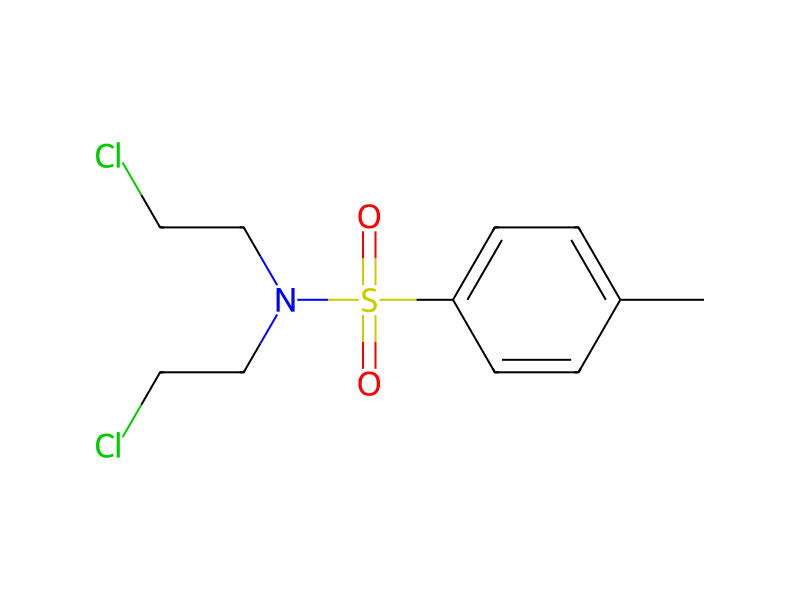
Basic information
- Standard SMILES
Cc1ccc(S(=O)(=O)N(CCCl)CCCl)cc1- InChIKey
PTVBBIMKLOMGSY-UHFFFAOYSA-N- Molecular formula
- C11H15Cl2NO2S
- Average molar mass
- 296.2 g/mol
- Monoisotopic mass
- 295.0200553
Names & identifiers
- Preferred name
- N,N-bis(2-chloroethyl)-p-toluenesulphonamide
- IUPAC
- N,N-bis(2-chloroethyl)-4-methylbenzenesulfonamide
- English name
- N,N-Bis(2-chloroethyl)-p-toluenesulfonamide
- Molecular formula
- C11H15Cl2NO2S
- Molecular weight
- 296.21
Names & synonyms
N,N-Bis(2-chloroethyl)-p-toluenesulphonamideEINECS 255-677-7DTXSID20194970NSC 49364RefChem:822129DTXCID60117461255-677-742137-88-2N,N-bis(2-chloroethyl)-4-methylbenzenesulfonamideN,N-Bis(2-chloroethyl)-p-toluenesulfonamideMFCD00018944C11H15Cl2NO2S
Show more names
DK780LABOTEST-BB LT00455209N,N-Bis(2-chloroethyl)Tolbutamide Impurity 13N-BIS(2-CHLOROETHYL)-P-TOLUENESULFONAMIDEN,N-Bis(-chloroethyl)-p-toluenesulfonamideN,N-BIS(B-CHLOROETHYL)-P-TOLUENESULFONAMIDE
N,N-bis(2-chloroethyl)-4-methylbenzene-1-sulfonamideNSC-49364Benzenesulfonamide, N,N-bis(2-chloroethyl)-4-methyl-N,N-Bis(2-chloroethyl)-p-toluenesulfonamide, Technical Grade 90%N,N-Bis(.beta.-chloroethyl)-p-toluenesulfonamideN,N-Bis(2-chloroethyl)-p-toluenesulfonamide, Technical Grade 90per centBenzenesulfonamide, N,N-bis(2-chloroethyl)-4-methyl-; p-Toluenesulfonamide, N,N-bis(2-chloroethyl)- (6CI,7CI); N,N-Bis(2-chloroethyl)-4-methylbenzenesulfonamide; N,N-Bis(2-chloroethyl)-4-methylbenzensulfonamide; N,N-Bis(2-chloroethyl)-p-toluenesulfonamide; NSC 49364NSC49364
Database identifiers
- CAS
42137-88-2- PubChem CID
- 96039
- DTXSID
DTXSID20194970- UNII
- QX3W3PH4DC
- EC Number
- 255-677-7
- Nikkaji
- J267.314B
Properties
Computed structural properties
- XLogP
- 2.6
- Topological polar surface area
- 45.8 Ų
- Hydrogen bond donors
- 0
- Hydrogen bond acceptors
- 3
- Rotatable bonds
- 6
- Heavy atoms
- 17
- Formal charge
- 0
- Complexity
- 302
Physicochemical properties
- Melting point
- 43 · 43-50 °C
- Boiling point
- 409.1 · 409.1±55.0 °C(Predicted)
- Density
- 1.2228 · 1.2228 (rough estimate)
- refractive index
- 1.6 · 1.6000 (estimate)
- storage temp.
- Keep in dark place,Sealed in dry,Room Temperature
- solubility
- soluble in Chloroform
- form
- powder to crystal
- pka
- -8.48 · -8.48±0.70(Predicted)
- color
- White to Light yellow
- BRN
- 2134258 · 2134258
- InChIKey
- PTVBBIMKLOMGSY-UHFFFAOYSA-N
- CAS DataBase Reference
- 42137 · 42137-88-2(CAS DataBase Reference)
- Symbol(GHS)
- 7 · GHS07
- Signal word
- Warning
- Hazard statements
- 315 · H315-H319-H335
- Precautionary statements
- 264 · P264-P280-P302+P352+P332+P313+P362+P364-P305+P351+P338+P337+P313-P261-P280a-P304+P340-P305+P351+P338-P405-P501a
- Hazard Codes
- Xi
- Risk Statements
- 36 · 36/37/38
- Safety Statements
- 24 · 24/25
- HS Code
- 29350090 · 29350090
Safety & regulation
GHS classification
GHS Classification
This chemical does not meet GHS hazard criteria for 2.2% (1 of 45) of reports.
Danger
H301 (84.4%): Toxic if swallowed [Danger Acute toxicity, oral];H315 (13.3%): Causes skin irritation [Warning Skin corrosion/irritation];H319 (13.3%): Causes serious eye irritation [Warning Serious eye damage/eye irritation];H335 (11.1%): May cause respiratory irritation [Warning Specific target organ toxicity, single exposure; Respiratory tract irritation]
P261, P264, P264+P265, P270, P271, P280, P301+P316, P302+P352, P304+P340, P305+P351+P338, P319, P321, P330, P332+P317, P337+P317, P362+P364, P403+P233, P405, and P501 (click each P-code to see the statement)
Aggregated GHS information provided per 45 reports by companies from 4 notifications to the ECHA C&L Inventory. Each notification may be associated with multiple companies.;Reported as not meeting GHS hazard criteria per 1 of 45 reports by companies.;There are 3 notifications provided by 44 of 45 reports by companies with hazard statement code(s).;Information may vary between notifications depending on impurities, additives, and other factors. The percentage value in parenthesis indicates the notified classification ratio from companies that provide hazard codes. Only hazard codes with percentage values above 10% are shown. For more detailed information, please visit ECHA C&L website.
Hazard information
Hazard Classes and CategoriesAcute Tox. 3 (84.4%);Skin Irrit. 2 (13.3%);Eye Irrit. 2 (13.3%)
Safety data
- hs_code
- 29350090
- risk_code
- 36/37/38
- Signal word
- Warning
- Symbol(GHS)
- GHS07
- hazard_code
- Xi
- safety_code
- 24/25
- Hazard statements
- H315-H319-H335
- Precautionary statements
- P264-P280-P302+P352+P332+P313+P362+P364-P305+P351+P338+P337+P313-P261-P280a-P304+P340-P305+P351+P338-P405-P501a
Chemistry & industry
Applications
UsesN,N-Bis(2-chloroethyl)-p-toluenesulfonaMide can be used as an intermediate used in the process for preparation of Cetirizine (C281100).
Upstream & downstream products
Upstream raw materials
Downstream products
Suppliers50 total
梯希爱(上海)化成工业发展有限公司021-67121386 · [email protected]
上海阿拉丁生化科技股份有限公司400-6206333 13167063860 · [email protected]
艾吉析科技(上海)有限公司17717235263 · [email protected]
成都彼样生物科技有限公司18108052721 · [email protected]
咸宁深蓝生物医药研发有限公司18171815831 · [email protected]
Suzhou ARTK Medchem Co., Ltd.+86-18168183658 · [email protected]
湖北科乐精细化工有限公司027-59101668 19945030958 · [email protected]
Dayang Chem (Hangzhou) Co.,Ltd.+86-0571-88938639 17705817739 · [email protected]
毕佳索(上海毕得医药科技股份有限公司)400-6005915 · [email protected]
Ark Pharm, Inc.847-367-3680 · [email protected]
上海迈瑞尔生化科技有限公司4006356688 18621169109 · [email protected]
北京索莱宝科技有限公司010-50973130 17801761073 · [email protected]
阿法埃莎(中国)化学有限公司400-6106006 · [email protected]
广东云星生物技术有限公司0751-18902340975/189023400307 18902340307 · [email protected]
山东李比希生物医药科技有限公司17866677155 · [email protected]
广东方信生物科技有限公司0751-2838688 13376594225 · [email protected]
南京诺利斯医药科技有限公司13901585132 · [email protected]
上海攀鸿化工科技有限公司021-56491756 13512199871 · [email protected]
Aceschem Inc.+1-817863-6948 +1-(817)863-6948 · [email protected]
云南西力生物技术股份有限公司0871-65217109 · [email protected]
湖北扬信医药科技有限公司0714-3999001 19171453112 · [email protected]
山东李比希生物医药科技有限公司15318973357; 15318973357 · [email protected]
Abblis Chemicals LLC+1-832-373-8299 · [email protected]
北京伊诺凯科技有限公司15652467323 · [email protected]
赛默飞世尔科技(中国)有限公司800-810-5118 · [email protected]
南京诺利斯医药科技有限公司13901585132 · [email protected]
上海健超生物科技有限公司150-2103-5486 18017383231 · [email protected]
TCI AMERICA800-4238616 · [email protected]
TOKYO CHEMICAL INDUSTRY CO., LTD.03-36680489 · [email protected]
TCI Europe320-37350700 · [email protected]
深圳振强药物研发有限公司0755-66853366 13670046396 · [email protected]
上海昶衍化工科技有限公司021-20242659 18930833303 · [email protected]
上海毕得医药科技股份有限公司400-164-7117 18317119277 · [email protected]
Labnetwork lnc.+86-27-50766799 +86-18062016861 · [email protected]
成都零六生物科技有限公司400-1166-196 13458535857 · [email protected]
北京福源坊科技有限公司010-57903446 15869909019 · [email protected]
常州翔龙医药科技有限公司18915873328 18915873328 · [email protected]
凯试(上海)科技有限公司021-50135380 · [email protected]
Sigma-Aldrich西格玛奥德里奇(上海)贸易有限公司021-61415566 800-8193336 · [email protected]
常州安奈凯医药科技有限公司+86-0519-8359-8696 · [email protected]
HANGZHOU LEAP CHEM CO., LTD.+86-571-87711850 +86-15355479329 · [email protected]
厦门志信化学有限公司+86-5922680277 +86-13806087780 · [email protected]
广东翁江化学试剂有限公司0751-2886766 13927870850 · [email protected]
上海玻尔化学试剂有限公司19102157732 · [email protected]
安阳鸿蒙新材料有限公司19588588067 · [email protected]
艾吉析科技(上海)有限公司17721401538;17717235263 17721401538 · [email protected]
武汉多普乐生物医药有限公司+86-02787215551 19945035818 · [email protected]
上海华恩医药科技有限公司13681955282
郑州阿尔法化工有限公司0371-53765687 18937137882 · [email protected]
上海源叶生物科技有限公司13636370518 · [email protected]
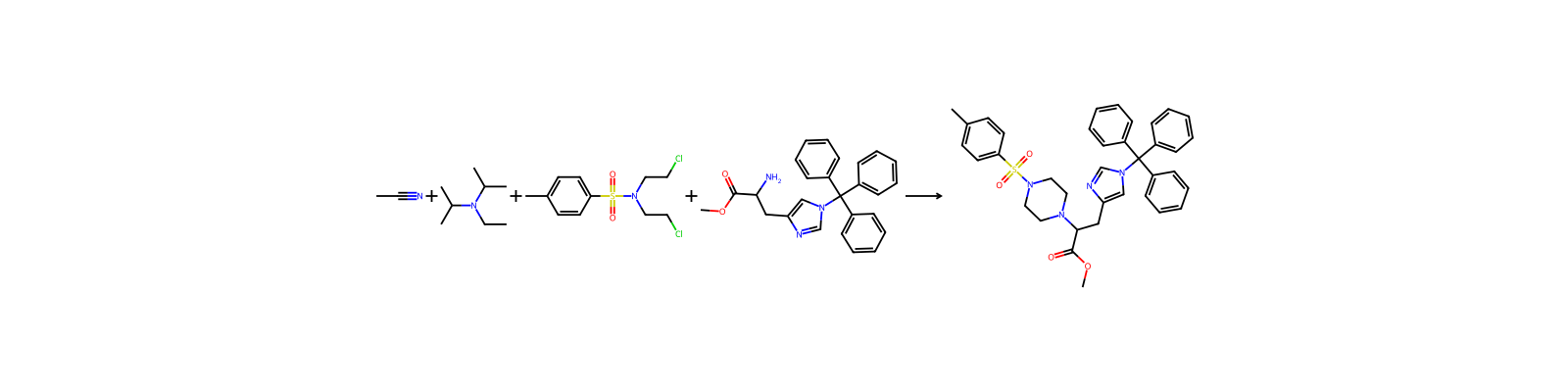
Related reactions
30 records




Linked notes
Loading…