HomeMCPWorkbenchSkills
HomeWorkbenchNotificationsMe
llms.txt · MCP GuidePrivacy Policy · Terms of Service · Supportv1.8.3
  1. Home
  2. /Compound

3-Bromodiphenyl ether

HCID 96165
New reaction
Print
Basic informationNames & identifiersPropertiesSafety & regulationChemistry & industryRelated reactionsCompound notes
Substructure searchFind similar structures

Basic information

CAS
6876-00-2
Standard SMILES
Brc1cccc(Oc2ccccc2)c1
InChIKey
AHDAKFFMKLQPTD-UHFFFAOYSA-N
Molecular formula
C12H9BrO
Average molar mass
249.1 g/mol
Monoisotopic mass
247.98368

Names & identifiers

Preferred name
3-Bromodiphenyl ether
IUPAC
1-bromo-3-phenoxybenzene
English name
3-Phenoxybromobenzene
Molecular formula
C12H9BrO
Molecular weight
249.1

Names & synonyms

1-Bromo-3-phenoxybenzene6876-00-23-BROMODIPHENYL ETHERBenzene, 1-bromo-3-phenoxy-NSC-57095PBDE 23W9N49713JNSC 57095RefChem:499334663-208-63-PhenoxybromobenzeneMFCD00474520
Show more names
BDE No2PBDE No. 2m-Phenoxybromobenzenem-Bromophenoxybenzenem-Phenoxyphenyl bromide
m-bromodiphenyl ether1-bromo-3-phenoxy-benzeneAKOS001586441AB91707EU-0066933SR-01000390202C24:1-beta-glucosyl ceramideUNII-3W9N49713J

Database identifiers

CAS
6876-00-2
PubChem CID
96165
DTXSID
DTXSID9074773
UNII
3W9N49713J
EC Number
663-208-6
Nikkaji
J151.727I

Properties

Computed structural properties

XLogP
4.6
Topological polar surface area
9.2 Ų
Hydrogen bond donors
0
Hydrogen bond acceptors
1
Rotatable bonds
2
Heavy atoms
14
Formal charge
0
Complexity
166

Experimental & physicochemical properties

SpringerMaterials Properties13C nuclear magnetic resonance spectrum

Physicochemical properties

Boiling point
200 · 200-203℃ (50 Torr)
Density
1.3944 g/cm3 · 1.3944 g/cm3 (20℃)
refractive index
1.6076 · 1.6076 (589.3 nm 20℃)
Flash point
110 ℃ · >110℃
storage temp.
Sealed in dry,Room Temperature
solubility
Chloroform (Sparingly), Ethyl Acetate (Slightly), Methanol (Sparingly)
form
liquid
color
Colourless
Henry's Law Constant
2.3 · 2.3×10-2 mol/(m3Pa) at 25℃, Long et al. (2017)
InChI
1S/C12H9BrO/c13-10-5-4-8-12(9-10)14-11-6-2-1-3-7-11/h1-9H
InChIKey
AHDAKFFMKLQPTD-UHFFFAOYSA-N

Safety & regulation

Safety information is for reference only and does not replace the supplier’s Safety Data Sheet (SDS), applicable regulations, or professional assessment.

GHS classification

GHS Classification · 4 items

Danger

H315 (97.5%): Causes skin irritation [Warning Skin corrosion/irritation]

P261, P264, P264+P265, P271, P272, P273, P280, P302+P352, P304+P340, P305+P354+P338, P317, P319, P321, P332+P317, P333+P317, P362+P364, P391, P403+P233, P405, and P501 (click each P-code to see the statement)

Aggregated GHS information provided per 40 reports by companies from 3 notifications to the ECHA C&L Inventory. Each notification may be associated with multiple companies.

Hazard information

Hazard Classes and CategoriesSkin Irrit. 2 (97.5%)

Safety data

wgk
3
rtecs
CY9040554
ridadr
UN 3077 9 / PGIII
hs_code
2909309090
risk_code
37/38-41-43-51/53
Signal word
Danger
Symbol(GHS)
GHS05,GHS07,GHS09
hazard_code
Xi,N
hazard_note
Irritant
safety_code
26-36/37/39-61
Storage Class
10 - Combustible liquids
target organs
Respiratory system
Hazard statements
H315-H317-H318-H335-H411
Hazard Classifications
Aquatic Chronic 2Eye Dam. 1Skin Irrit. 2Skin Sens. 1STOT SE 3

Chemistry & industry

Applications · 1 item

Uses1-Bromo-3-phenoxybenzene is part of a group of compounds called polybrominated diphenyl ethers. 1-Bromo-3-phenoxybenzene, along with other similar compounds, are widely used in industry as brominated flame retardants. Unfortunately, with their release into the environment, they pose significant hazards to the humans and wildlife that live in surrounding areas. 1-Bromo-3-phenoxybenzene is also known to induce toxic effects on the central nervous system, the liver, and kidneys in rats.

Upstream & downstream products

Upstream raw materials

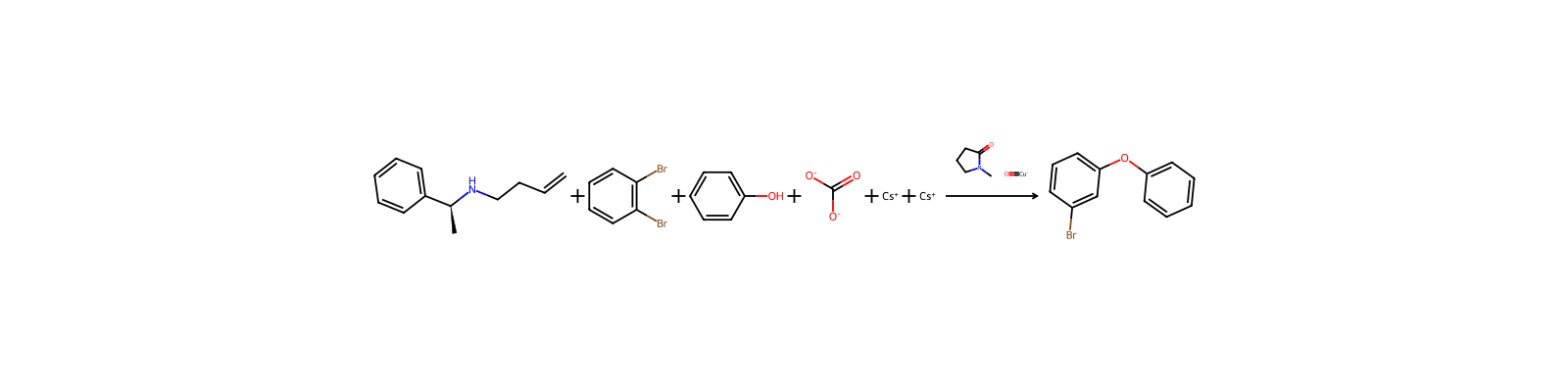
3-Bromophenylboronic acid3-PhenoxyanilineDiphenyliodonium bromidePhenolSodium benzenolateChlorotriphenyltinBenzene3-Bromofluorobenzene1,3-Dibromobenzene3-Bromophenol

Downstream products

Bromobenzene

Related reactions

37 records
New reaction record
HRID 29068 reaction equation
HRID 29068As product
HRID 123661 reaction equation
HRID 123661As product
HRID 146604 reaction equation
HRID 146604As reactant
HRID 210099 reaction equation
HRID 210099As reactant
HRID 222501 reaction equation
HRID 222501As product
HRID 222502 reaction equation
HRID 222502As reactant
HRID 261839 reaction equation
HRID 261839As product
HRID 322025 reaction equation
HRID 322025As product
PreviousPage 1 of 5

Compound notes

On this pageBasic informationNames & identifiersPropertiesSafety & regulationChemistry & industryRelated reactionsCompound notes
SMILES
Brc1cccc(Oc2ccccc2)c1
EWG's Food Scores
1 · 1
FDA UNII
3 W9N49713J · 3W9N49713J
EPA Substance Registry System
2 · PBDE 002 (6876-00-2)
UNSPSC Code
12352100 · 12352100
NACRES
22 · NA.22
Symbol(GHS)
5 · GHS05,GHS07,GHS09
Signal word
Danger
Hazard statements
315 · H315-H317-H318-H335-H411
Precautionary statements
261 · P261-P264-P273-P280-P302+P352-P305+P351+P338
target organs
Respiratory system
Hazard Codes
Xi,N
Risk Statements
37 · 37/38-41-43-51/53
Safety Statements
26 · 26-36/37/39-61
RIDADR
3077 · UN 3077 9 / PGIII
WGK Germany
3 · 3
RTECS
9040554 · CY9040554
Hazard Note
Irritant
HS Code
2909309090 · 2909309090
Storage Class
10 · 10 - Combustible liquids
Hazard Classifications
2 Eye · Aquatic Chronic 2Eye Dam. 1Skin Irrit. 2Skin Sens. 1STOT SE 3
Precautionary statements
P261-P264-P273-P280-P302+P352-P305+P351+P338