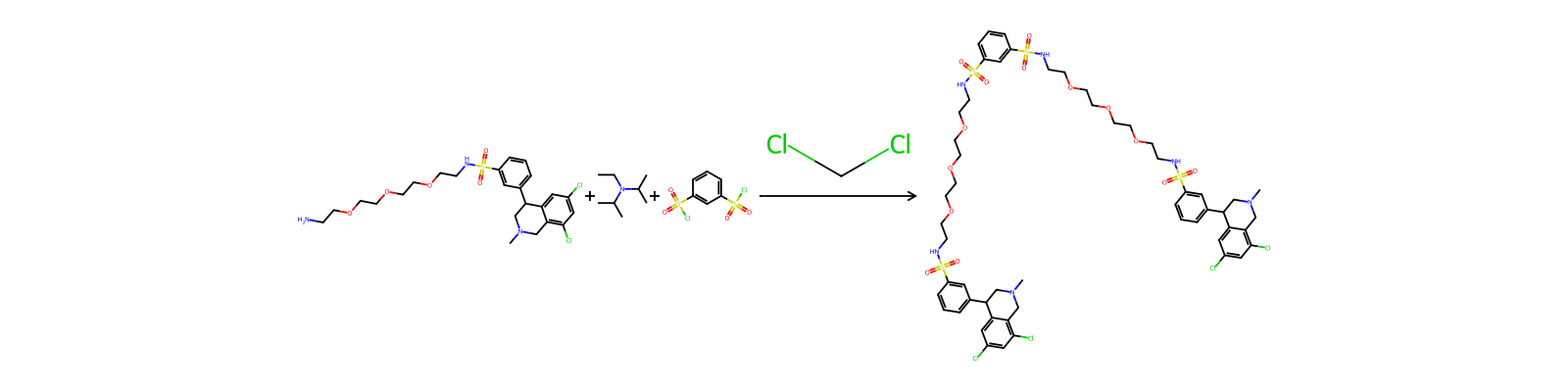
HRID 45751As reactant

585-47-7O=S(=O)(Cl)c1cccc(S(=O)(=O)Cl)c1ALIQZUMMPOYCIS-UHFFFAOYSA-N585-47-7DTXSID3060407Safety information is for reference only and does not replace the supplier’s Safety Data Sheet (SDS), applicable regulations, or professional assessment.
Danger
H314 (99.3%): Causes severe skin burns and eye damage [Danger Skin corrosion/irritation]
P233, P260, P261, P264, P264+P265, P271, P272, P280, P284, P301+P330+P331, P302+P352, P302+P361+P354, P304+P340, P305+P354+P338, P316, P317, P321, P333+P317, P342+P316, P362+P364, P363, P403, P405, and P501 (click each P-code to see the statement)
Aggregated GHS information provided per 151 reports by companies from 5 notifications to the ECHA C&L Inventory. Each notification may be associated with multiple companies.
Uses1,3-Benzenedisulfonyl chloride is used as a pharmaceutical intermediates. The compound is used to produce1,3-benzenedisulfonohydrazide.
General DescriptionBenzene-1,3-disulfonyl chloride (BDD) or 1,3-benzenedisulfonyl chloride is dichloride of 1,3-benzenedisulfonic acid. It is a colorless (white) crystalline solid with a melting point of 59-62 °C. It is soluble in common organic solvents. Compounds are sensitive to moisture and react in water; therefore, they should be stored in dry conditions. It has corrosive properties and can cause severe skin burns and eye damage.


