
Oxaloacetic Acid
Completing data — refresh the page later to see the latest
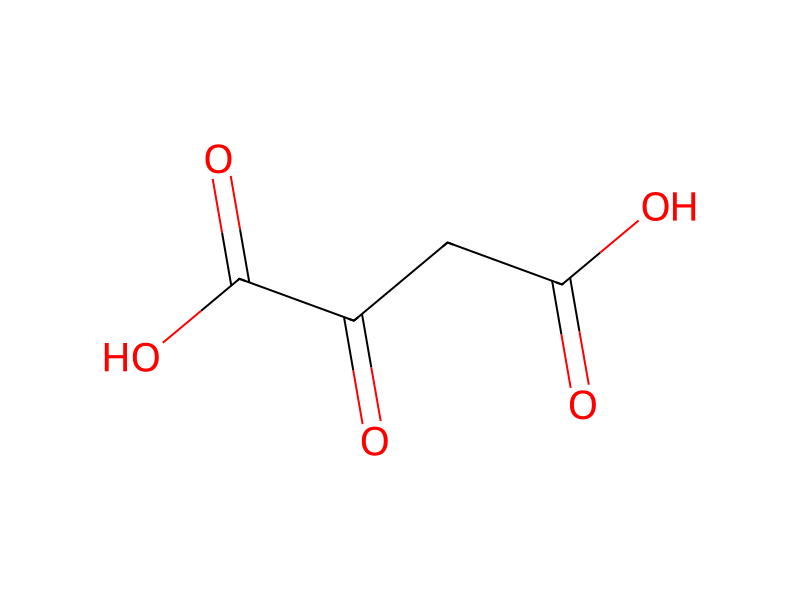
Basic information
- CAS
328-42-7- Standard SMILES
O=C(O)CC(=O)C(=O)O- InChIKey
KHPXUQMNIQBQEV-UHFFFAOYSA-N- Molecular formula
- C4H4O5
- Average molar mass
- 132.07 g/mol
- Monoisotopic mass
- 132.00587323
Overview
Oxaloacetic acid is an oxodicarboxylic acid that is succinic acid bearing a single oxo group. It has a role as a geroprotector and a metabolite. It is an oxo dicarboxylic acid and a C4-dicarboxylic acid. It is functionally related to a succinic acid. It is a conjugate acid of an oxaloacetate(2-).
Names & identifiers
- Preferred name
- Oxaloacetic Acid
- IUPAC
- 2-oxobutanedioic acid
- English name
- Oxaloacetic acid
- Molecular formula
- C4H4O5
- Molecular weight
- 132.07
Names & synonyms
oxalacetic acidoxaloacetic acid328-42-72-Oxobutanedioic acidoxaloacetateKetosuccinic acidOxosuccinic acid2-Ketosuccinic acidButanedioic acid, oxo-Bioepg2-oxo-butanedioic acidketo-oxaloacetate
Show more names
2-OXOSUCCINIC ACIDOAAOXOBUTANEDIOIC ACIDoxalaceticNSC 77688NSC 2842052-OXOSUCCINICOXLACETIC ACID
DTXSID8021646NSC-776882F399MM81JDTXCID901646CHEBI:30744Acid, OxalaceticAcid, Oxaloacetic2 Ketosuccinic Acid
Database identifiers
- CAS
328-42-7- PubChem CID
- 970
- DTXSID
DTXSID8021646- ChEMBL
CHEMBL1794791- ChEBI
CHEBI:30744- UNII
- 2F399MM81J
- EC Number
- 206-329-8
- Nikkaji
- J5.675H
Properties
Computed structural propertiesFilling in
- XLogP
- -0.6
- Topological polar surface area
- 91.7 Ų
- Hydrogen bond donors
- 2
- Hydrogen bond acceptors
- 5
- Rotatable bonds
- 3
- Heavy atoms
- 9
- Formal charge
- 0
- Complexity
- 158
Experimental & physicochemical properties
Chemical ClassesOther Classes -> Organic Acids
DrugsPharmaceuticals -> Listed in ZINC15
LipidsFatty Acyls [FA] -> Fatty Acids and Conjugates [FA01] -> Dicarboxylic acids [FA0117]
Solubility134 mg/mL
Melting Point161 °C
Physical Description
Off-white powder; [Alfa Aesar MSDS]
Solid
Collision Cross Section139.45 Ų [M+H]+ [CCS Type: DT; Method: stepped-field]
Physicochemical properties
- Melting point
- 161 °C · 161 °C (dec.)(lit.)
- Boiling point
- 163.94 °C · 163.94°C (rough estimate)
Safety & regulation
Safety information is for reference only and does not replace the supplier’s Safety Data Sheet (SDS), applicable regulations, or professional assessment.
GHS classification
GHS Classification
Danger
H314 (88.5%): Causes severe skin burns and eye damage [Danger Skin corrosion/irritation]
P260, P264, P264+P265, P280, P301+P330+P331, P302+P361+P354, P304+P340, P305+P351+P338, P305+P354+P338, P316, P321, P337+P317, P363, P405, and P501 (click each P-code to see the statement)
Aggregated GHS information provided per 61 reports by companies from 6 notifications to the ECHA C&L Inventory. Each notification may be associated with multiple companies.
Hazard information
Regulatory Information
Chemical: Butanedioic acid, oxo-
Status: Active Update: 14-04-2021 https://echa.europa.eu/registration-dossier/-/registered-dossier/22927
Butanedioic acid, oxo-: Does not have an individual approval but may be used under an appropriate group standard
Other Safety InformationEvaluation - Chemicals that are unlikely to require further regulation to manage risks to environment
Hazards SummaryCauses convulsions in acute intraperitoneal studies of mice; [RTECS] Causes burns; Inhalation may cause corrosive injuries to upper respiratory tract and lungs; [Alfa Aesar MSDS] See Oxalic acid and Acetic acid.
Hazard Classes and CategoriesSkin Corr. 1B (88.5%)
Toxicology
Adverse EffectsDermatotoxin - Skin burns.
Safety data
Chemistry & industry
Pharmacology
Tissue LocationsLiver
Cellular LocationsMitochondria
Metabolite Pathways2-Hydroxyglutric Aciduria (D And L Form)
Uses & manufacturing
General Manufacturing InformationButanedioic acid, 2-oxo-: ACTIVE
Applications
DescriptionOxaloacetic acid, also known as oxalacetic acid, is is an α-keto acid and a key component of cellular metabolism in its conjugate base form, oxaloacetate. Oxaloacetate reacts with acetyl-coenzyme A (acetyl-CoA; ) and water to form citrate in the first step of the citric acid cycle and is regenerated by oxidation of L-malate in the final step. It is an intermediate in gluconeogenesis that is formed in mitochondria via carboxylation of pyruvate and subsequently decarboxylated and phosphorylated to form phosphoenolpyruvate. It can be converted to aspartate via addition of an amino group from glutamate. Oxaloacetate (30 μmol/min per 100 g for 30 minutes, i.v.) reduces blood glutamate levels, severity of neurological dysfunction, and brain edema in a rat model of closed head injury.
UsesUse as a TCA (Krebs cycle) intermediate supplement in hybridoma cell culture applications. Enhances hybridoma growth and productivity.
UsesOxaloacetic acid is a substrate for malate dehydrogenase and oxaloacetate decarboxylase. It is an inhibitor of succinic dehydrogenase. It is four carbon dicarboxylic acid that is an intermediate in the citric acid cycle and glucogenesis.
General DescriptionOxaloacetic acid is a dicarboxylic acid. It is an intermediate in the citric acid cycle. It is highly soluble in water and is present ubiquitously. It is produced in the mitochondria by the action of pyruvate carboxylase on pyruvate. Breakdown products of oxaloacetate includes malate, pyruvate and aspartic acid.
Related reactions
31 records



Compound notes
Loading…