
Di-tert-butyl azodicarboxylate
Completing data — refresh the page later to see the latest

Basic information
- CAS
870-50-8- Standard SMILES
CC(C)(C)OC(=O)N=NC(=O)OC(C)(C)C- InChIKey
QKSQWQOAUQFORH-UHFFFAOYSA-N- Molecular formula
- C10H18N2O4
- Average molar mass
- 230.26 g/mol
- Monoisotopic mass
- 230.12665706
Names & identifiers
- Preferred name
- Di-tert-butyl azodicarboxylate
- IUPAC
- tert-butyl N-[(2-methylpropan-2-yl)oxycarbonylimino]carbamate
- English name
- Di-tert-Butyl azodicarboxylate
- Molecular formula
- C10H18N2O4
- Molecular weight
- 230.26
Names & synonyms
Di-tert-butyl azodicarboxylate870-50-8DTXSID201306310RefChem:586103DTXCID201736276212-796-9Di-tert-butyl diazene-1,2-dicarboxylateAzodicarboxylic Acid Di-tert-butyl EsterDi-tert-butylazodicarboxylateMFCD00015001di-t-butyl azodicarboxylate(E)-di-tert-butyl diazene-1,2-dicarboxylate
Show more names
di-tert-butyl (E)-diazene-1,2-dicarboxylateDi-tert-Butyl azodicDi-tert-butyl azodiformateSKL270NSC 109889DI-TERT-BUTYL AZODICARBOXYALTEBis(tert-butoxycarbonyl)diazene
Di-(tert-butyl) diazene-1,2-dicarboxylate1,2-Diazenedicarboxylic acid, 1,2-bis(1,1-dimethylethyl) esterDTADdi-tert-butylazocarboxylatetert-butyl {[(tert-butyl)oxycarbonyl]diazenyl}formatetert-butyl N-tert-butoxycarbonyliminocarbamatedi t-butyl azodicarboxylateDitertbutyl azodicarboxylate
Database identifiers
- CAS
870-50-8- PubChem CID
- 97268
- DTXSID
DTXSID201306310- EC Number
- 212-796-9
Properties
Computed structural propertiesFilling in
- XLogP
- 2.9
- Topological polar surface area
- 77.3 Ų
- Hydrogen bond donors
- 0
- Hydrogen bond acceptors
- 4
- Rotatable bonds
- 4
- Heavy atoms
- 16
- Formal charge
- 0
- Complexity
- 267
Physicochemical properties
- Melting point
- 89 · 89-92 °C(lit.)
- Boiling point
- 287.1 · 287.1±9.0 °C(Predicted)
- Density
- 1.06 · 1.06±0.1 g/cm3(Predicted)
- storage temp.
- 2 · 2-8°C
- solubility
- Chloroform (Sparingly), Methanol (Slightly)
- form
- Crystals or Crystalline Powder
- color
- Yellow
- Water Solubility
- Insoluble
- Sensitive
- Light Sensitive
- BRN
- 1911434 · 1911434
- InChI
- InChI=1S/C10H18N2O4/c1-9(2,3)15-7(13)11-12-8(14)16-10(4,5)6/h1-6H3
- InChIKey
- QKSQWQOAUQFORH-VAWYXSNFSA-N
- SMILES
- N(C(OC(C)(C)C)=O)=NC(OC(C)(C)C)=O
- CAS DataBase Reference
- 870 · 870-50-8(CAS DataBase Reference)
- UNSPSC Code
- 12352108 · 12352108
Safety & regulation
Safety information is for reference only and does not replace the supplier’s Safety Data Sheet (SDS), applicable regulations, or professional assessment.
GHS classification
GHS Classification
This chemical does not meet GHS hazard criteria for 10.7% (6 of 56) of reports.
Warning
H315 (89.3%): Causes skin irritation [Warning Skin corrosion/irritation];H319 (89.3%): Causes serious eye irritation [Warning Serious eye damage/eye irritation];H335 (87.5%): May cause respiratory irritation [Warning Specific target organ toxicity, single exposure; Respiratory tract irritation]
P261, P264, P264+P265, P271, P280, P302+P352, P304+P340, P305+P351+P338, P319, P321, P332+P317, P337+P317, P362+P364, P403+P233, P405, and P501 (click each P-code to see the statement)
Aggregated GHS information provided per 56 reports by companies from 8 notifications to the ECHA C&L Inventory. Each notification may be associated with multiple companies.;Reported as not meeting GHS hazard criteria per 6 of 56 reports by companies.;There are 7 notifications provided by 50 of 56 reports by companies with hazard statement code(s).;Information may vary between notifications depending on impurities, additives, and other factors. The percentage value in parenthesis indicates the notified classification ratio from companies that provide hazard codes. Only hazard codes with percentage values above 10% are shown. For more detailed information, please visit ECHA C&L website.
Hazard information
Hazard Classes and CategoriesSkin Irrit. 2 (89.3%);Eye Irrit. 2 (89.3%);STOT SE 3 (87.5%)
Safety data
- PPE
- dust mask type N95 (US), Eyeshields, Gloves
- wgk
- 3
- ridadr
- 1325
- hs_code
- 29270000
- risk_code
- 36/37/38-11
- Signal word
- Danger
Chemistry & industry
Applications
UsesDi-tert-butyl azodicarboxylate is a reagent used in the preparation of acyl hydrazinedicarboxylates via photoorganocatalytic hydroacylation of dialkyl azodicarboxylates with aldehydes in presence of phenylglyoxylic acid as photocatalyst.
UsesDi-tert-butyl azodicarboxylate is a reagent used in the preparation of acyl hydrazinedicarboxylates. It is also used in the electrophilic amination of beta-keto esters catalyzed by an axially chiral guanidine. It serves as a precursor in an enantioselective synthesis of 3,6-dihyropyridazines employing organocatalysts such as L-proline or (S)-2-pyrrolidinyl tetrazole. It is also utilized in the asymmetric Friedel-Crafts amination through a chiral organocatalyst. Further, it acts as a reactant for preparation of hexapeptide key fragments through stereo selective selenocyclization/oxidative deselenylation reactions. In addition to this, it is employed as a starting material in the synthesis of pyrroloisoquinoline template through stereoselective N-acyliminium-mediated cyclization and enolate amination for preparation of peptidomimetic compounds and Barbier-type propargylation reactions.
UsesUtilized in the asymmetric Friedel-Crafts amination via a chiral organocatalyst.
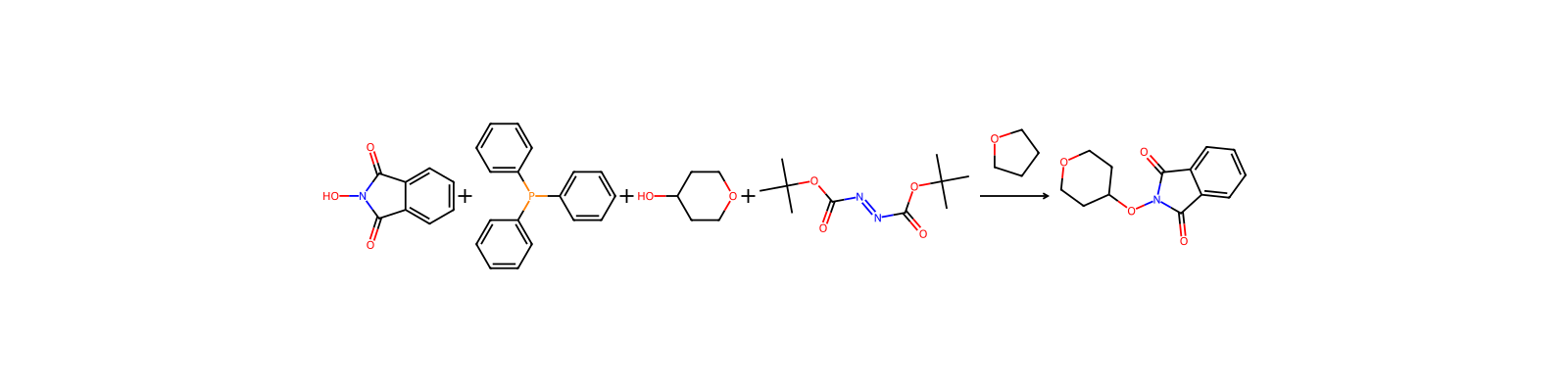
General DescriptionDi-tert-butyl azodicarboxylate is a an acid labile reagent for Mitsunobu reactions allowing facile isolation of products and for the electrophilic amination and hydrazination of enolates and lithium alkyls.
Upstream & downstream products
Downstream products
Related reactions
744 records


Compound notes
Loading…