
HRID 130907As product
Completing data — refresh the page later to see the latest
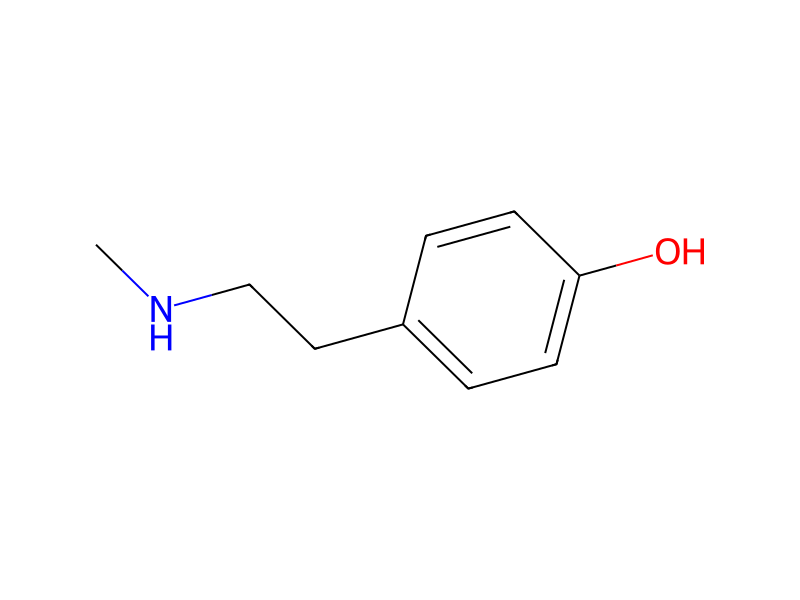
370-98-9CNCCc1ccc(O)cc1AXVZFRBSCNEKPQ-UHFFFAOYSA-NN-methyltyramine is a member of tyramines. It has a role as a mouse metabolite. It is a conjugate base of a N-methyltyraminium.
370-98-9DTXSID60190496CHEMBL5169925CHEBI:17458Safety information is for reference only and does not replace the supplier’s Safety Data Sheet (SDS), applicable regulations, or professional assessment.
Danger
H302 (100%): Harmful if swallowed [Warning Acute toxicity, oral]
P260, P261, P264, P270, P271, P280, P301+P317, P301+P330+P331, P302+P361+P354, P304+P340, P305+P354+P338, P316, P319, P321, P330, P363, P403+P233, P405, and P501 (click each P-code to see the statement)
The GHS information provided by 1 company from 1 notification to the ECHA C&L Inventory.
UsesN-Methyltyramine is a protoalkaloid that can be isolated from various plant species. N-Methyltyramine is an α2-adrenoreceptor antagonist. N-Methyltyramine enhances appetite and digestion of foods by stimulating gastrin and pancreatic secretions. N-Methyltyramine can relax mouse small intestinal smooth muscle and inhibits small intestinal propulsion[1][2].
DefinitionChEBI: N-methyltyramine is a member of tyramines. It has a role as a mouse metabolite. It is a conjugate base of a N-methyltyraminium.


