
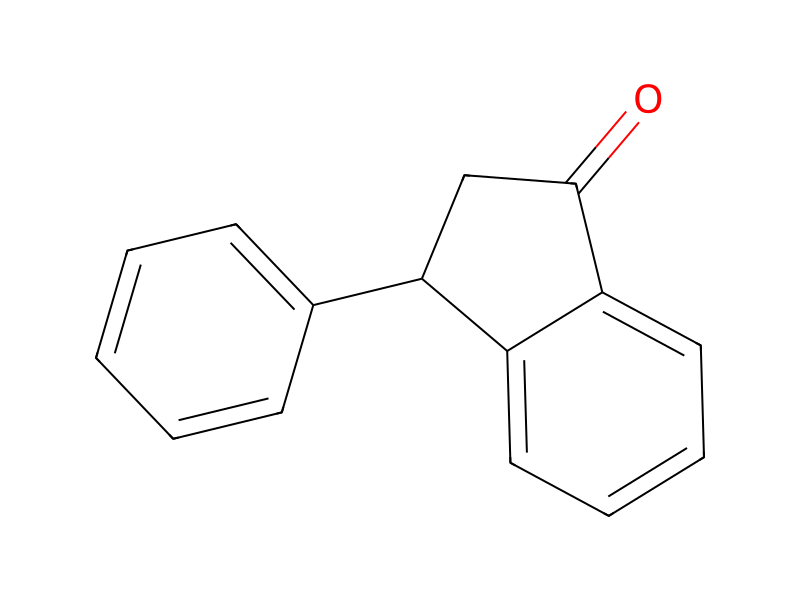
Basic information
- Standard SMILES
O=C1CC(c2ccccc2)c2ccccc21- InChIKey
SIUOTMYWHGODQX-UHFFFAOYSA-N- Molecular formula
- C15H12O
- Average molar mass
- 208.25 g/mol
- Monoisotopic mass
- 208.088815
Names & identifiers
- Preferred name
- 1-Indanone, 3-phenyl-
- IUPAC
- 3-phenyl-2,3-dihydroinden-1-one
- English name
- 3-PHENYL-1-INDANONE
- Molecular formula
- C15H12O
- Molecular weight
- 208.26
Names & synonyms
3-Phenyl-1-indanone16618-72-71H-Inden-1-one, 2,3-dihydro-3-phenyl-1-Indanone, 3-phenyl-3-PhenylindanoneNSC 82364BRN 1370263DTXSID7013140274-07-00-01673 (Beilstein Handbook Reference)RefChem:433222(+-)-3-Phenyl-1-indanoneDTXCID20894140
Show more names
AKOS BC-09643-phenyl-1-indanonTIMTEC-BB SBB008151
1H-Inden-1-one, 2,3-dihydro-3-phenyl-(9CI)625-438-53-Phenyl-2,3-dihydro-1H-inden-1-one3-Phenylindan-1-one3-phenyl-2,3-dihydroinden-1-oneMFCD00037722NSC82364MLS000691949
Database identifiers
- CAS
16618-72-7- PubChem CID
- 98146
- DTXSID
DTXSID701314027- ChEMBL
CHEMBL1571712- EC Number
- 625-438-5
- Nikkaji
- J36.988H
Properties
Computed structural properties
- XLogP
- 3.1
- Topological polar surface area
- 17.1 Ų
- Hydrogen bond donors
- 0
- Hydrogen bond acceptors
- 1
- Rotatable bonds
- 1
- Heavy atoms
- 16
- Formal charge
- 0
- Complexity
- 265
Physicochemical properties
- Melting point
- 75 · 75-78 °C (lit.)
- Boiling point
- 148 °C/0.7 · 148 °C/0.7 mmHg (lit.)
- Density
- 1.162 · 1.162
- refractive index
- 1.5361 · 1.5361 (estimate)
- storage temp.
- Sealed in dry,Room Temperature
- InChI
- 1S/C15H12O/c16-15-10-14(11-6-2-1-3-7-11)12-8-4-5-9-13(12)15/h1-9,14H,10H2
- InChIKey
- SIUOTMYWHGODQX-UHFFFAOYSA-N
- SMILES
- O=C1CC(c2ccccc2)c3ccccc13
- CAS DataBase Reference
- 16618 · 16618-72-7
- EWG's Food Scores
- 1 · 1
- UNSPSC Code
- 12352100 · 12352100
- NACRES
- 22 · NA.22
- Symbol(GHS)
- 7 · GHS07
- Signal word
- Warning
- Hazard statements
- 302 · H302
- Precautionary statements
- 280 · P280-P305+P351+P338
- PPE
- 95 · dust mask type N95 (US), Eyeshields, Gloves
- Hazard Codes
- Xn
- Risk Statements
- 22 · 22
- Safety Statements
- 36 · 36
- WGK Germany
- 3 · 3
- RTECS
- 7538200 · NK7538200
- Storage Class
- 11 · 11 - Combustible Solids
- Hazard Classifications
- 4 Oral · Acute Tox. 4 Oral
- Toxicity
- 50 · mouse,LD50,intravenous,180mg/kg (180mg/kg),U.S. Army Armament Research & Development Command, Chemical Systems Laboratory, NIOSH Exchange Chemicals. Vol. NX#02960,
Safety & regulation
GHS classification
GHS Classification
This chemical does not meet GHS hazard criteria for 2.5% (1 of 40) of reports.
Warning
H302 (97.5%): Harmful if swallowed [Warning Acute toxicity, oral]
P264, P270, P301+P317, P330, and P501 (click each P-code to see the statement)
Aggregated GHS information provided per 40 reports by companies from 2 notifications to the ECHA C&L Inventory.;Reported as not meeting GHS hazard criteria per 1 of 40 reports by companies.;There is 1 notification provided by 39 of 40 reports by companies with hazard statement code(s).;Information may vary between notifications depending on impurities, additives, and other factors. The percentage value in parenthesis indicates the notified classification ratio from companies that provide hazard codes. Only hazard codes with percentage values above 10% are shown. For more detailed information, please visit ECHA C&L website.
Hazard information
Hazard Classes and CategoriesAcute Tox. 4 (97.5%)
Safety data
- PPE
- dust mask type N95 (US), Eyeshields, Gloves
- wgk
- 3
- rtecs
- NK7538200
- Toxicity
- mouse,LD50,intravenous,180mg/kg (180mg/kg),U.S. Army Armament Research & Development Command, Chemical Systems Laboratory, NIOSH Exchange Chemicals. Vol. NX#02960,
- risk_code
- 22
- Signal word
- Warning
- Symbol(GHS)
- GHS07
- hazard_code
- Xn
- safety_code
- 36
- Storage Class
- 11 - Combustible Solids
- Hazard statements
- H302
- Hazard Classifications
- Acute Tox. 4 Oral
- Precautionary statements
- P280-P305+P351+P338
Chemistry & industry
Applications
Uses3-Phenyl-1-indanone can be used as a pharmaceutical synthesis intermediate and can be used in laboratory research and development processes.
Upstream & downstream products
Upstream raw materials
Suppliers38 total
南京世洲生物科技有限公司025-85560043 15850508050 · [email protected]
温州共赢化学有限公司+86-0086-577-64498589 +86-15355981851 · [email protected]
Dayang Chem (Hangzhou) Co.,Ltd.+86-0571-88938639 17705817739 · [email protected]
Syntechem Co.,Ltd[email protected]
安耐吉化学&3A(安徽泽升科技股份有限公司)400-0056266 · [email protected]
梯希爱(上海)化工贸易有限公司021-61109150 · [email protected]
上海瀚鸿科技股份有限公司021-54306202 13764082696 · [email protected]
上海泰坦科技股份有限公司400-6009262 15618770481 · [email protected]
天津林宸科技有限公司15122256084 15122256084 · [email protected]
上海翱跃化工科技有限公司021-021-64367138 15900495324 · [email protected]
宝鸡缔都医药化工有限公司029-81145305 17791533577 · [email protected]
山东西亚化学有限公司13355009207 13355009207 · [email protected]
Shenzhen Excellent Biotech Co., Ltd.13480692018 · [email protected]
贵州易妥化学科技有限公司18628235590 · [email protected]
上海昶衍化工科技有限公司021-20242659 18930833303 · [email protected]
上海寰川实业有限公司021-61478794 · [email protected]
Sigma-Aldrich西格玛奥德里奇(上海)贸易有限公司021-61415566 800-8193336 · [email protected]
郑州九亿时光新材料有限公司+86-15225627621 +86-13213167925 · [email protected]
厦门志信化学有限公司+86-5922680277 +86-13806087780 · [email protected]
上海阿拉丁生化科技股份有限公司6206333 13167063860 · [email protected]
湖北创联康成药物化学有限公司027-65388397 18164111589 · [email protected]
上海源叶生物科技有限公司13636370518 · [email protected]
上海颖心实验室设备有限公司021-021-59178156 15300768757 · [email protected]
泰安市嘉叶生物科技有限公司15318151873;13127280945 · [email protected]
杭州洁汉化工有限公司+86-571-86217390; +8618058761490 · [email protected]
Capot Chemical Co.,Ltd.+86-(0)57185586718 +86-13336195806 · [email protected]
江苏艾康生物医药研发有限公司025-58851090 13913916777 · [email protected]
career henan chemical co+86-0371-86658258 · [email protected]
Aladdin Scientific[email protected]
北京珐默兹医药科技有限公司15811073878 · [email protected]
上海皓鸿生物医药科技有限公司400-8210725 4008210725 · [email protected]
Alchem Pharmtech,Inc.8485655694 · [email protected]
Capot Chemical Co., Ltd+86 (0) 571 85 58 67 18
上海研邦医药科技有限公司15618536883 · [email protected]
重庆卡兰医药有限公司[email protected]
Hefei TNJ Chemical Industry Co.,Ltd.+86-0551-65418671 +86-189 4982 3763 · [email protected]
河南威梯希化工科技有限公司0371-55135753 18003832934 · [email protected]
北京珐默兹医药科技有限公司15811073878 · [email protected]
Related reactions
14 records


Linked notes
Loading…